Astrium awarded ESA contract for Euclid Payload Module
Astrium will deliver a fully integrated module incorporating a 1.2 metre diameter silicon carbide (SiC) telescope and housing the mission’s science instruments. Astrium is a world-leader in SiC technology – as payload leader for the ESA missions Herschel and Gaia.

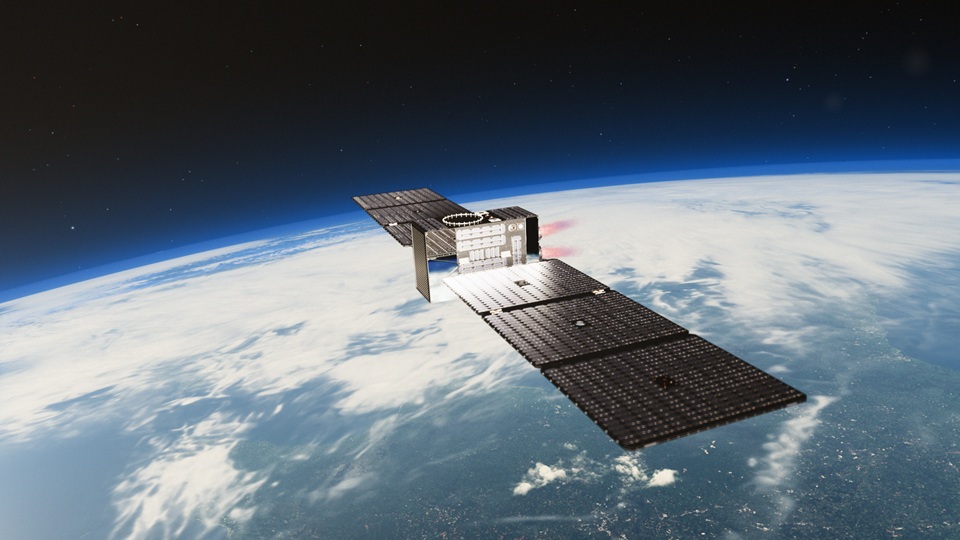
Above:
Gaia.
© Astrium / 2006
Herschel has been delivering unique science since 2009 and Gaia is scheduled for launch in 2013.

Euclid is the second 'Medium Class' mission in ESA’s Cosmic Vision programme. With the ultimate goal to understand the origin of the Universe’s accelerating expansion, Euclid will map the geometry of the dark universe to an unprecedented accuracy. Euclid is unique in the combination of its two methods for measuring that geometry, namely weak gravitational lensing and galaxy clustering.
Weak gravitational lensing is observed by measuring very precisely any distortion to the images of galaxies caused by invisible matter between them and the Earth. Using this and the distribution of galaxies in space and how that has evolved over cosmological time, allows Euclid to help scientists take a step towards answering questions about the nature of dark energy and dark matter.
Euclid will collect deep and high resolution images of the sky by rotating the spacecraft once every 80 minutes. Within six years of observation, covering more than one third of the entire sky, Euclid will measure the shapes of, and distances to, more than two billion galaxies.