Astrium's double success

Alain Charmeau, CEO of Astrium Space Transportation said: “After this new launch success, ATV-3 has now to achieve its automatic rendezvous with the ISS at a speed of 28,000 km/h within a precision of less than 10 centimetres. This rendezvous in space uses one of the most cutting-edge technologies that Astrium has developed as system integrator for ATV to be ready for future challenges.

“Astrium is continuing to build the two remaining ATVs which are perfectly on schedule for launch in 2013 and 2014. We are currently studying new evolutions on behalf of ESA, the European Space Agency, for both the automated transfer vehicle and launchers in order to maintain and develop Europe’s amazing space technologies. A number of options for the programme that will succeed the ATV programme clearly focus on the ATV spacecraft’s capability to perform these 'low orbit' missions and build on the significant achievements already derived from European cooperation as part of ESA. The further development of ATV would reflect part of Europe's financial contribution to the ISS after 2016.”


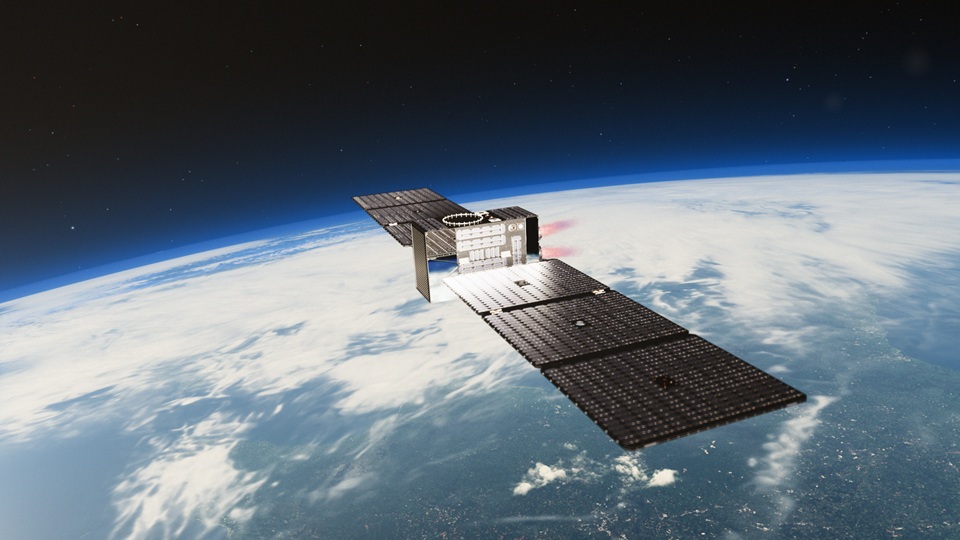
Once the ATV has been released at an altitude of around 260 km, its four solar panels with a wingspan of 22.3 metres are extended, as well as an antenna for communications with the ISS. Relying on the GPS receivers on board ATV, the ATV Control Centre (ATV-CC, operated by CNES, (French Space Agency, Toulouse) commands ATV to execute autonomously its final orbit control manoeuvre. This operation puts the ATV on a trajectory that allows it to initiate rendezvous with the ISS at about 30 km behind and 5 km below the Station.
The rendezvous is performed in steps triggered by the ATV-CC in coordination with ISS, the ATV is then computing and performing manoeuvres automatically, relying on relative GPS navigation and optical sensors. The ATV’s suite of sophisticated sensors, software layers and systems ensure its reliability and safety.
The ATV is due to rendezvous with the ISS on 28th of March 2012 (GMT), after which automatic docking will commence. Once the ATV Edoardo Amaldi aligns precisely its docking system opposite the Russian docking port, the almost 20-tonne cargo spacecraft will gently touch the Russian docking port. This contact then triggers the automatic execution by ATV of the mechanical and electrical docking procedure that will eventually connect ATV to the ISS, making it physically and operationally part of it. ESA astronaut André Kuipers will oversee the rendezvous and docking manoeuvre of the Edoardo Amaldi, a task he has been specially trained and prepped for by Astrium instructors.

The cargo spacecraft is delivering 6.6 tonnes of freight to the space station (above), including four tonnes of fuel, water and various gases. In order to maintain the same orbit as the ISS, the ATV requires 3,150 kg of fuel as well as a further 860 kg to perform evasive and reboost manoeuvres when no other spacecraft is docked to the ISS. In the course of its mission, the Edoardo Amaldi will reboost the ISS up to 10 times. Oxygen (70 kg), air (30kg) and water (285 kg) also form part of the ATV's 'fluid' cargo, while everyday necessities, experiments, spare parts and so-called care packages from the astronauts' families make up a further 2.2 tonnes of the payload.
The astronauts will gradually unload this cargo over the six-month period that the ATV remains docked to the ISS. According to the latest plans, the ATV Edoardo Amaldi will leave the ISS at the end of the summer loaded with waste. That waste will be disposed of during the ATV's controlled reentry into the Earth's atmosphere, by which time the ATV will have traveled around four million kilometers. At the same time, the ATV-4 Albert Einstein will arrive in Kourou in preparation for its own launch, planned for early 2013.
Astrium is also the prime contractor of the Ariane 5, one of the world’s largest and most ambitious space programmes. The European Ariane 5 launcher is the continent's 'workhorse', being specifically designed to transport heavy payloads into space. Astrium Space Transportation manages the full industrial value chain from producing components and stages, to full integration of the launcher in French Guiana in accordance with customer needs.
Being a payload in excess of 20 tonnes, the ATV Edoardo Amaldi ranks as one of the heaviest items of cargo ever transported by an Ariane 5, the ES version of which is perfectly adapted to this special mission due to its reignitable upper stage with the Aestus engine. Unlike communication satellites, for example, ATVs are not launched into a geostationary transfer orbit at an altitude of about 36,000 km. Instead, they are released into a low earth orbit (LEO) at an altitude of approximately 260 km, a manoeuvre that requires this reignitable upper stage. Once in its orbit, the ATV finds its own way to the International Space Station being at an altitude of around 400 km.
This Ariane 5 flight with ATV Edoardo Amaldi is the 47th successful flight in a row.
Astrium is the number one company in Europe for space technologies and the third in the world. In 2011, Astrium had a turnover close to €5bn and 18,000 employees worldwide - mainly in France, Germany, the United Kingdom, Spain and the Netherlands - and is the sole European company covering the entire range of civil and defence space systems and services.
Its three business units are: Astrium Space Transportation for launchers and orbital infrastructure; Astrium Satellites for spacecraft and ground segment; Astrium Services for comprehensive fixed and mobile end-to-end solutions covering secure and commercial satcoms and networks, high security and broadcast satellite communications equipment and systems and bespoke geo-information services, worldwide.
Astrium is a wholly owned subsidiary of EADS, a global leader in aerospace, defence and related services. In 2011, the Group – comprising Airbus, Astrium, Cassidian and Eurocopter – generated revenues of €49.1bn and employed a workforce of over 133,000.