Galileo launch brings Europe's sat nav system closer

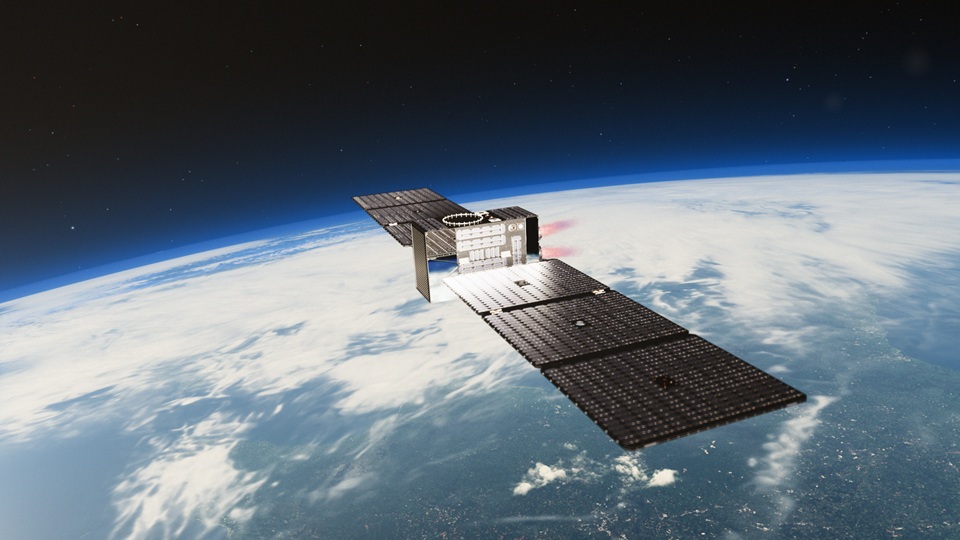
Above:
Artist's impression of the four Galileo In-Orbit Validation satellites in their orbits.
Credit: ESA - P. Carril
The satellites’ payloads were designed, manufactured and tested in the UK by Astrium and will be used with the two other satellites launched last year to validate the Galileo system design before becoming part of the final Galileo system. UK company SSTL is building the navigation payloads for the next 22 satellites which will form the operational constellation.

Four is the minimum number of satellites needed to achieve a navigational fix on the ground, with one satellite each to measure latitude, longitude, altitude and provide a time reference.
Once this second pair of satellites has been commissioned and tested, the quartet will form a completely operational mini-constellation that will be used to validate the Galileo system.
These two new satellites are also the first to carry search and rescue antennas to pinpoint aircraft and ships in distress as part of the international Cospas–Sarsat system.
Catherine Mealing -Jones, Director of Growth, Applications and EU Programmes for the UK Space Agency, said: "This second successful launch is another major step towards the start of Galileo services. It’s only once services start that we will see the growth that Galileo promises to deliver. Growth in downstream applications and services is going to be increasingly important for the UK space industry."
The technologies that the constellation will use have already been demonstrated with two British-built test satellites called GIOVE-A and -B, launched in 2005 and 2008, respectively. GIOVE-A has remained operational long after its expected lifespan and GIOVE-B contains the most reliable timing device ever launched into space.
A joint initiative of the European Commission (EC) and the European Space Agency (ESA), Galileo is the European Union’s answer to the American global satellite navigation system GPS. It is designed to provide a highly accurate global positioning system under civilian control with worldwide coverage and is one of the biggest space projects ever initiated in Europe.
The UK has made a considerable investment in the project and is involved at every level in developing this next generation of satellite navigation technologies.
The EC plans for further satellites to be launched every 3 months from spring 2013, until 18 are in orbit and Initial Operational Capability (IOC) is reached around 2015. At this point, initial Galileo services should be certified as ready for use.
At the heart of each Galileo satellite are the atomic clocks which will allow people using receivers, for example, built into smart phones, to know their position to within a metre. These ultra-precise clocks will all beat in rhythm, rigorously synchronized with the ground network of control stations. That is why Galileo has been described as "one vast space clock".
Galileo will offer a number of services from 2015 onwards including an open signal, a search and rescue service, a public regulated service for Government approved users and also a prototype commercial service.
The European Commission (EC) estimates that 6-7% of European GDP – around €800 billion by value – is already dependent on satellite navigation currently provided by US GPS or Russian Glonass satellites.
The Government is supporting the industry’s ambitious goals for growth in the UK space sector - growing revenues from £7.5bn to £40bn by 2030 and creating 100,000 high-value jobs in the sector.
Much of this growth will come from applications based on space services such as Galileo. The Government wants to see Galileo services start as quickly as possible to stimulate the development of new technologies and space-based solutions.