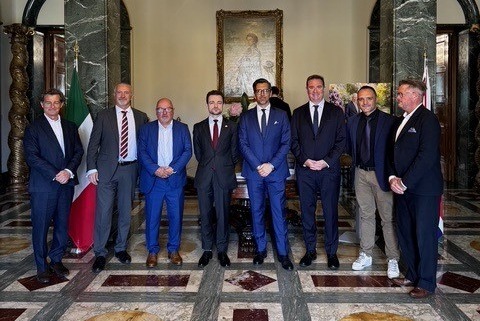
IATA urges UK Government to use aviation policy to drive growth
Specifically, IATA asked the Government to address high taxes and severe capacity constraints while developing policies to support the industry’s commitments on climate change.

Tyler (above) said: “The UK is the world’s second largest market for international air travel, bringing enormous benefits to the economy. Aviation in the UK is at the centre of over GBP 90 billion of economic activity and supports the livelihoods of nearly 1.8 million people. The connectivity provided by aviation enables London to function as a global financial centre to be a global hub of culture and to host the Olympics. Great Britain is an island. Aviation connects it to the global community and global economy. Government policies must recognise and nurture that important role.”

Aviation’s future capability to be a pillar supporting the UK economy is jeopardised, however, by a regulatory approach that constrains the growth of the UK’s only hub airport (Heathrow) and a fiscal policy that burdens the industry with heavy taxes. IATA encouraged the government to address these issues in a national aviation policy that will follow from the ongoing consultation process.
Capacity: IATA supported the further development of Heathrow over other proposals to provide hub capacity in the south east of the UK. Heathrow, a vital component of the UK’s economy supporting 220,000 jobs and GBP 11 billion in economic activity, is operating at 99% of its capacity. New capacity is urgently needed to support the needs of London as a global capital of finance and culture.
“The UK is falling behind in connectivity. London has less frequent links to 27 emerging market destinations than the daily connections offered from continental European hubs. If the UK wants to do business with these developing markets, air connectivity is the enabler,” said Tyler. He noted that London has no non-stop services to some developing markets such as Manila, Jakarta, Santiago and the Chinese cities of Chengdu, Shenyang and Guangzhou, although daily services exist from continental European hubs.
Proposals have been floated to address the need for more capacity by building a new airport to serve the London region. Such a project would be enormously expensive and politically uncertain. “For a fraction of the cost of building a new airport, the UK could get all the additional capacity needed to ensure that Heathrow continues as a great aviation hub and without the economic dislocation of moving 220,000 jobs that depend on Heathrow” Tyler said.
IATA forecasts indicate that 205 million people will travel to or from the UK in 2015, accounting for about one in every seven international air travelers. “The Government needs to make Heathrow’s expansion a priority in a competitive new UK aviation policy so that the UK can realize the economic benefits of connectivity and continue to punch above its weight globally,” Tyler said.
Taxation: The national policy must also reduce the UK’s high tax burden on aviation. “Chancellor George Osborne’s proposal to reduce corporate taxes from 28% to 22% by 2014 is welcome relief, but it is not a comprehensive solution. The high cost of doing business in the UK must also be addressed,” Tyler said. “The ever increasing Air Passenger Duty (APD) is a GBP 2.9 billion annual burden on UK businesses reliant on connectivity. And passenger demand is growing more slowly than at other European hubs because the APD is pricing air travel out of the range that consumers can bear.” IATA estimates the planned increase in the APD will result in the loss of 7,000 UK jobs on top of the damage that it is already doing to the economy.
Environment: IATA urged the UK to ensure that its aviation policy supports the industry’s climate change commitments to (1) improve fuel efficiency by 1.5% annually to 2020, (2) cap net carbon emissions from 2020 and (3) cut net carbon emissions in half by 2050 compared to 2005 levels.
“Aviation’s license to grow depends upon managing its environmental impacts. We have a long history of doing precisely that in partnership with regulators. Over the last three decades Heathrow’s noise contour was reduced by 60%. And we have managed to contain aviation’s emissions at 2% of global manmade CO2 with a 70% improvement in fuel efficiency over the last four decades.
IATA called on the UK to support the development of sustainable biofuels for aviation with policy measure that de-risk the investment needed to reduce cost and increase production. It also urged the EU to find a solution to the global impasse developing around the EU’s inclusion of international aviation in its emissions trading scheme through the International Civil Aviation Organization (ICAO) process.
“Nobody wants a trade war. And ICAO has a process to find a solution. However, the frequent and robust reiteration by the EU Directorate General for Climate Action that nothing can be done to defer or amend the European scheme is not helpful. Europe’s trading partners are looking for signals that it is prepared to find solutions with the international community beyond its current plans in an agreement through the ICAO process,” said Tyler.
“The national aviation policy discussion is a great opportunity to replace the tax, regulate and restrict policy trajectory of today with one that supports connectivity, jobs and economic prosperity with sustainable growth. That’s exactly what is needed to re-start the UK economy. By refocusing the policy agenda towards competitive, cost-efficient and sustainable growth, aviation can do so much more than the already impressive support for GBP 90 billion of economic activity and 1.8 million jobs. A strong aviation industry is a foundation stone of an economically strong and competitive Great Britain. That needs to be understood from the people on the high street to the Prime Minister in Downing Street,” said Tyler.