Paving the way for world's first gravitational wave detector

Above:
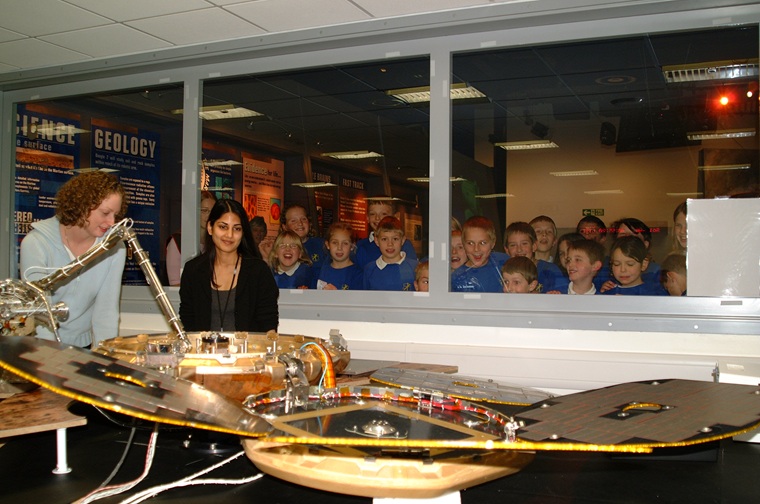
Examining the optical bench for contamination.
Courtesy Paul Gavin/IGR/AEI/Milde Science Communication
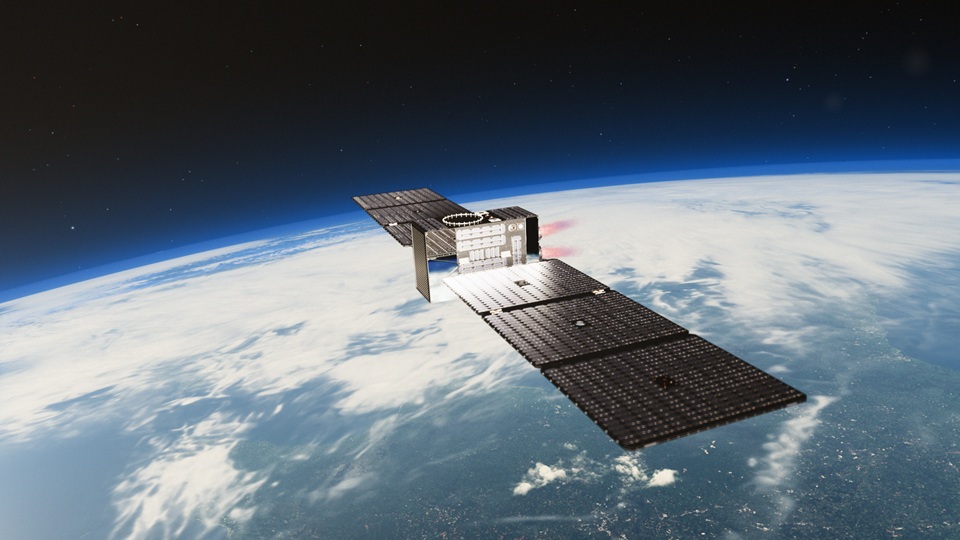
The new technology is the optical bench of the LISA (Laser Interferometer Space Antenna) Pathfinder mission – a spacecraft that aims to prove essential key technologies for future gravitational-wave observatories, such as the proposed LISA mission.

Built and tested at the Institute for Gravitational Research (IGR) at the University of Glasgow, the optical bench has now been shipped to Astrium in Germany for integration with the rest of the Science Module.
LISA Pathfinder could pave the way to a completely new ‘view’ of the Universe, complementing our understanding of its evolution. The mission aims to demonstrate the new technology needed for future gravitational-wave observatories to trace the formation, growth, and merger history of massive black holes. This new information could tell us more about the way space and time are interconnected.
Gravitational waves are generated by exotic objects such as collapsing binary star systems and massive black holes. To detect them will require some of the most precise and advanced technology ever launched into space, and the Pathfinder mission is vital to its success. It will be used to prove the ultra-high precision technology needed to make a test mass float freely in space so that any effects on its trajectory can only be the result of external gravitational forces. These test masses are two metal cubes which will be placed into gravitational freefall.

Above:
The LISA Pathfinder optical bench.
Courtesy Paul Gavin/IGR/AEI/Milde Science Communication
LISA Pathfinder is an ESA led mission involving European space companies and research institutes from the UK, France, Germany, Italy, The Netherlands, Spain, Switzerland and NASA.
In addition to the optical bench, the UK is providing two other components of the Science Module payload; the Phasemeter, which has already been delivered from Birmingham to Astrium for integration, and the Charge Management System, due for delivery from Imperial College later this year. The UK's involvement in the science payload is funded by the UK Space Agency.
The spacecraft was built by EADS Astrium UK and SciSys UK Ltd has contributed to development of the satellite’s on-board software. The mission is scheduled for launch in 2015.