Surrey engineers use XBox tech in nanosat
STRaND-2 is the latest mission in the cutting edge STRaND (Surrey Training, Research and Nanosatellite Demonstrator) programme, following on from the smartphone-powered STRaND-1 satellite that is near completion.

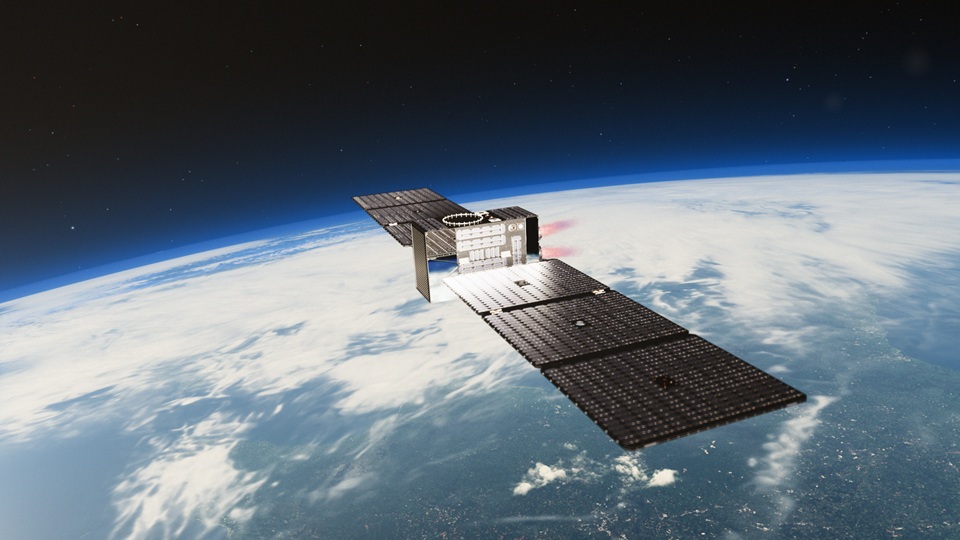
Similar in design to STRaND-1 (above), the identical twin satellites will each measure 30cm (3 unit Cubesat) in length, and utilise components from the XBOX Kinect games controller to scan the local area and provide the satellites with spatial awareness on all three axes.

Docking systems have never been employed on such small and low cost missions and are usually reserved for big-budget space missions to the International Space Station (ISS), or historically, the Mir space station and the Apollo programme. The STRaND team sees the relatively low cost nanosatellites as intelligent 'space building blocks' that could be stacked together and reconfigured to build larger modular spacecraft.
SSTL Project Lead Shaun Kenyon explained: “We were really impressed by what MIT had done flying an autonomous model helicopter that used Kinect and asked ourselves: Why has no-one used this in space? Once you can launch low cost nanosatellites that dock together, the possibilities are endless – like space building blocks.”
The STRaND-2 twins will be separated after launch. After the initial phase of system checks, the two satellites will be commanded to perform the docking procedure and, when in close proximity, the Kinect-based docking system will provide the satellites with 3D spatial awareness to align and dock.
Dr Chris Bridges, SSC Project Lead, said: “It may seem far-fetched but our low cost nanosatellites could dock to build large and sophisticated modular structures such as space telescopes. Unlike today’s big space missions, these could be reconfigured as mission objectives change, and upgraded in-orbit with the latest available technologies.”
Other applications include the safe removal of space debris and spacecraft maintenance, with a low cost 'snap-on' nanosatellite providing backup power, propulsion or additional on-board computing capability.