UK student mission to Mars takes off

Above:
Mars photographed using NASA's Hubble Space Telescope.
Courtesy NASA, ESA, and The Hubble Heritage Team (STScI/AURA).
This is the final stage of a unique project aimed to encourage young people to take up careers in the UK space industry.

The experiments were carried 26km up into Earth’s atmosphere on two high altitude balloons, named Phobos and Deimos after the moons of Mars, where they experienced temperatures as low as -50°C, pressures 1% of that at sea level and increased levels of radiation; conditions which are very close to that of the surface of Mars.

The 79 experiments on Phobos were successfully recovered in good condition four hours after launch in Fenny Compton. The tracking system on Deimos failed to report its landing location and so it and its experiments have not yet been found and we are asking the Oxfordshire and Warwickshire public for help in locating it. Current estimates place it in the area around Long Itchington but this is far from certain.
The project was devised and is run by young space engineers from the Bristol based Aerospace Division of SEA (a Cohort plc company) with funding from the UK Space Agency. The space engineers are also Science, Technology, Engineering and Mathematics (STEM) ambassadors and were assisted in finding interested students by Graphic Science, the STEM coordinators for Bristol, Bath & Somerset and Gloucestershire.
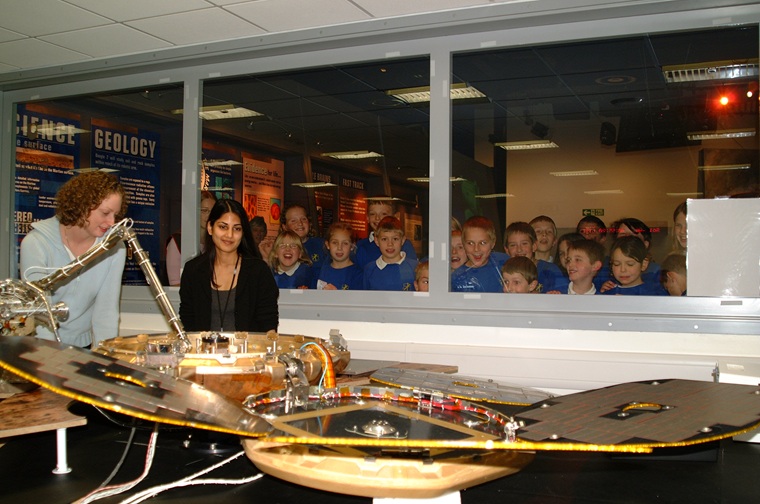
During a series of classroom workshops students aged seven to 24 from six schools and universities in Bath and Bristol were set the challenge to come up with experiments for testing anything that humans might want to take or do on Mars in the future. All of the experiments had to fit inside a Kinder Surprisetm toy capsule and will be mounted onto a special tray beneath the balloons to maximise their exposure to the hostile environment.
The idea for the mission was inspired by the UK Space Agency sponsored technology demonstration missions, UKube-1 and TechDemoSat-1, and the need to promote careers in an industry that has grown by nearly 8% throughout the recession and is worth over £9.1bn to the UK economy.
Andrew Bacon (25), SEA’s lead engineer for the project, said: “We run STEM projects like MARSBalloon because it is important for students to realise that we have a thriving space industry in the UK and that we need them to help us keep it that way.”
The experiments recovered from Phobos will be returned to the students who made them. They will have three weeks to report on their results where they will be published on the UK Space Agency’s website.