HutanBio partners with Wakud on scalable SAF feedstocks

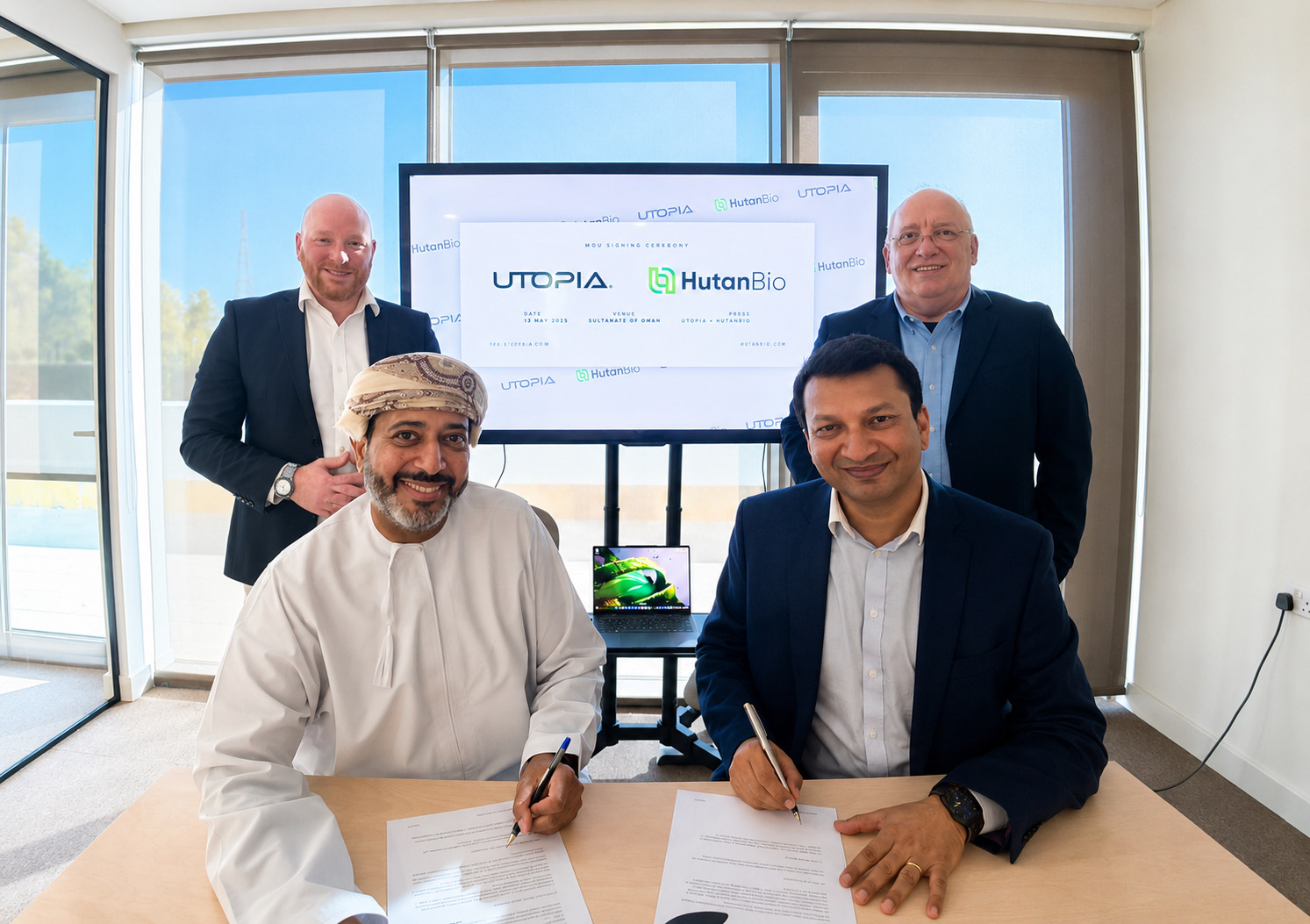
Image courtesy HutanBio
Under the terms of the MoU, Wakud International, owner of the country’s first dedicated biodiesel refinery, is expected to act as an offtaker as HutanBio progresses towards commercial deployment in Oman.
The MoU marks a significant milestone for HutanBio and comes at a critical time for the aviation sector, where feedstock availability is widely recognised as one of the biggest barriers to scaling sustainable aviation fuel production.
The partnership is designed to support the future production of sustainable fuel feedstocks for hard-to-abate sectors including aviation, where airlines face mounting pressure to reduce emissions while maintaining long-haul operations.
Unlike many conventional biofuel feedstocks, HutanBio’s proprietary algae platform uses seawater, sunlight and carbon dioxide to produce oil in coastal desert environments, avoiding competition with food production and freshwater resources.
Founded in 2019, HutanBio is developing a low-carbon oil platform to produce sustainable fuel feedstocks without relying on arable land or freshwater. The technology uses proprietary marine microalgae, rooted in research from the University of Cambridge and later developed at King Abdullah University of Science and Technology (KAUST) in Saudi Arabia.
The company’s founding team first came together through the University of Cambridge, where early research focused on discovering and developing industrial organisms from nature. That work led to the identification of a new-to-science organism which now underpins HutanBio’s platform. While production will take place in Oman, HutanBio’s intellectual property, leadership team and engineering biology expertise remain rooted in Cambridge, reinforcing the UK’s position as a global hub for sustainable fuel innovation.
The milestone supports HutanBio’s decision to establish its first commercial site in Oman, where existing refinery infrastructure, coastal desert land, high solar radiation and access to saline water create strong conditions for scaling algae-based biofuel production.
Manshu Agarwal, CEO of HutanBio, said: "One of the biggest barriers to scaling sustainable aviation fuel is access to sufficient feedstock. The industry needs solutions that can grow rapidly without placing additional pressure on agricultural land or freshwater resources.
"This agreement is an important step towards commercial deployment and demonstrates how new feedstock pathways can support the future growth of sustainable aviation fuels.
"Oman offers a unique combination of solar intensity, coastal geography, human capital and existing refinery infrastructure, making it one of the strongest locations globally to scale our platform.
"Our ambition is to help diversify and decentralise the production of low-carbon liquid fuels. Aviation, shipping and heavy transport will need sustainable fuel options for decades to come, and the UK has an opportunity to play a leading role by contributing the science, IP and technical expertise that can support new international fuel supply chains."
John Jones, COO of Utopia World BioEnergy, said: "By partnering with HutanBio, Utopia World is proactively building a pipeline of ultra-low carbon feedstocks for 2027 and beyond, ensuring continuity, scalability and integrity in future fuel production."
HutanBio is backed by the UK Innovation & Science Seed Fund (UKI2S), managed by Future Planet Capital, through its Engineering Biology portfolio, which supports early-stage companies commercialising breakthrough biological technologies with the potential to address major environmental and industrial challenges.
Oliver Sexton, Investment Lead for Engineering Biology at UKI2S, managed by Future Planet Capital, added: “HutanBio’s unique carbon negative platform has shown it produces high quality aviation grade fuel that are entirely sustainable. It offers a new way to power transport that needs energy density not possible using battery technology.
Moreover, it offers fuel security – fuel can be grown with sunlight and space and sea water, making fuels available irrespective of geopolitical tension. This is a huge technology break through that can pay a major part of decarbonizing the economy.”
HutanBio has already proven its technology through pilot operations in Malaysia and is now preparing for further testing, certification and commercial deployment. Its first Oman site is expected to deploy in 2027, with longer-term expansion potential across regions including India, Northern Africa, Australia, parts of Asia and the US.
The company is also undertaking oil testing and further carbon intensity analysis, following lifecycle assessment work conducted with EcoAct, part of Schneider Electric. HutanBio plans to pursue ISCC certification for its Malaysia pilot plant and future Oman commercial demonstration site.
Sign up for our newsletter and get our latest content in your inbox.
Similar Reads