


UK-Japan partnerships advance quantum and future connectivity tech

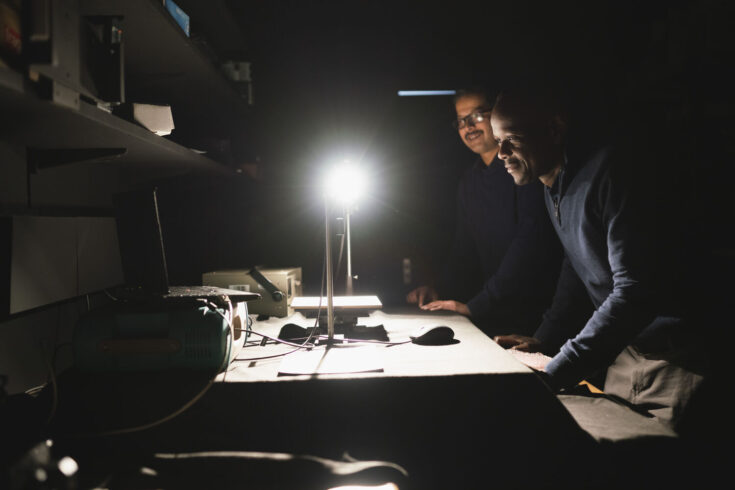
Above: Professor Jadu Dash and Dr Booker Ogutu in their lab in the School of Geography and Environmental Science at the University of Southampton.
Courtesy UKRI
The announcements were highlighted during the Prime Minister’s visit to Japan, where he committed to deepening the science and tech ties between the two countries.
They include:
- three new joint quantum technology research projects to address challenges such as drug discovery and secure communications and navigation in environments where GPS is unavailable
- a £6 million UK-Japan research programme on advanced connectivity technologies
Developing resilient, seamless digital networks
The UK and Japan are committing £6 million to a shared research programme exploring advanced connectivity technologies.
These technologies will help to provide seamless coverage so that everyone can access digital services wherever they are and ensure networks can reliably withstand cyberthreats and natural disasters.
Details on this funding opportunity will be available on the funding finder in due course.
Quantum technology projects
The new quantum projects are funded by the Engineering and Physical Sciences Research Council (EPSRC) and the Japan Science and Technology Agency (JST).
The projects started in early January 2026 and will run for five years.
The projects will combine each country’s expertise to turn cutting-edge quantum research into technologies that make life healthier, safer and more connected.
EPSRC has invested £4.5 million and JST has invested just over ¥1.1 billion (£5.2 million).
Funded projects
The three new projects are:
Massive scaling of semiconductor quantum-dot technologies
This project is jointly led by Dr Masaya Kataoka of National Physical Laboratory in the UK and Professor Tetsuo Kodera of the Institute of Science Tokyo in Japan.
It will develop scalable semiconductor quantum-dot devices, enabling powerful quantum computers and ultra-sensitive sensors.
By combining expertise in computing, measurement and precision standards, the collaboration aims to advance quantum technologies and support the development of future researchers in the field.
Distributed and secure quantum computation
This project is jointly led by Professor David Lucas of the University of Oxford in the UK and Professor Mio Murao of the University of Tokyo in Japan.
It will build the foundations of a quantum internet using ion-trap nodes and photonic links.
By integrating advanced hardware and privacy-preserving protocols, it will enable ultra-secure communication and faster scientific discovery, while training future specialists to strengthen global quantum networks.
Quantum control and sensing
This project is jointly led by Professor Janet Anders of the University of Exeter in the UK and Professor Masahito Ueda of Tokyo University in Japan.
This collaboration will develop smarter control techniques to make quantum sensors faster and more accurate in noisy environments.
These sensors will improve medical diagnostics, navigation without GPS and resource exploration, while advancing fundamental science and training the next generation of quantum experts.
Dr Kedar Pandya, Executive Director for Strategy at EPSRC said: "These investments will help turn quantum science into practical tools that improve security, healthcare and transport and by developing connectivity technologies we can ensure reliable digital access for everyone.
"Bringing together researchers from both countries means we can push the boundaries of science and unlock the real world benefits these technologies can deliver."
Quantum technology uses the unusual rules of quantum physics (the science of particles so small they can exist in two places at once) to achieve things conventional technology cannot.
Instead of working through problems step by step, they can explore many possibilities at the same time.
This makes them much faster for certain tasks, for example:
- faster cures for disease: quantum computers can model molecules and chemical reactions with unprecedented accuracy, speeding up drug discovery and improving treatments
- reliable navigation: quantum sensors can guide ships, planes and cars without GPS, which is critical when signals fail in tunnels or remote areas
- sharper diagnostics and cleaner energy: ultra-precise sensors can improve medical scans, monitor environmental changes and make energy systems more efficient
Quantum technologies are complex and require expertise across hardware, software and applications. By joining forces under Japan’s Quantum Technology Innovation Strategy and ASPIRE programme and the UK’s National Quantum Strategy and National Quantum Technologies Programme (NQTP), the UK and Japan will:
- accelerate progress
- train the next generation of quantum specialists
- deliver technologies that make life healthier, safer and more connected
The UK-Japan partnership
The UK launched the world’s first national quantum programme, NQTP, in 2014 and has invested over £1 billion to build a thriving quantum ecosystem.
Japan brings complementary strengths in quantum communication, ion-trap systems and advanced manufacturing, guided by its Quantum Technology Innovation Strategy and ASPIRE programme.
Together, the two nations aim to accelerate innovation, share expertise and set global standards for quantum technologies.
Sign up for our newsletter and get our latest content in your inbox.
Similar Reads




Sign up for our newsletter. Select all sectors relevant to you.
Related