General Atomics

Solus Power secures MoD contract to develop Kratos

Solus Power has secured a contract with the Ministry of Defence’s Defence and Security Accelerator (DASA) to further develop its novel dual use battery technology, Kratos.


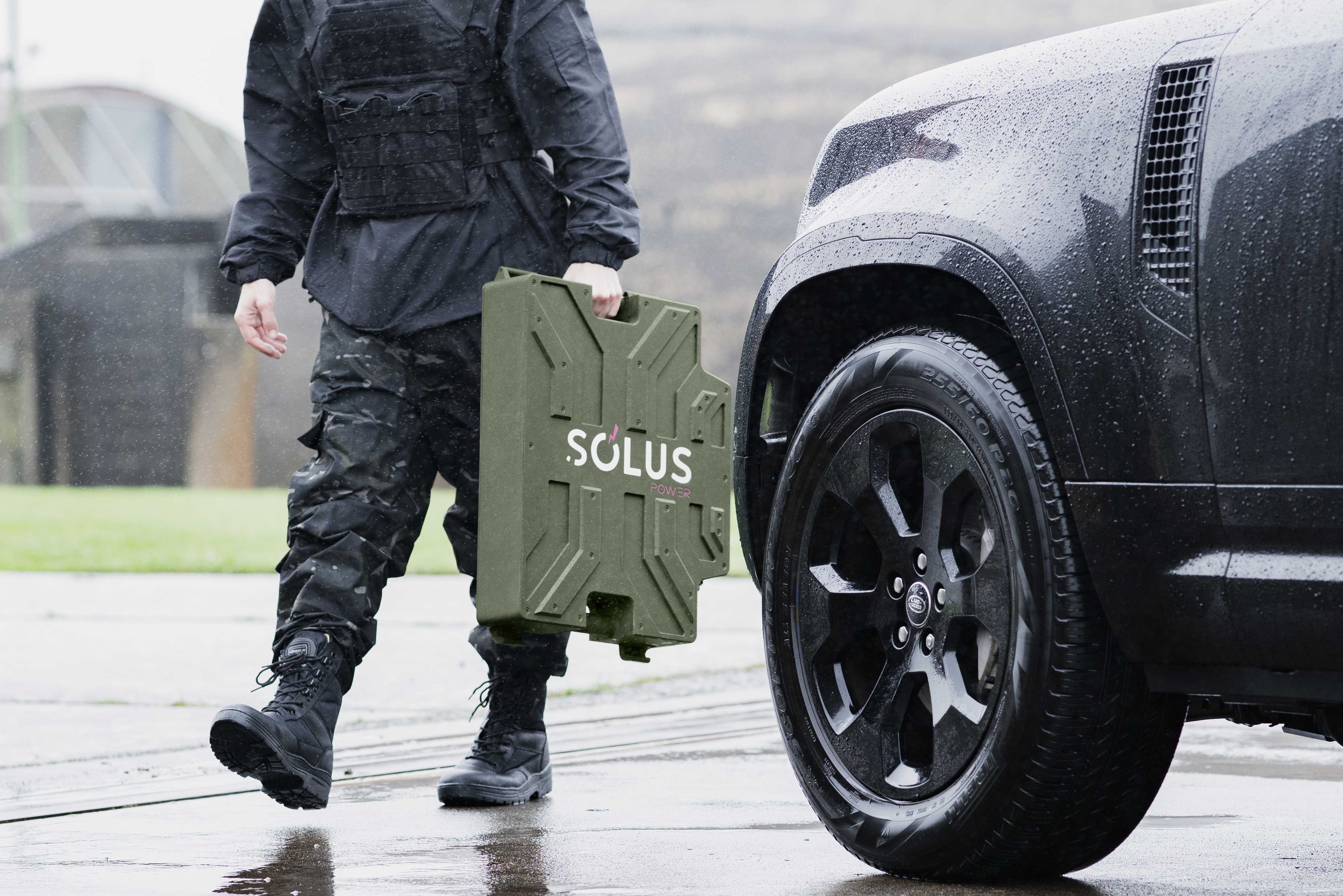
Image courtesy Solus Power

Awarded through DASA’s themed competition, Delivering operational advantage via improved self-sufficiency and operational energy innovation, the funding will accelerate development of Solus Power’s military grade portable battery unit.

Working in collaboration with DASA and the Defence Science and Technology Laboratory (Dstl), Solus Power will advance Kratos towards field testing. Dstl, acting as technical partner, will ensure the technology meets the operational requirements of the Royal Navy’s Future Commando Force, which is funding the work.

Kratos has been recognised for its ability to enhance deployed self-sufficiency and endurance across maritime, land and air domains, while reducing logistical burden and optimising power and energy use.

Solus Power’s Kratos technology presents a ruggedised and portable lithium-ion battery pack described as a ‘Jerry can of electricity’ to provide rapid DC-to-DC charging. Its scalable architecture allows users to link multiple units for higher energy demands, making it ideal for powering field command centres, medical units, and disaster relief.

Kratos is tactically portable, suitable for hand-carry, vehicle mounting, or drone deployment. Its low heat signature and silent operation enhance operational stealth, making it a dependable power source for missions where discretion is critical.

Stas Leonidou, founder and CEO of Solus Power, said: “We are delighted that Solus Power’s Kratos has been recognised for its game-changing potential, and we are excited to be working with DASA and the MoD to further develop the technology. Our mission is to revolutionise energy access across defence, ensuring reliable and sustainable power in diverse and challenging environments. Kratos’ ability to provide portable, flexible, and scalable off-grid power whenever and wherever it’s needed is an ideal solution to support global defence, security, and the evolving electrified military landscape.”

Over the past nine years, DASA has established itself as a key enabler of defence and security innovation, building strong expertise and partnerships across government, academia, and industry.

By seeking novel technologies that enable greater self-sufficiency and operational endurance for deployed forces, DASA supports a more resilient, agile, and self-sustaining military capability.

Darren Browning, Dstl technical partner, said: “Science and technology innovation enables our Armed Forces to be more resilient and effective. Dstl’s critical technical advice helped shape the power requirements for the solution and its ability to power varied electronic systems. We’ll be using our extensive technical experience to thoroughly assess this next stage and ensure the product meets user needs.”

The DASA Project Manager for the competition added: "At DASA, we are dedicated to finding and supporting breakthrough solutions that address the challenges faced by modern defence forces. Through the Delivering operational advantage via improved self-sufficiency and operational energy innovation themed competition, we were seeking innovations that could achieve greater self-sufficiency and operational endurance for a deployed force, and we look forward to seeing what this project delivers.”

With modern operations increasingly reliant on advanced electronics, surveillance systems, and electric mobility, the demand for reliable, portable power is growing. Traditional power sources like diesel generators are noisy, heavy, fuel-dependent, and logistically complex.

Energy resilience is fast becoming a critical national security priority. Scalable, ruggedised, and self-sufficient power solutions are essential for off-grid and battlefield environments. The transition to electrified power generation, storage, and distribution is set to transform how armed forces operate – boosting efficiency and improving mission success rates.

Kratos supports a wide range of military and emergency use cases, from powering base infrastructure such as surveillance systems to supporting soldier-level technology like wearable devices, communications equipment, and smart weaponry. Its scalable, portable design makes it ideal for land operations, drone support, and rapid deployment in disaster response or field maintenance scenarios.

Related

UK blames Iran’s Revolutionary Guards for RAF Fairford ‘bomb plot’
Boeing B-52H Stratofortress USAF at RAF Fairford
UK blames Iran’s Revolutionary Guards for RAF Fairford ‘bomb plot’
UK government accuses Iran's Revolutionary Guards of directing a suspected plot targeting RAF Fairford, following seven arrests.
Aerospace Defence Security

13 Oct 2026

Workforce challenges hold back aerospace and defence firms, but only one in five prioritises action
Engineer robotic mechanic women technician working in advance robotic industry plant work assembly robot arm repair fix maintenance or service large machine by hand skill
Workforce challenges hold back aerospace and defence firms, but only one in five prioritises action
New PwC research reveals a gap between workforce pressures and strategic priorities, as UK employers face persistent vacancies and rising demand for technical skills.
Aerospace Defence

13 Oct 2026

UK backs quantum technology firms with £50m funding for defence, rail and GPS-free navigation
Quantum Growth Alliance
UK backs quantum technology firms with £50m funding for defence, rail and GPS-free navigation
A new Government package is set to develop advanced quantum sensors and communications systems aimed at boosting security, infrastructure resilience and economic growth.
UK blames Iran’s Revolutionary Guards for RAF Fairford ‘bomb plot’
Boeing B-52H Stratofortress USAF at RAF Fairford
UK blames Iran’s Revolutionary Guards for RAF Fairford ‘bomb plot’
UK government accuses Iran's Revolutionary Guards of directing a suspected plot targeting RAF Fairford, following seven arrests.
Aerospace Defence Security

13 Oct 2026

Workforce challenges hold back aerospace and defence firms, but only one in five prioritises action
Engineer robotic mechanic women technician working in advance robotic industry plant work assembly robot arm repair fix maintenance or service large machine by hand skill
Workforce challenges hold back aerospace and defence firms, but only one in five prioritises action
New PwC research reveals a gap between workforce pressures and strategic priorities, as UK employers face persistent vacancies and rising demand for technical skills.
Aerospace Defence

13 Oct 2026

UK backs quantum technology firms with £50m funding for defence, rail and GPS-free navigation
Quantum Growth Alliance
UK backs quantum technology firms with £50m funding for defence, rail and GPS-free navigation
A new Government package is set to develop advanced quantum sensors and communications systems aimed at boosting security, infrastructure resilience and economic growth.
UK and Germany back SaxaVord in new European space launch deal
SaxaVord Spaceport, Shetland
UK and Germany back SaxaVord in new European space launch deal
The UK and Germany have agreed to deepen space launch cooperation, with Scotland's SaxaVord Spaceport securing European access to orbit.
Aerospace Defence Space

9 Oct 2026

Excelerate Technology to build UK CNI robotic security solution
Satellite in Earth orbit
Excelerate Technology to build UK CNI robotic security solution
In a project co-funded by the European Space Agency Business Applications and Space Solutions (ESA BASS) and supported by the UK Space Agency, Excelerate Technology will build and demonstrate how space-enabled assets can provide innovative safety and security solutions, including protection of Critical National Infrastructure (CNI) at a site in the UK.
World Space Week: How British technology will help ESA return to the Moon
ESA Argonaut
World Space Week: How British technology will help ESA return to the Moon
As Europe prepares to return to the Moon, British-developed LEIA LiDAR technology will help ESA's Argonaut lander autonomously identify safe touchdown zones on the lunar surface.
Space

5 Oct 2026

Two in five UK workers lack training on AI-powered cyber threats
Cyber security being done by a man on a computer
Two in five UK workers lack training on AI-powered cyber threats
Adding AI to the already complex business of cyber security has the potential to make attacks more sophisticated and harder to spot.
Security

13 Oct 2026

UK blames Iran’s Revolutionary Guards for RAF Fairford ‘bomb plot’
Boeing B-52H Stratofortress USAF at RAF Fairford
UK blames Iran’s Revolutionary Guards for RAF Fairford ‘bomb plot’
UK government accuses Iran's Revolutionary Guards of directing a suspected plot targeting RAF Fairford, following seven arrests.
Aerospace Defence Security

13 Oct 2026

UK backs quantum technology firms with £50m funding for defence, rail and GPS-free navigation
Quantum Growth Alliance
UK backs quantum technology firms with £50m funding for defence, rail and GPS-free navigation
A new Government package is set to develop advanced quantum sensors and communications systems aimed at boosting security, infrastructure resilience and economic growth.