UK-made RAF drones become operational

Image courtesy Leonardo
The StormShroud drone is a groundbreaking first-of-its-kind drone that will make the RAF’s world-class combat aircraft more survivable and more lethal. The advanced drones offer a step change in capability by using Leonardo’s high-tech BriteStorm signal jammer to disrupt enemy radar at long ranges, protecting British aircraft and pilots.
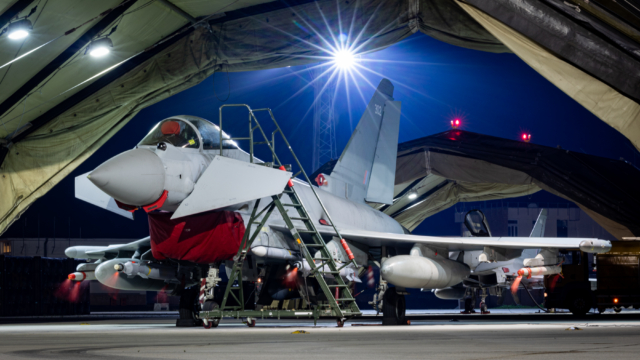
In revolutionary new tactics, the drones support aircraft like Typhoon and F35 Lightning, by confusing enemy radars and allowing combat aircraft to attack targets unseen. This means for the first time, the RAF will benefit from high-end electronic warfare without needing crew to man it, freeing them up for other vital frontline missions.
The RAF is investing an initial £19 million into the cutting-edge drones, which are made in the UK and directly support 200 highly skilled engineering jobs at multiple UK locations already from West Wales to Somerset, with further opportunities expected in future. StormShroud is just the first of a family of next-generation drones – known as Autonomous Collaborative Platforms (ACPs) – being delivered to the RAF.
The fleet of Tekever AR3 small Uncrewed Air Systems (UAS) now entering service with the RAF under the name StormShroud, will all be equipped with Leonardo’s latest electronic warfare payload, BriteStorm. The Tekever AR3 and AR5 have had extensive use on the frontline in Ukraine against Putin’s illegal war, racking up more than 10,000 hours of flight for Ukraine’s forces.
The RAF is taking the next step by integrating best-in-class signal scrambling technology into the drones to boost the UK’s defences at home, as the Prime Minister steps up UK defence capabilities to counter complex threats in the face of global instability.
The Prime Minister will visit a Leonardo UK site in the South East today to see first-hand the expertise that goes into manufacturing the drones and meeting the staff involved in delivering it, including many engineering apprentices representing the next generation of British defence industry excellence.
Prime Minister Keir Starmer said: "Investment in our defence is an investment in this country’s future. Putting money behind our Armed Forces and defence industry is safeguarding our economic and national security by putting money back in the pockets of hard-working British people and protecting them for generations to come.
"Together with our allies, this government is taking the bold action needed to stand up to Putin and ruthlessly protect UK and European security, which is vital for us to deliver our Plan for Change and improve lives of working people up and down the country.
"It is a privilege to meet and learn from the young minds driving innovation in defence technology and we will continue to invest in the industries of the future to deliver security and opportunity for the British people through our Plan for Change."
In a further vote of confidence in Britain’s defence industry, British-Portuguese tech company Tekever, who manufacture the drones in the UK, plan to invest a further £400 million over the next five years across the UK and create up to 1,000 more highly skilled jobs. Ricardo Mendes, CEO of TEKEVER, said: “TEKEVER is proud to be part of the RAF’s Autonomous Collaborative Platforms (ACP) programme, rapidly delivering the STORMSHROUD capability in under six months. This programme is a strong example of how the Ministry of Defence and Industry can work collaboratively to deliver cutting edge defence capability at pace while incorporating lessons learned from operational feedback in Ukraine and supporting the UK sovereign industrial base.
"Building on this foundation and our long term partnership with MoD in supporting Ukraine we are today announcing our OVERMATCH programme, investing £400 million in the UK over the next five years and creating 1,000 high-skilled jobs. This strategic commitment to the UK is more than an industrial expansion – it is a plan to position the UK to lead the transformation of Europe’s defence landscape by delivering faster, more adaptive capabilities that stay ahead of evolving threats.”
The RAF’s new ‘StormShroud’ autonomous collaborative platforms (ACPs) equipped with Leonardo’s latest electronic warfare payload, BriteStorm, will be able to confuse and suppress enemy radars during air combat missions, providing a new way for UK Armed Forces to deal with increasingly capable air defence systems.
BriteStorm is a ‘stand-in jammer’, a sophisticated electronic warfare device designed to be deployed ahead of high-value crewed combat aircraft, flying on-board small uncrewed aircraft or missiles. It suppresses and deceives an enemy’s Integrated Air Defence System (IADS), degrading their ability to find and track allied aircraft.
To deliver this effect, BriteStorm employs high-powered digital jamming and deception techniques, developed by Leonardo’s Electronic Warfare experts to be effective against a wide spectrum of threats. By generating confusion for the enemy, BriteStorm maximises operational freedom for friendly forces.
The BriteStorm payload comprises a Miniature Techniques Generator (MTG) along with a series of Transmit Receive Modules (TRMs) tailored to the operator’s platform of choice. BriteStorm is small, lightweight, with a low power requirement making it platform agnostic – specifically designed to integrate into a wide range of uncrewed aircraft.
To future-proof the system against rapidly evolving enemy equipment and techniques, BriteStorm takes an open approach to software. Operators can configure the payload to defeat a wide range of threats and can exploit intelligence and mission data captured during sorties to update the payload to handle new threats as they emerge during operations.
Learning from recent operational lessons, BriteStorm has been designed to be attritable. On its return, BriteStorm is rapidly reprogrammable for subsequent missions but if destroyed in the defence of higher-value or crewed platforms, its loss would be tolerable.
Research and development of BriteStorm began in 2017 at Europe’s leading hub for electronic warfare technology, located in Luton, UK. The Leonardo site employs over 1,200 people and invested almost £175 million with British suppliers in 2024.
As part of the UK’s defence industrial combat air enterprise, the site in Luton plays a major role in programmes that protect the security of the UK, including the Global Combat Air Programme (GCAP) and the development of upgrades for the Eurofighter Typhoon.
StormShroud has been developed in the UK by the Royal Air Force Rapid Capabilities Office (RCO) and the Catalyst team in Defence Equipment & Support (DE&S). Entering service with 216 Squadron, StormShroud will be operated by regular and reserve personnel. As the evolving capability embeds, it will be supported by Leonardo and other industry partners.
Sign up for our newsletter and get our latest content in your inbox.
Similar Reads




Sign up for our newsletter. Select all sectors relevant to you.
Related