

Operation Blue Skies takes off with oceanic airspace trial to test AI-driven contrail avoidance

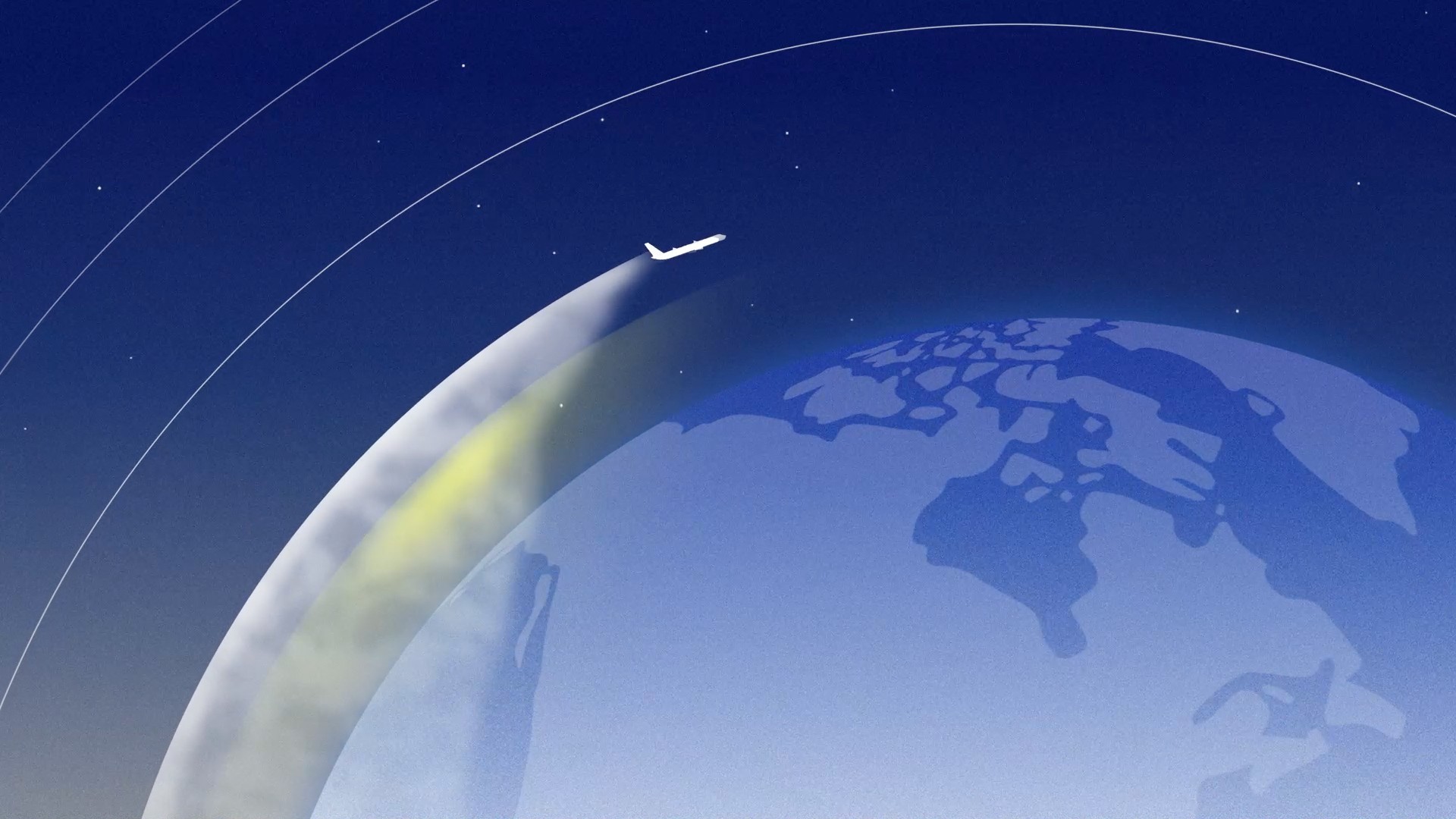
A UK-based consortium – comprising Google, the UK Department for Transport, the Met Office, NATS, Contrails.org, Imperial College London and the University of Cambridge – has launched Operation Blue Skies, backed by the UK Government as the world’s first oceanic airspace-scale trial, aimed at reducing the climate impact of aviation contrails.
Operation Blue Skies is a £5 million, 30-month programme, partly funded by £2.65 million from the UK Government’s Department for Transport. It comprises two operational trials conducted during the winter months, across NATS-controlled Shanwick oceanic airspace, the eastern half of the North Atlantic corridor. The programme will evaluate the operational feasibility and environmental benefits of adjusting commercial flights’ altitude to avoid the atmospheric conditions that contribute to the formation of persistent, warming contrails.
Professor Marc Stettler, Professor of Transport and Environment at Imperial College London, said: “In 2020, our study found that small changes to flight paths could reduce the climate impact of contrails. Operation Blue Skies is a chance to test that idea in the real world and on a scale we’ve never seen before. At Imperial, our role is to independently assess what happens, from the effects on airline operations to the benefits for the climate and provide the evidence needed to decide whether this approach could become part of everyday aviation. It’s exciting to see Imperial’s research helping to shape practical solutions to one of aviation’s biggest climate challenges.”
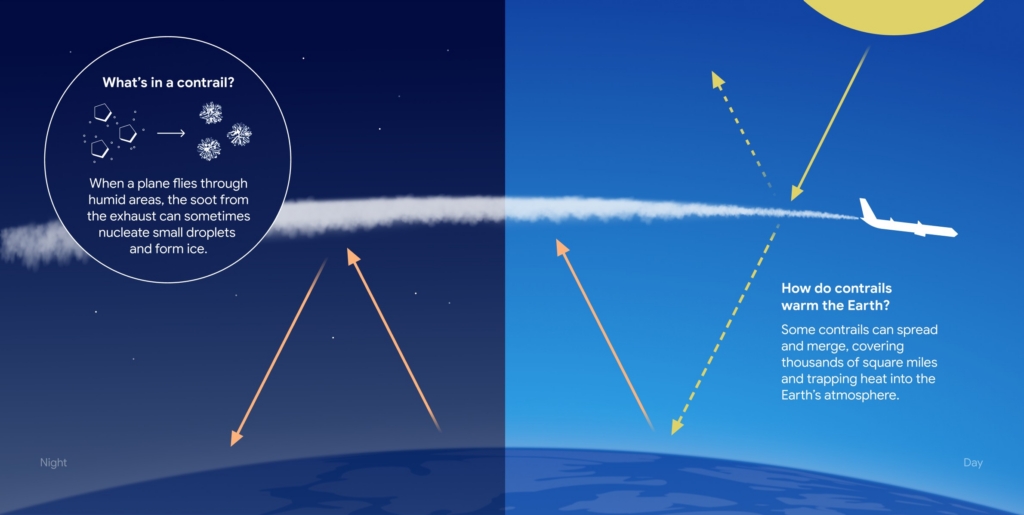
Professor Steven Barrett, Regius Professor of Engineering at the University of Cambridge said: “Contrail avoidance could drastically reduce the global climate impact of aviation, at minimal cost to passengers and companies. Operation Blue Skies is a big step forward in this process, as it will test the ability of the UK to reduce contrail coverage at an airspace-wide scale and in a real-world setting. It’s an exciting step in building a more sustainable aviation industry.”
How AI will highlight interventions needed to reduce impact of contrails
Atmospheric modelling shows that the Shanwick airspace accounts for approximately 5% of global contrail warming and a significant fraction of this warming is concentrated in the winter season between November and February. Operation Blue Skies is designed to target this specific high-impact window by using AI models to identify where and when interventions have the greatest
potential to reduce contrail-related climate impact.
Ian Jopson, Director Sustainability at NATS, said: “Decarbonising aviation will take a range of solutions and understanding the role of contrails is an important part of that journey. This trial will allow us to test how contrail avoidance could work within the complex, highly coordinated environment of air traffic management. By bringing together world-leading science and operational expertise, we can start to build the real-world evidence needed to understand whether this could make a meaningful contribution to reducing aviation’s overall climate impact.”
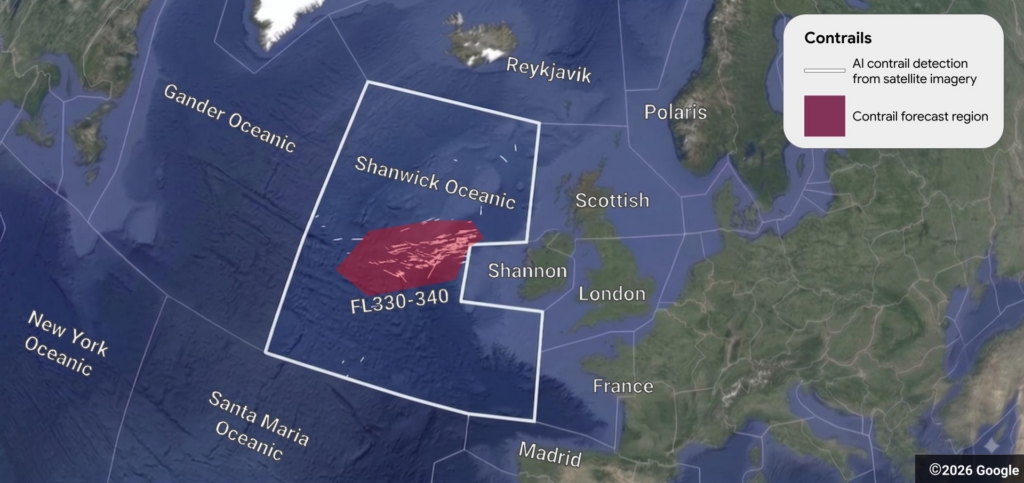
The trials will focus on minor altitude adjustments within standard flight operations, coordinated through established and standard Air Traffic Control (ATC) communication channels. Trial manoeuvres will take place primarily during winter testing windows in 2026-2027 and 2027-2028, with approximately 20 to 40 test days per winter. Testing will be conducted during periods of lower
air traffic.
This trial sits alongside major UK Government investments in innovative aviation decarbonisation projects, including £219 million to boost homegrown green fuel production to cut emissions from flying whilst boosting growth and creating green jobs.
Keir Mather, UK Government Minister for Aviation, Maritime and Freight, said: “We’re partnering with Google to back British experts and innovators to find practical ways to make flying cleaner. This is a world-first and it’s British ingenuity leading the way. By testing small tweaks to flight paths over the Atlantic, we can cut the vapour trails left behind by planes. From £219 million for home-grown sustainable fuel to zero-emission aircraft, we’re backing innovation to make UK aviation cleaner, support thousands of skilled jobs and drive growth in the sector.”
Driving climate innovation through British research and public-private partnership
Operation Blue Skies programme is co-funded by its industry partners and the Department for Transport (DfT) through the ATI Programme, a partnership between the Aerospace Technology Institute (ATI), the Department for Business, Innovation, Science and Trade (BIST) and Innovate UK.
To ensure public funding directly advances sovereign scientific capabilities, 100% of the government grant funding is allocated directly to academic, non-profit and aviation partners. Google UK is participating on a pro-bono basis, contributing £1.4 million in-kind through AI research expertise, engineering time and high-performance computing infrastructure to advance open climate science.
Contrails.org is working alongside the consortium partners to connect the scientific and operational pieces of the trial: assessing and integrating forecasts, shaping trial parameters and supporting data analysis so Operation Blue Skies can test whether contrail avoidance is safe, measurable and practical across oceanic airspace.
Marc Shapiro, Executive Director of Contrails.org, said: “For five years, we’ve worked to build the scientific understanding and forecasting tools to predict where and when contrails form and how much they warm the planet. The next critical step is to prove these tools work reliably in real operations, leading to real, verified reductions in contrail warming. Operation Blue Skies will help us understand how to do that safely, measurably and at scale.”
Consortium roles and scientific verification
The multidisciplinary consortium brings together technical and scientific expertise across five key
operational areas:
● Google UK: Developing AI models to predict and avoid warming contrails, while using
machine learning and satellite imaging to track and verify impact.
● NATS (the UK’s leading air navigation service provider): Trial airspace operations, air
traffic control coordination, conduct safety assessment and air traffic controller training.
● Contrails.org: Leading forecast assessment and integration, designing trial parameters, and
supporting data analysis.
● Imperial College London & University of Cambridge: Evaluating trial outcomes and
providing independent verification of climate impact.
● Met Office: Developing a new UK contrail forecast capability and ensuring meteorological
accuracy throughout the trial.

Combining evidence, technology and SAF to realise sustainable salient solutions
Kemal Armada, Product Manager, Google said: “Contrail avoidance has reached a pivotal moment. The question is no longer whether we can mitigate contrails but whether we can make that mitigation work at the scale of the global aviation system. This trial is an important step toward making that a reality, while demonstrating the strength of British research and innovation in developing practical solutions to one of aviation’s most important climate challenges.”
Gary Elliott, CEO, Aerospace Technology Institute said: “Operation Blue Skies demonstrates the UK’s ability to bring together government, industry and academia to tackle some of aviation’s most complex sustainability challenges. Building on the ATI’s non-CO2 roadmap, the project will explore how contrail avoidance could work alongside decarbonisation measures such as advanced aircraft technologies and sustainable aviation fuels (SAF). By generating real-world evidence at an unprecedented scale, Operation Blue Skies will help build the understanding needed to inform future industry and policy decisions, while reinforcing the UK’s position at the forefront of aerospace innovation.”
James Shapland, Head of Regulated Transport Services at the Met Office, said: “As a key partner to the aviation industry, we are pleased to bring our trusted weather intelligence and sector expertise to this programme. Our understanding of regional weather regimes will provide an important scientific basis for the trials and developing a global contrail forecast capability aligns with our strategic work to support the aviation industry in managing its longer-term environmental impacts.”
Sign up for our newsletter and get our latest content in your inbox.
Similar Reads


Sign up for our newsletter. Select all sectors relevant to you.
Related