



JFD Global develops advanced medical monitoring system
James Fisher Defence (JFD Global) has commenced a project to deliver to the Submarine Delivery Agency (SDA) - a new medical monitoring capability for integration into the NATO Submarine Rescue System (NSRS).

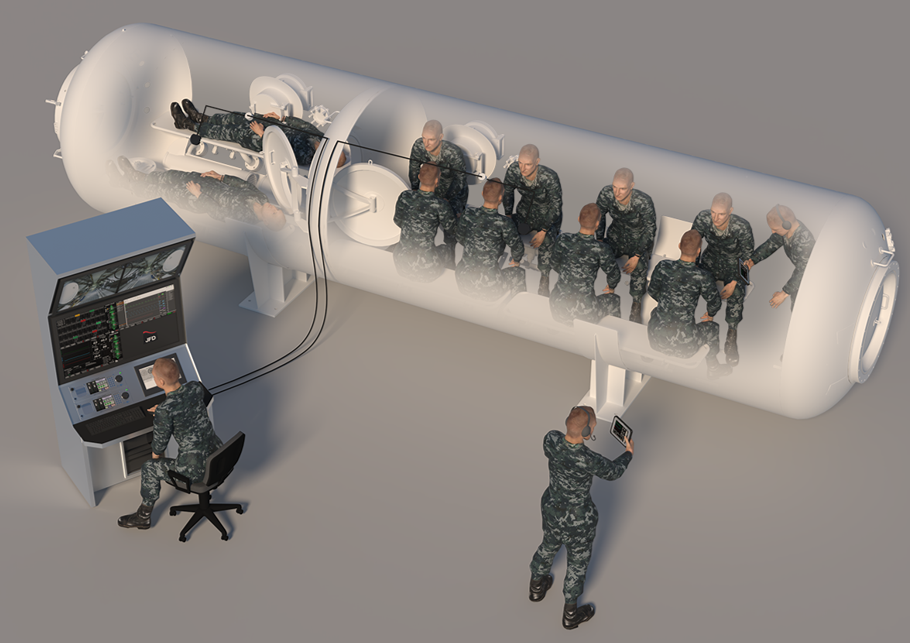
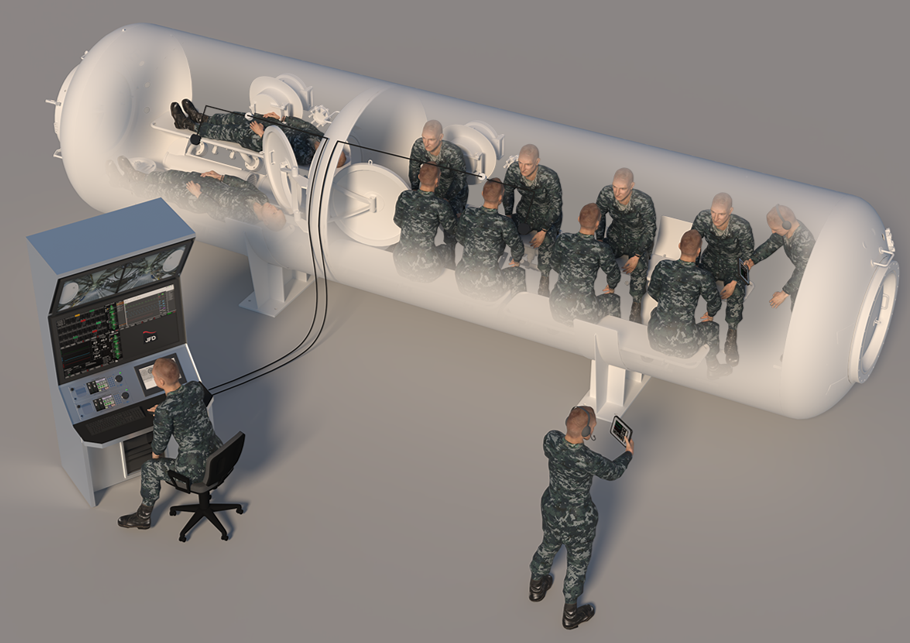
Image courtesy James Fisher Defence (JFD Global)
The innovation marks a major upgrade to the NSRS’s existing capability, expanding capacity from monitoring four submariners to up to 76, including medical personnel, during rescue operations. Continuous, real-time monitoring begins the moment submariners enter the Deck Decompression Chamber (DDC) on the rescue vessel, with data instantly accessible to onboard medics and shore-based medical teams. This enables faster response times, more accurate triage and improved treatment outcomes in highly demanding clinical scenarios.
The system uses a three-tier approach: wearable devices to track key indicators such as heart rate, stress, fatigue and core temperature; diagnostic tools including ECG monitors and ultrasound; and advanced critical care equipment for unstable or deteriorating casualties. Data hubs, connected to more than 100 certified medical components, ensure automated, accurate monitoring and can link via satellite for remote medical support.
The modular platform can be integrated across submarine escape and rescue systems and adapted for other defence and commercial diving operations. Complementary defence applications include submarine platforms, distressed submarine (DISSUB) entry kits, dive recompression chambers, and surface vessels.
Richard Devlin, Defence Director at JFD Global said: “This development represents an innovative step change in how we safeguard the lives of submariners in rescue situations. By combining wearable technology with integrated diagnostics and real-time data sharing, the medics can detect issues earlier, respond faster and give crews the very best chance of recovery. Safety has always been our number one priority, and this new capability strengthens that commitment.”
Surgeon Commander Simon Phillips, Defence Consultant Advisor in Diving and Hyperbaric Medicine and Head of Diving Medicine at the Institute of Naval Medicine (INM) said: “The new medical monitoring system set to be developed for NSRS is a significant enhancement over existing medical equipment used previously. It will ultimately improve care for all rescued submariners and will help to support the medical and rescue teams.”
Captain Mike Lyons RN, Head of Submarine Programmes for In-Service Submarines within the SDA and the Operational Duty Holder for the NSRS said:“I am delighted that this work can commence as it will increase capability in how we can recognise potential injuries for rescued submariners. Although the chances of needing rescue remain extremely low, we must ensure that the system is best prepared to meet all realistic challenges that it may face.”
Sign up for our newsletter and get our latest content in your inbox.
Similar Reads
1

2

3



Sign up for our newsletter. Select all sectors relevant to you.
Related
Enhanced aviation programme to help college students into airport careers

Enhanced aviation programme to help college students into airport careers
Manchester Airports Group (MAG) is building on its partnership with Trafford & Stockport College to bring industry insights into the classroom and enable young people to get hands-on experience relevant to today's aviation sector.
3 innovative technologies selected for trial at Glasgow Airport

3 innovative technologies selected for trial at Glasgow Airport
The companies selected are part of an initiative supporting the development and adoption of new technologies across the UK’s aviation sector.
UK blames Iran’s Revolutionary Guards for RAF Fairford ‘bomb plot’

UK blames Iran’s Revolutionary Guards for RAF Fairford ‘bomb plot’
UK government accuses Iran's Revolutionary Guards of directing a suspected plot targeting RAF Fairford, following seven arrests.
MI5 warns UK defence businesses to strengthen security
MI5 warns UK defence businesses to strengthen security
Defence suppliers and critical infrastructure operators must strengthen protection against sabotage, cyber attacks and drone threats, MI5 chief Sir Ken McCallum has warned.
UK firm MARSS wins £370m Kuwait counter-drone contract, creating 100 jobs

UK firm MARSS wins £370m Kuwait counter-drone contract, creating 100 jobs
MARSS will deploy a nationwide AI-enabled counter-drone network for Kuwait under a £370m contract, creating around 100 skilled jobs in the UK.
UK blames Iran’s Revolutionary Guards for RAF Fairford ‘bomb plot’
UK blames Iran’s Revolutionary Guards for RAF Fairford ‘bomb plot’
UK government accuses Iran's Revolutionary Guards of directing a suspected plot targeting RAF Fairford, following seven arrests.
UK and Germany back SaxaVord in new European space launch deal

UK and Germany back SaxaVord in new European space launch deal
The UK and Germany have agreed to deepen space launch cooperation, with Scotland's SaxaVord Spaceport securing European access to orbit.
Excelerate Technology to build UK CNI robotic security solution

Excelerate Technology to build UK CNI robotic security solution
In a project co-funded by the European Space Agency Business Applications and Space Solutions (ESA BASS) and supported by the UK Space Agency, Excelerate Technology will build and demonstrate how space-enabled assets can provide innovative safety and security solutions, including protection of Critical National Infrastructure (CNI) at a site in the UK.
World Space Week: How British technology will help ESA return to the Moon
World Space Week: How British technology will help ESA return to the Moon
As Europe prepares to return to the Moon, British-developed LEIA LiDAR technology will help ESA's Argonaut lander autonomously identify safe touchdown zones on the lunar surface.
MI5 warns UK defence businesses to strengthen security
MI5 warns UK defence businesses to strengthen security
Defence suppliers and critical infrastructure operators must strengthen protection against sabotage, cyber attacks and drone threats, MI5 chief Sir Ken McCallum has warned.
Two in five UK workers lack training on AI-powered cyber threats

Two in five UK workers lack training on AI-powered cyber threats
Adding AI to the already complex business of cyber security has the potential to make attacks more sophisticated and harder to spot.
UK blames Iran’s Revolutionary Guards for RAF Fairford ‘bomb plot’
UK blames Iran’s Revolutionary Guards for RAF Fairford ‘bomb plot’
UK government accuses Iran's Revolutionary Guards of directing a suspected plot targeting RAF Fairford, following seven arrests.