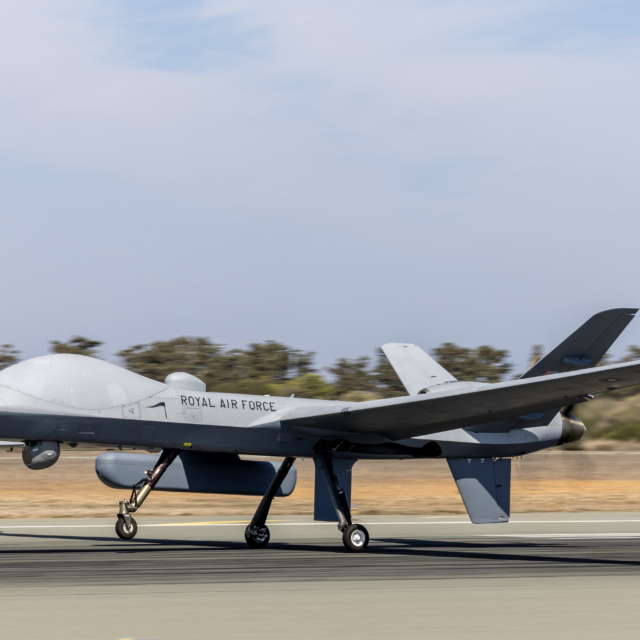
Royal Navy tracks Russian warships in UK waters as RAF Protector makes operational debut

Royal Navy warships and aircraft recently monitored Russian naval movements around Britain, with support from RAF Protector RG1 drones, which marked the type’s operational debut in UK airspace.

The Russian Vishnya-class intelligence-gathering vessel, Viktor Leonov (CCB-175), is shadowed by a Royal Navy-operated Merlin HM2 helicopter off the Outer Hebrides on 29 September 2026. Image: MOD Crown Copyright/Royal Navy
Image: MOD Crown Copyright/Royal Navy

The Royal Navy has tracked and intercepted three Russian warships – comprising an intelligence-gathering vessel, a guided-missile frigate and a landing ship – during a series of operations around British waters that spanned September and October.

Conducted over a 17-day period, the three maritime interdiction operations involved the Royal Navy’s second Type 45 air-defence destroyer, HMS Dauntless (D33) – which was recently seen sailing with suspected counter-uncrewed aerial system (C-UAS) launchers – and the River-class offshore patrol vessel, HMS Tyne (P281).

HMS Tyne (P281) shadows the Russian Navy's Ropucha-class landing ship, RFN Aleksandr Shabalin (110), as it transits the English Channel on 13 October 2026. Image: MOD Crown Copyright/Royal Navy
Image: MOD Crown Copyright/Royal Navy

Also involved in the operations were Merlin HM2 and Wildcat HMA2 helicopters employed by the Royal Navy Fleet Air Arm (FAA), as well as a Royal Air Force (RAF)-operated MQ-9B Protector RG1 medium-altitude, long-endurance (MALE) unmanned air vehicle (UAV) from RAF Waddington, Lincolnshire. The recent engagements marked the Protector RG1’s first operational deployment in UK airspace.

The operations were disclosed by the Royal Navy on 2 November and highlight the increasing demands on UK forces to monitor and track Russian naval activity in local waters, including those protecting civilian-flagged oil tankers that are associated with Moscow’s sanctioned ‘shadow fleet’.

Merlin HM2s track Russian spy ship as it shadows NATO exercise off Scotland

Between 29 September and 8 October, Merlin HM2 helicopters were deployed at short notice from RNAS Culdrose in Cornwall to Glasgow Prestwick Airport in South Ayrshire, Scotland, to monitor the Russian Navy’s Vishnya-class intelligence-gathering vessel, Viktor Leonov (CCB-175).

Operating in waters around the Outer Hebrides, Viktor Leonov was closely monitoring NATO warships participating in Exercise Strike Warrior 26 (SW26). Held from 21 September to 9 October, SW26 was a multinational training exercise that involved more than 2,000 personnel, over 30 warships and a plethora of aircraft from six different allied nations.
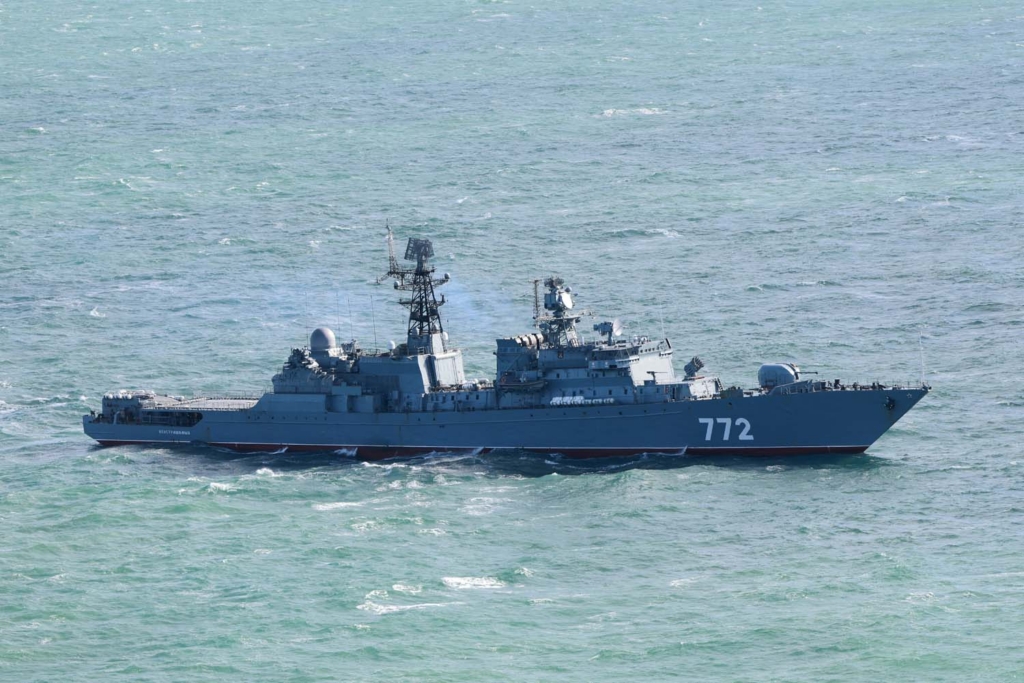
The Russian Navy's Neustrashimy-class guided-missile frigate is shadowed by an 815 NAS-operated Wildcat HMA2 as it transits the English Channel on 10 October 2026. Image: MOD Crown Copyright/Royal Navy
Image: MOD Crown Copyright/Royal Navy

The deployment formed part of Operation Iceblast, which was designed to demonstrate the Merlin Helicopter Force’s ability to operate away from its main operating base at short notice and maintain surveillance in response to operational requirements. The deployment also served to prove the force’s ability to protect the infrastructure surrounding the UK’s nuclear deterrent.

Capt James Hall, the commanding officer of RNAS Culdrose, said: “This operation has been a critical means for demonstrating to ourselves, our adversaries and the nation that we are willing and capable of securing the homeland 24/7.”

Meanwhile, between 1-14 October, HMS Dauntless and HMS Tyne monitored the Russian Navy’s Neustrashimy-class guided-missile frigate, RFN Neustrashimy (772), as the warship escorted sanctioned cargo vessels through the English Channel.

The frigate has reportedly spent much of the past three months providing protection for Russian-linked merchant shipping, with the UK and its allies intensifying their action against ‘shadow fleet’ vessels suspected of helping Moscow to evade sanctions.

The Russian Navy's Ropucha-class landing ship, RFN Aleksandr Shabalin (110), escorts a cargo vessel associated with Russia's sanctioned 'shadow fleet' through the English Channel on 13 October 2026. Image: MOD Crown Copyright/Royal Navy
Image: MOD Crown Copyright/Royal Navy

Commenting on this, Cmdr Neil Skinner, the commander of HMS Dauntless, said: “The Royal Navy’s ability to monitor and respond to activity around the [UK] is fundamental to our role in protecting the nation’s interests at sea…

“HMS Dauntless maintained the close and proficient monitoring of the Russian warship, Neustrashimy, during her operations within the English Channel, providing reassurance to the UK and our allies whilst contributing to a comprehensive understanding of the maritime environment that surrounds us,” he added.

RAF Protector RG1 marks operational debut over UK waters

Between 11-14 October, HMS Tyne was subsequently tasked with monitoring the Russian Navy’s Ropucha-class landing ship, RFN Aleksandr Shabalin (110), which was escorting the Russian-flagged general cargo ship, MV Energy-2, and offshore tug and supply ship, Proton, towards the Baltic Sea.

Operating from North Shields, HMS Tyne was supported by a Wildcat HMA2 multi-mission maritime helicopter from 815 Naval Air Squadron (NAS), which is home-based at RNAS Yeovilton in Somerset, as the Russian vessels passed through the English Channel.
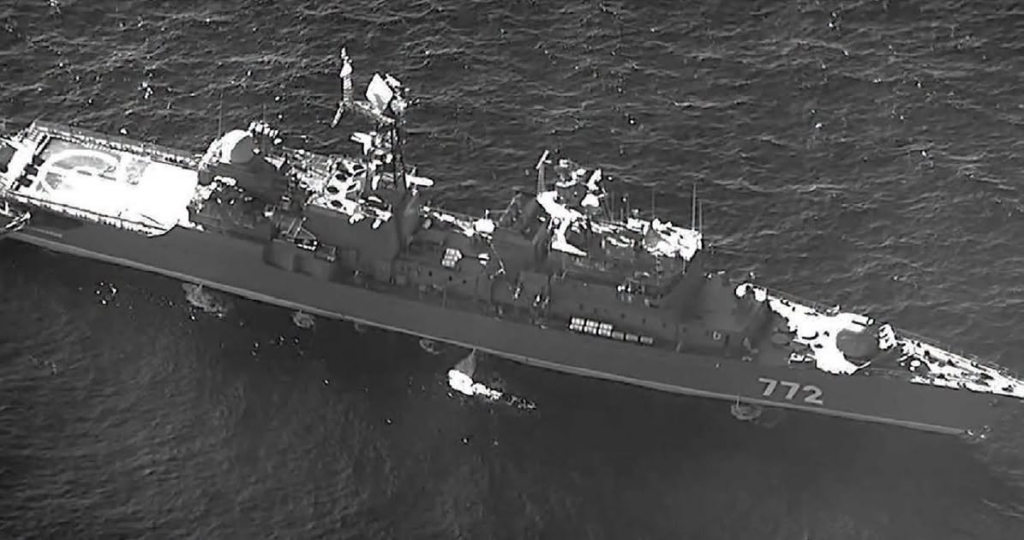
The Russian Navy's Neustrashimy-class guided-missile frigate, RFN Neustrashimy (772), is tracked by an RAF Protector RG1 as it sails through the English Channel. Image: MOD Crown Copyright/Royal Air Force
Image: MOD Crown Copyright/Royal Air Force

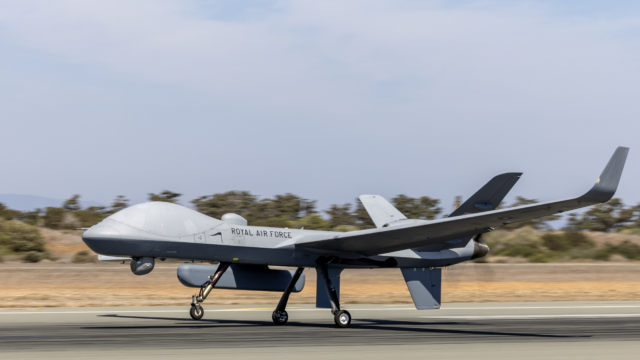
The wider surveillance effort also marked a significant milestone for the RAF, with its fledgling fleet of Protector RG1 MALE UAVs undertaking its first operational sorties in UK airspace.

The aircraft provided more than ten hours of intelligence, surveillance and reconnaissance (ISR) support over the English Channel, working alongside Dauntless and Tyne, as well as the Royal Navy’s deployed Merlin HM2 and Wildcat HMA2 helicopters.

An RAF-operated Protector RG1 lands back at RAF Waddington after completing its first flight in UK skies on 17 November 2023. Image: MOD Crown Copyright/AS1 Amelia Turnbull
Image: MOD Crown Copyright/AS1 Amelia Turnbull

The Royal Navy reported that monitoring activity involving Russian naval movements increased by 25% during the first seven months of 2026 when compared with the same period in 2025.

These operations underline the importance of sustained maritime surveillance and coordination between the Royal Navy and RAF as the UK seeks to closely monitor Russian military movements, protect national interests and strengthen security around its sovereign maritime approaches.

Related

QinetiQ to support Government’s tech talent drive
TechFirst
QinetiQ to support Government’s tech talent drive
By providing work experience opportunities and technology programmes, including cyber security, QinetiQ is supporting the UK Government TechFirst initiative, aimed at delivering practical skills and career support for young people.
MOD seeks industry input on next-generation medical evacuation system
Imagery of the Atlas A400M, seen here operated by crews of LXX & 30 Squadron overseen by an XXIV Squadron instructor, carrying on beach landings over on Pembrey Sands. This was facilitated by Tactical Air Traffic Controllers and Tactical Fire who ensure the beach and activity is completed as intended. Along with conducting touch and go's alongside full stop landings, the aicraft also despatched a pair of RWMIK's driven by 16 Air Assault Brigade as part of an Engine Running Operation or ERO.
MOD seeks industry input on next-generation medical evacuation system
The MOD is looking to modernise the specialist systems used to transport patients with dangerous infectious diseases back to the UK.
Aerospace Defence

2 Nov 2026

Jersey Airport seeks UK counter-drone support after two nights of flight disruption
Control Tower at Jersey Airport
Jersey Airport seeks UK counter-drone support after two nights of flight disruption
Multiple flight diversions and cancellations sparked a police investigation and prompted fresh efforts to strengthen drone detection around Jersey Airport.
Aerospace

2 Nov 2026

NCSC says AI-powered attack on UK critical infrastructure likely by 2028
Futuristic Hand Reaching for AI Technology Interface Representing Artificial Intelligence and Data Management in a Digital World. Glyphic
NCSC says AI-powered attack on UK critical infrastructure likely by 2028
The NCSC warns the UK could face AI-powered cyber attacks on critical national infrastructure by 2028, prompting fresh warnings over national security and defence.
Defence Security

3 Nov 2026

QinetiQ to support Government’s tech talent drive
TechFirst
QinetiQ to support Government’s tech talent drive
By providing work experience opportunities and technology programmes, including cyber security, QinetiQ is supporting the UK Government TechFirst initiative, aimed at delivering practical skills and career support for young people.
RAF Protector reaches 1,000 operational flying hours in Middle East
Protector RG Mk1
RAF Protector reaches 1,000 operational flying hours in Middle East
The MQ-9B-based drone reached the milestone within its first year of service as it takes over operational duties from the RAF's Reaper fleet.
Defence

3 Nov 2026

QinetiQ to support Government’s tech talent drive
TechFirst
QinetiQ to support Government’s tech talent drive
By providing work experience opportunities and technology programmes, including cyber security, QinetiQ is supporting the UK Government TechFirst initiative, aimed at delivering practical skills and career support for young people.
Space cybersecurity starts on the ground: The hidden risks in satellite supply chains
headshot for Benny Czarny Opswat CEO
Space cybersecurity starts on the ground: The hidden risks in satellite supply chains
Compromised suppliers, unchecked files and insecure updates can threaten satellites before they reach orbit. OPSWAT founder and CEO Benny Czarny explains why prevention must start on the ground
Insights Security Space

31 Oct 2026

Plextek receives King’s Award for Enterprise in Innovation
King’s Award for Enterprise in Innovation from His Royal Highness the Duke of Gloucester.
Plextek receives King’s Award for Enterprise in Innovation
HRH The Duke of Gloucester has presented Plextek with the King’s Award for Enterprise in Innovation for its PLX-T60 sensing platform.
NCSC says AI-powered attack on UK critical infrastructure likely by 2028
Futuristic Hand Reaching for AI Technology Interface Representing Artificial Intelligence and Data Management in a Digital World. Glyphic
NCSC says AI-powered attack on UK critical infrastructure likely by 2028
The NCSC warns the UK could face AI-powered cyber attacks on critical national infrastructure by 2028, prompting fresh warnings over national security and defence.
Defence Security

3 Nov 2026

QinetiQ to support Government’s tech talent drive
TechFirst
QinetiQ to support Government’s tech talent drive
By providing work experience opportunities and technology programmes, including cyber security, QinetiQ is supporting the UK Government TechFirst initiative, aimed at delivering practical skills and career support for young people.
National awards highlight innovations transforming policing
Digital & Innovation Awards 2026
National awards highlight innovations transforming policing
A number of innovative projects that are helping to transform policing were recognised at the National Police Chiefs’ Council Innovation and Digital Summit, along with individuals who are inspiring and spearheading technological change.
Events Security

3 Nov 2026