UK tech launches into space aboard NASA’s IMAP mission

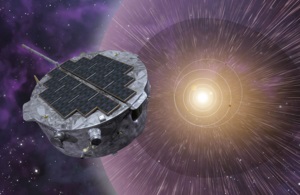
Above: Artist’s impression of IMAP.
Courtesy UKSA / Credit – John Hopkins Applied Physics Laboratory
IMAP will act like a weather station in space, studying the solar wind – streams of charged particles that constantly blow out from the Sun – mapping the shape of the magnetic bubble that surrounds our Solar System.
IMAP successfully lifted off from NASA’s Kennedy Space Center in Florida, on 24 September at 12:30pm BST. The spacecraft will spend around three-four months in transit before reaching its final orbit around the Sun about one million miles from Earth. There it will study how solar wind, and cosmic particles interact with the heliosphere – a vast region that shields our planet and neighbouring worlds from harmful cosmic radiation.
At the heart of the UK’s contribution is the MAG instrument, a highly sensitive magnetometer developed by Imperial College London with £4.2 million funding from the UK Space Agency. MAG will measure the strength and direction of magnetic fields in space, providing crucial data to improve our understanding of space weather.
Space weather can disrupt satellites, GPS signals and power grids on Earth, as well as pose risks to astronauts. IMAP will deliver real-time monitoring of these hazards, strengthening global resilience and supporting safer human exploration of the Moon, Mars and beyond.
Science and Technology Minister Liz Lloyd said: "The UK is proud to play a leading role in this international mission. Our £4.2 million investment in the magnetometer instrument will help protect the technologies we all depend on – from GPS to power grids – while paving the way for safer human exploration of space.
"The Interstellar Mapping and Acceleration Probe mission stands as a great example of how British universities’ expertise can help solve global challenges and secure our technological future.
"The groundbreaking Tech Prosperity Deal between the UK and the USA will build further on the partnership between the UK Space Agency and NASA on science and exploration missions."
Science and collaboration at the core
IMAP is a US-led international mission, coordinated by NASA with contributions from 25 institutions across six countries. The UK’s leadership in developing MAG reflects the nation’s reputation for excellence in space science and instrumentation.
The instrument builds on heritage from Solar Orbiter, another successful European mission carrying UK-led instruments, launched in 2020. NASA selected Imperial College London as its trusted partner to design and deliver MAG for IMAP, underscoring Britain’s world-class expertise in magnetometry.
Professor Timothy Horbury from Imperial College London, Science lead of the IMAP magnetometer, said: "We were delighted to contribute to the IMAP mission, and with UK Space Agency support, we designed, built, and delivered our instrument in just three years, a testament to the expertise of our outstanding engineering team at Imperial.
"Our magnetic field instrument will help us understand how particles are accelerated at shock waves and travel through the solar system.
"I’m especially excited that our data will be made public within minutes of being measured over a million miles away, supporting real-time space weather forecasts. It’s a great example of how scientific measurements can positively impact society."
The mission also reflects the growing UK-US partnership in space science, with NASA and the UK Space Agency agreeing this week to develop AI models to support future exploration missions under the Transatlantic Tech Prosperity Deal.
Mission highlights
In addition to measuring solar wind, IMAP will detect high-energy particles, interstellar dust and atoms drifting in from beyond the stars. Together, these observations will help us see how our Solar System interacts with the wider galaxy.
This knowledge is not just for scientists. Space weather, driven by solar eruptions, can disrupt satellites, knock out GPS and even cause power cuts on Earth. With IMAP’s real-time monitoring, scientists will be able to provide earlier warnings, giving operators more time to protect critical services we rely on every day – from banking transactions to mobile phone networks.
Looking further ahead, IMAP’s findings will be essential for planning safe human missions to the Moon, Mars and beyond. By understanding how radiation and energetic particles move through space, we can better shield astronauts on long journeys, opening the door to the next era of exploration.
Sign up for our newsletter and get our latest content in your inbox.
Similar Reads



Sign up for our newsletter. Select all sectors relevant to you.
Related