

DESI completes 3D map of the Universe

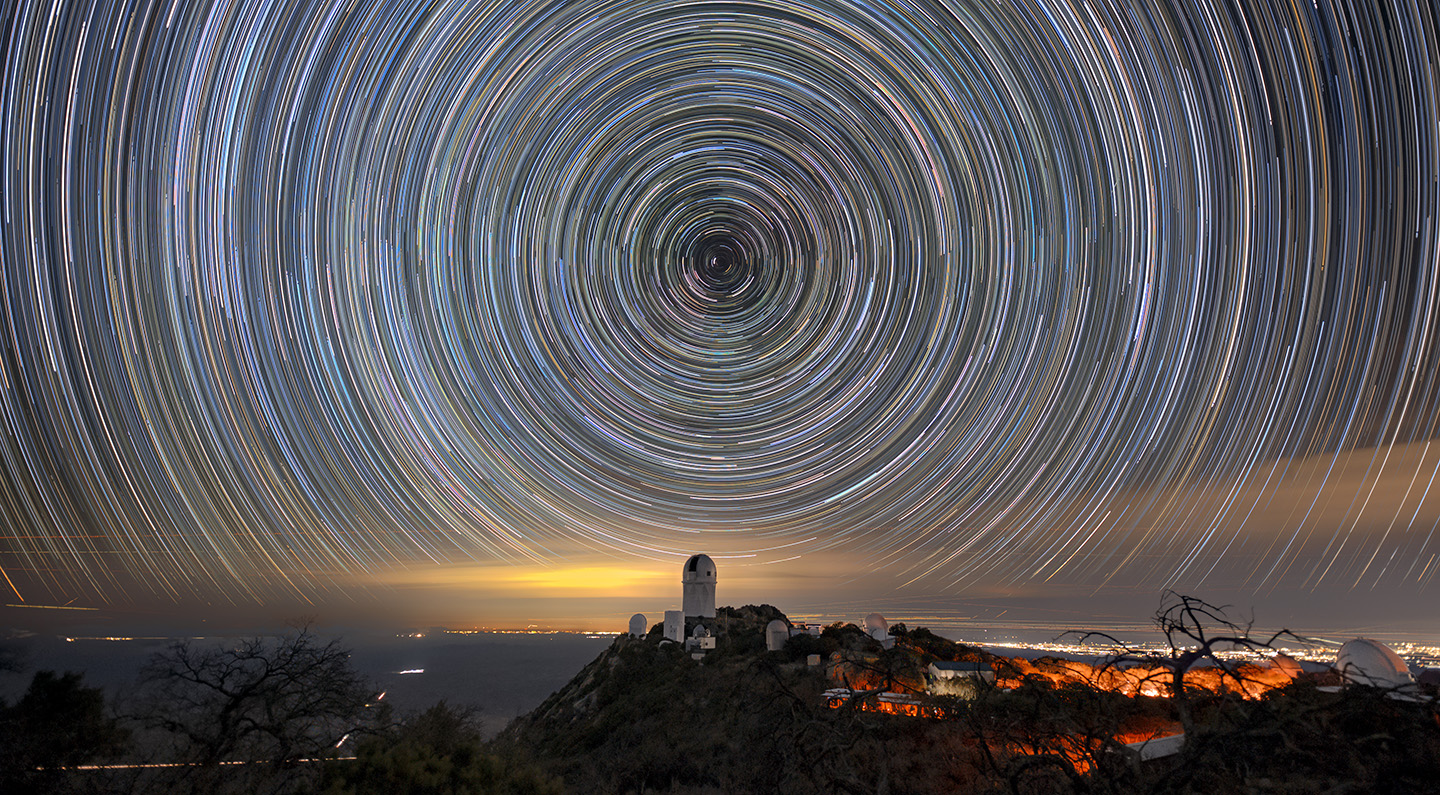
Above: Star trails over the Mayall Telescope that houses DESI.
Credit: Luke Tyas/Berkeley Lab and KPNO/NOIRLab/NSF/AURA
The Dark Energy Spectroscopic Instrument (DESI) has completed mapping over 47 million galaxies and quasars, creating the largest high resolution 3D map of our universe and with clues that dark energy might evolve, DESI will continue observations into 2028, thereby expanding the map further.
The largest 3D map of the Universe is a major milestone in understanding the force driving cosmic expansion. This milestone was reached when DESI’s 5,000 fibre-optic sensors captured their final scheduled observations, targeting a region of sky near the Little Dipper.
The survey was completed ahead of schedule and has delivered significantly more data than originally projected.
Chasing dark energy
Researchers are using the dataset to investigate dark energy, the mysterious force that makes up roughly 70% of the Universe and drives its accelerating expansion.
By comparing how galaxies clustered billions of years ago with their distribution today, the DESI collaboration has traced dark energy’s influence across 11 billion years of cosmic history.
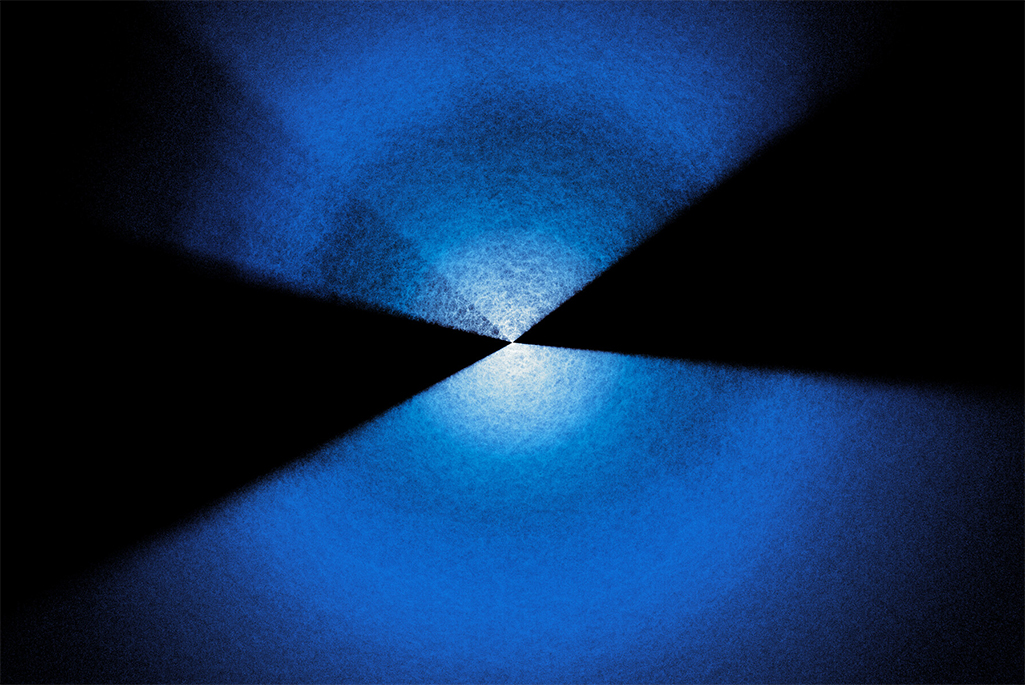
Above: Researchers use DESI’s huge 3D map to study dark energy. Earth is at the centre of this map, and every point is a galaxy.
Credit: DESI collaboration and KPNO, NOIRLab, NSF, AURA, R. Proctor
Early results from the first three years of DESI data hinted that dark energy, long thought to be a ‘cosmological constant’, might be evolving over time.
With the full five-year dataset now complete, researchers now have significantly more data to test whether this suggestion persists.
If confirmed, it would mark a major shift in our understanding of the Universe and its ultimate fate, which hinges on the balance between matter and dark energy.
A paradigm shift
University College London’s Professor Ofer Lahav, who is a member of the DESI Executive Committee and involved in the project for over a decade, said: "This is a very exciting milestone.
"The data-gathering phase has far exceeded expectations.
"DESI observations processed so far suggest the intriguing possibility that the density of dark energy may evolve over time.
"The collaboration will now analyse the full dataset to test this result, as its confirmation would represent a paradigm shift in our understanding of the universe.
"In addition, the spectra of the 47 million galaxies and quasars form a gold mine for studying how galaxies have formed and evolved."
Key UK contributions
DESI’s quest to understand dark energy is a global endeavour, with more than 900 researchers, including 300 PhD students, from over 70 institutions around the world, including the UK.
Mounted at the Kitt Peak National Observatory (NSF NOIRLab) in Arizona, it is managed by the US Department of Energy’s Lawrence Berkeley National Laboratory (Berkeley Lab).
The Science and Technology Facilities Council (STFC) supports the UK component of the study.
Key contributions from the UK team include the following:
- Durham University has played a major role in DESI, with Durham researcher Dr Willem Elbers leading major parts of the analysis. This includes the determination of the mass of neutrinos, elementary particles that make up a small fraction of the Universe’s dark matter.
- UCL has been engaged in DESI from the start. The UCL’s instrumentation team, led by Peter Doel, was involved in the design, construction and testing of DESI’s optical corrector. This consists of six lenses, up to 1.1 metres in diameter, that focus light onto the fibre-optic system, enabling it to be captured for spectroscopic analysis.
- Associate Professor Seshadri Nadathur, University of Portsmouth, co-chaired DESI’s galaxy and quasar clustering working group, leading the effort to extract dark energy measurements from DESI’s map.
Promising discoveries ahead
Professor Carlos Frenk, Professor of Fundamental Physics at Durham University, said: "Only 10 years ago, I would have thought that measuring the rate at which the Universe expands with an accuracy of one percent was just fantasy. Yet DESI has done it.
"The amount and quality of the DESI data, and the analysis carried out by an international team of very talented scientists, are behind this achievement.
"The rewards are huge: the data suggest an unexpected behaviour of dark energy that may upturn the currently accepted view of how our Universe evolves."
A dataset on an unprecedented scale
DESI has now collected cosmological data from six times as many galaxies and quasars as all previous surveys combined.
The collaboration will now begin processing the full dataset, with the first dark energy results from DESI’s full five-year survey expected in 2027.
Meanwhile, scientists continue to analyse the survey’s first three years of data, refining dark energy measurements and producing additional results on the structure and evolution of the Universe.
Several new studies based on these data are expected later this year.
Associate Professor Seshadri Nadathur, University of Portsmouth, said: "It is hard to overstate how important this DESI map of galaxies will be for cosmology.
"The possibility of dark energy evolving with time would be revolutionary on its own, and there are still many other things we can do with the data, including weighing neutrinos, the lightest known fundamental particles.
"We’ve barely scratched the surface so far, and I’m excited to see what else we can learn."
DESI began collecting data in May 2021 and has far surpassed its original goals.
The plan was to capture light from 34 million galaxies and quasars, extremely distant, bright objects powered by supermassive black holes.
However, the instrument instead observed more than 47 million galaxies and quasars, plus 20 million stars.
DESI is now pushing beyond its original mission, expanding its map of the Universe into new and more challenging regions of the sky.
Through 2028, the survey will grow by about 20%, from 14,000 to 17,000 square degrees.
For comparison, the Moon covers just 0.2 square degrees, while the full sky spans more than 41,000.
This expansion will take DESI closer to the Milky Way, where nearby stars can obscure distant galaxies, and further to the south, where observations must peer through more of Earth’s atmosphere.
The survey will also revisit previously mapped areas to observe a new class of galaxies, fainter, more distant ‘luminous red galaxies.’
These additional measurements will create a denser, more detailed map, sharpening our view of how the Universe has evolved over time.
The extended survey is already underway.
By integrating the new observations with the ongoing programme, researchers are making efficient use of telescope time and ensuring continuous data collection.
Dr Michael Levi, DESI director and a scientist at Berkeley Lab, said: "DESI’s five-year survey has been spectacularly successful.
"The instrument performed better than anticipated. The results have been incredibly exciting and the size and scope of the map and how quickly we’ve been able to execute is phenomenal.
"We’re going to celebrate completion of the original survey and then get started on the work of churning through the data, because we’re all curious about what new surprises are waiting for us."
Sign up for our newsletter and get our latest content in your inbox.
Similar Reads


Sign up for our newsletter. Select all sectors relevant to you.
Related