

UK aviation gender pay gap hits 53% as women miss out on highest-paid roles



The gender pay gap among major UK aviation employers has reached 53%, more than four times the national average, according to a new industry report. The findings show women remain underrepresented in senior leadership and the highest-paid aviation jobs.
The Women in Aviation and Aerospace (WiAA) Charter’s 2026 report, From Ambition to Action, was produced with management consultancy Oliver Wyman.
It identifies a persistent divide between women’s participation in aviation and their access to the technical, operational and commercial roles that lead to senior leadership.
It also finds that women are less likely than men to leave their employers, suggesting the greater challenge is career progression rather than retention.
Why the UK aviation gender pay gap has reached 53%
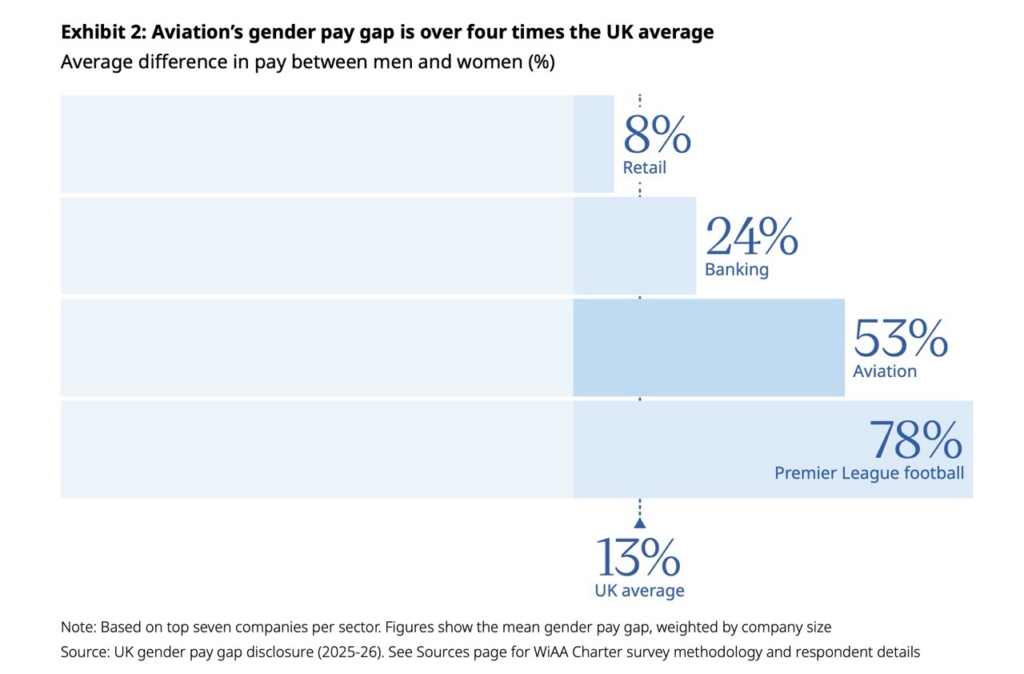
The report’s analysis of UK government gender pay disclosures puts aviation’s mean gender pay gap at 53%, compared with the national average of 13%. The figure is also substantially higher than the 24% gap in banking and 8% in retail.
The findings place aviation second only to Premier League football among the sectors examined.
The gender pay gap measures the difference in average earnings between men and women across an organisation. It does not necessarily indicate that women are paid less than men for equivalent work.
In aviation, the disparity partly reflects women’s concentration in cabin crew, customer-facing and support positions. Men still dominate many higher-paid technical, operational and leadership roles.
The Charter’s survey also found that women account for less than 20% of employees in the highest-paid 10% of roles.
Why women remain underrepresented in aviation leadership
The report identifies a sharp decline in female representation at the highest levels of aviation and aerospace management.
Around 60% of surveyed organisations have at least 25% female representation at senior manager and director level. However, only 25% of organisations reach that threshold at executive and board level. At manager level and below, half of surveyed organisations have at least 25% female representation.
The figures suggest that while employers are making progress in developing women into middle management, fewer are reaching the most senior decision-making positions.
The report identifies unequal access to operational leadership experience, professional sponsorship and influential networks as potential barriers.
These challenges begin earlier in employees’ careers. According to the International Air Transport Association (IATA), women account for just 4.7% of pilots and 3.1% of aircraft maintenance engineers globally.
These occupations provide important pathways into senior management, as well as commercial and financial leadership positions.
Limited female representation in these roles restricts the pool of potential future executives.
Are women leaving the aviation industry?
One of the report’s most revealing findings is employee retention. Average attrition among women in the surveyed organisations was 8%, compared with 11% among men.
Women leaving the industry is not the main cause of their underrepresentation in senior leadership. Instead, the report finds progression into senior roles is a more likely cause.
It also highlights lengthy and expensive qualification pathways, limited flexibility in operational jobs and unequal caring responsibilities as obstacles to career development.
For aviation and aerospace businesses facing growing demand for experienced engineers, operational specialists and managers, these findings are worth considering.
Failing to develop existing female employees into senior positions could limit the industry’s ability to make full use of its available talent.
What are airlines doing to close the leadership gap?
Several airlines featured in the report are introducing programmes to improve women’s access to technical and leadership positions.
At easyJet, the proportion of female candidates accepted into aircraft engineering apprenticeships increased from 20% to 35% for April 2026. The airline also reports that its number of female pilots has tripled to approximately 370.
Meanwhile, just under 70% of participants in its AccelerateHER programme have either progressed or entered succession plans for executive leadership positions.
“In my experience, progress most often breaks down between hiring and senior progression,” said Sophie Dekkers, easyJet’s Chief Commercial Officer.
She added that leadership representation can lag without active sponsorship and visibility.
Virgin Atlantic‘s Chief Operating Officer Suzanne Roddie, who became the airline’s first female COO in 2026, also emphasised the importance of varied career experience.
Roddie began her career in the airline’s people team before moving into airport and network operations leadership.
She said career progression often comes from “building broad operational experience, and stepping into opportunities outside your original specialism.”
Her experience shows how the ability to move between business functions can help employees develop the skills required for executive leadership.
Are aviation employers doing enough to measure progress?
The report also raises concerns about how effectively companies measure their efforts to improve female representation.
More than 70% of surveyed organisations have appointed a senior executive responsible for workforce composition, while 96% offer flexible or hybrid working arrangements.
However, only 25% track talent attraction data, 39% monitor relevant employee survey results and 43% collect exit interview information linked to representation.
Without consistent data, employers may struggle to identify where women encounter barriers to progression or determine which initiatives are effective.
The report also distinguishes between mentoring, which provides advice and guidance, and sponsorship, where senior leaders actively support employees for promotions and important assignments.
It argues that sponsorship is particularly important for advancement into executive positions.
What happens next for women in aviation and aerospace?
The WiAA Charter was established at the Farnborough International Airshow in 2018 with 40 signatories. By July 2026, membership had grown to more than 260 organisations.
The Charter is now developing a partnership with Cranfield University to provide access to executive education and professional development opportunities.
Its recommendations include expanding technical apprenticeships, strengthening sponsorship programmes, improving access to operational leadership and measuring career progression more consistently.
The report is based on anonymous, self-reported survey responses collected from Charter signatories between January and March 2026. Its authors acknowledge that the findings are not representative of the entire aviation and aerospace industry.
Nevertheless, the results highlight a significant challenge for employers.
“No one organisation will crack it alone. Our shared mission has to be mobilising change across organisations, industries, and sectors,” Katherine Bennett CBE, Chief Executive Officer, High Value, Manufacturing Catapult; Non-Executive Director, Women in Aviation and Aerospace Charter said in the report.
“Representation is improving—but not in the areas where it matters most. The focus must now shift: from participation to progression, and from overall representation to representation in key parts of the organisations,” said Sumati Sharma, Partner at Oliver Wyman, Women in Aviation and Aerospace Charter Founder and Co-Chair, in the Foreword of the report. “Delivering this will require continued collaboration across the sector.”
Increasing the number of women entering aviation is an important first step. Ensuring they can advance into the industry’s highest-paid and most influential positions will be essential to closing the leadership and earnings gaps.
“This report is both a reflection of progress and a call to action to build an industry where every woman and girl can see a future that is shaped only by their talent and ambition,” Sharma concluded.
Sign up for our newsletter and get our latest content in your inbox.
Similar Reads




Sign up for our newsletter. Select all sectors relevant to you.
Related