
General Atomics

British Army trials tactical drone warfare skills in first “Drone Wars” competition

Held at Sandhurst, the competition showcased how drones are being integrated into reconnaissance, targeting and support roles as the Army adapts to emerging battlefield technologies.

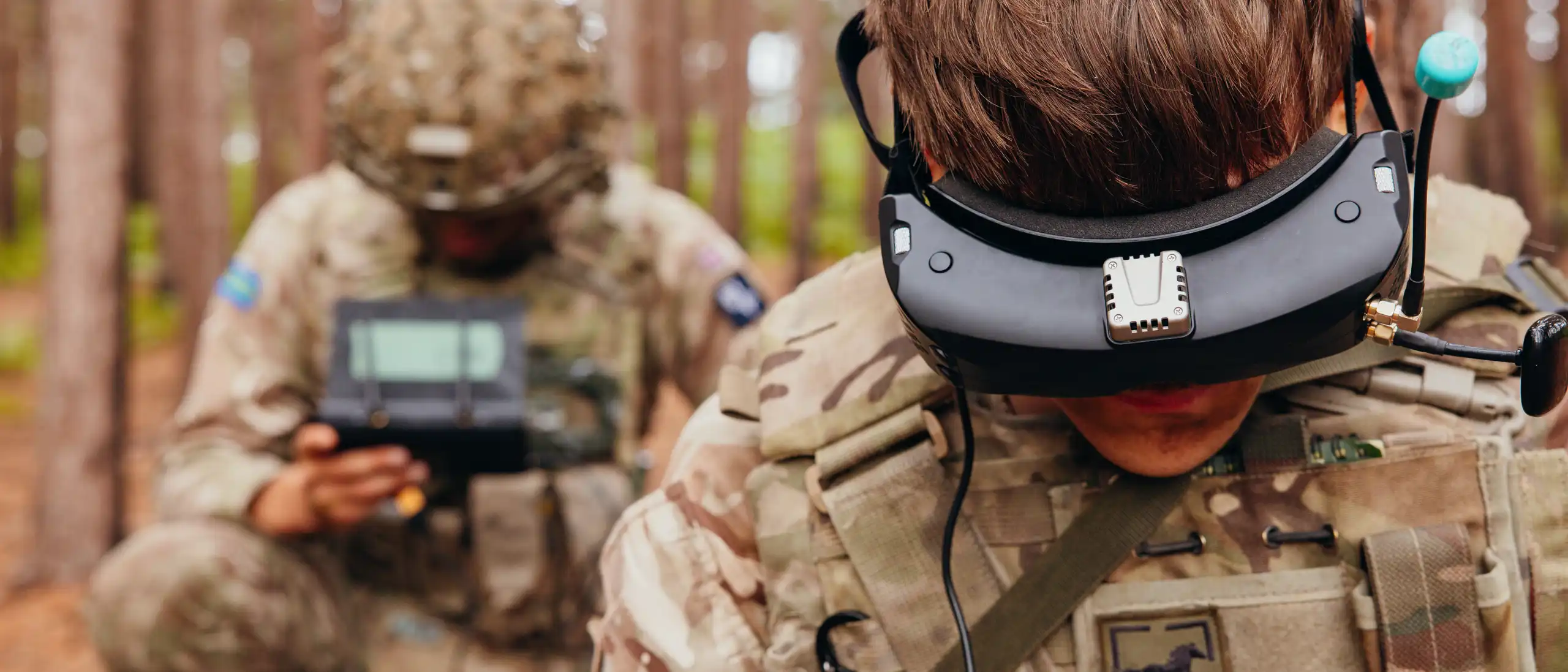
Tpr Harvey Chilman, Queen's Royal Hussars, flew his FPV drone to strike an enemy position during 'Drone Wars' competition. Image: MOD Crown Copyright/British Army
Image: MOD Crown Copyright/British Army

The British Army has completed its inaugural “Drone Wars” competition, bringing together 23 teams at the Royal Military Academy Sandhurst to test how effectively soldiers can employ drones as part of wider battlefield operations.

Held in September, the competition was designed to assess the tactical use of uncrewed systems rather than simply flying proficiency, reflecting the British Army’s growing emphasis on integrating drones across its battle formations.

The event provided an opportunity for personnel from different parts of the British Army to demonstrate how rapidly evolving drone technology can be incorporated into established military tactics, techniques and procedures (TTPs).
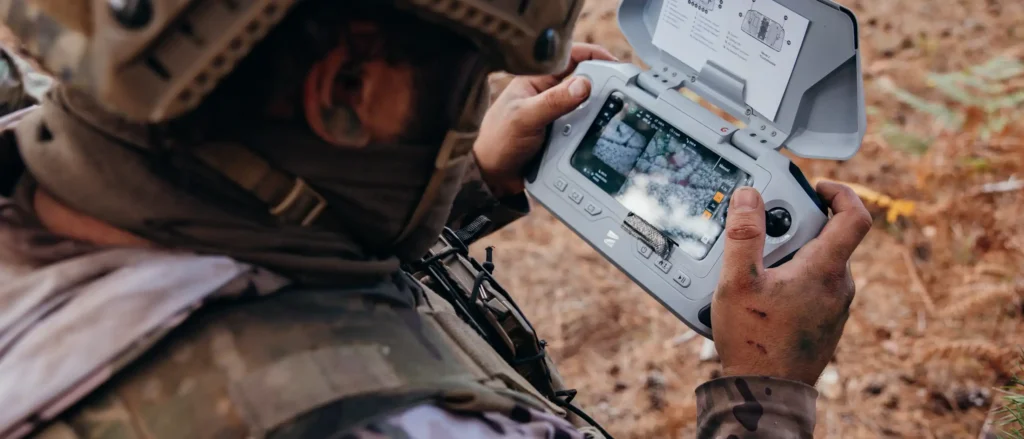
Soldier from Ranger Regiment flies an FPV drone during the 'Drone Wars' competition. Image: MOD Crown Copyright/British Army
Image: MOD Crown Copyright/British Army

Competitors were required to combine drone operation with decision-making, reconnaissance, targeting and communication skills, mirroring the increasingly complex role of uncrewed systems on contemporary battlefields.

Teams of four soldiers from units ranging from Royal Armoured Corps (RAC) formations to Royal Engineers (RE) and Royal Logistic Corps (RLC) regiments followed a patrol route that incorporated six tasks. Throughout these challenges, competitors were judged on speed and accuracy while operating different types of drones.

Army tests uncrewed systems in six missions under battlefield conditions

These six challenges were designed to replicate a range of battlefield missions, including intelligence-gathering, targeting, strike and casualty evacuation (CASEVAC) taskings.

Soldiers were required to use a First-Person View (FPV) drone to strike a moving vehicle, fly another FPV system into a bunker and interpret video from a drone being flown by another operator before directing a kinetic strike against an identified target.

Other tasks involved locating friendly troops and delivering medical supplies via drone, conducting aerial reconnaissance ahead of an infantry assault, and locating an enemy position before calling in an artillery strike.
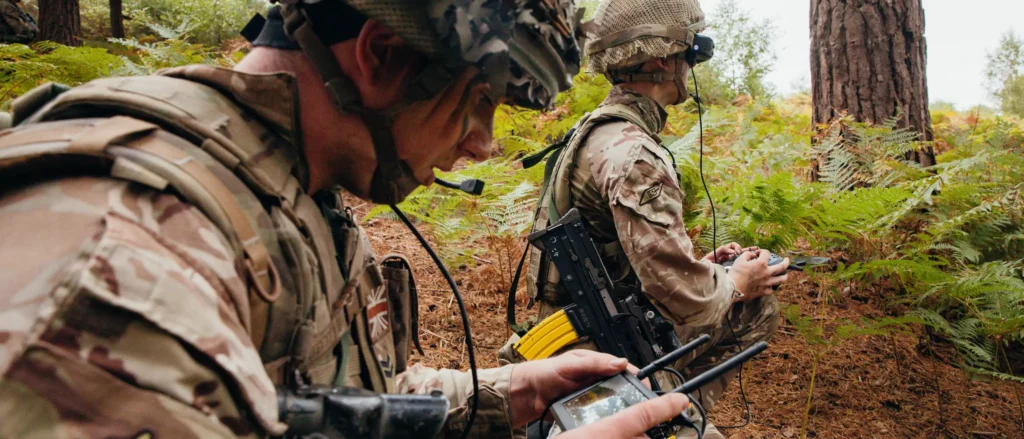
A Royal Tank Regiment commander views live feed as an FPV drone pilot flew over an enemy target during 'Drone Wars' competition. Image: MOD Crown Copyright/British Army
Image: MOD Crown Copyright/British Army

The organiser of the inaugural ‘Drone Wars’ event, Maj Callum Jones of the 1st Battalion, The Royal Gurkha Rifles (1 RGR), said the British Army was “embracing drone technology as a key element of modern soldiering.” He added that the participation of troops from the RE and RLC demonstrated “how broad the adoption of drones is” across the Army.

“Drones are no longer a specialist field, and every soldier needs to be aware of how to use drones and how to defend against drones used by the enemy,” Jones explained. “What we are testing is how soldiers use drones tactically, not how well they can fly them. As well as striking targets, soldiers are using drones to gather information to inform other actions, such as calling in artillery or launching an infantry attack.”

A team drawn from the 2nd and 4th Battalions of the British Army’s special operations-capable Ranger Regiment ultimately won the inaugural competition.

British Army “hunter-killer” teams put drone-enabled warfare into practice

The competition also demonstrated how drones can be integrated with the Army’s existing capabilities. Tpr Darel Anderson of the Household Cavalry Regiment and Tpr Harvey Chilman of the Queen’s Royal Hussars operated together as a “hunter-killer” team, with Anderson using an artificial intelligence (AI)-powered Skydio autonomous drone to identify targets while Chilman operated an FPV drone to conduct strikes.

Anderson said his unit had been working to understand how best to exploit the technology. “I’ve been flying drones for two years and we’re working hard as a unit to understand how best to use them,” he said. “Drones help us see more of the battlefield, so we can strike the enemy before they get close enough to target us.

“You need good observation skills to interpret what the drone is seeing, and then to clearly communicate that information to other soldiers. These are basic soldiering skills that we’re using in a different way with new technology,” he added.
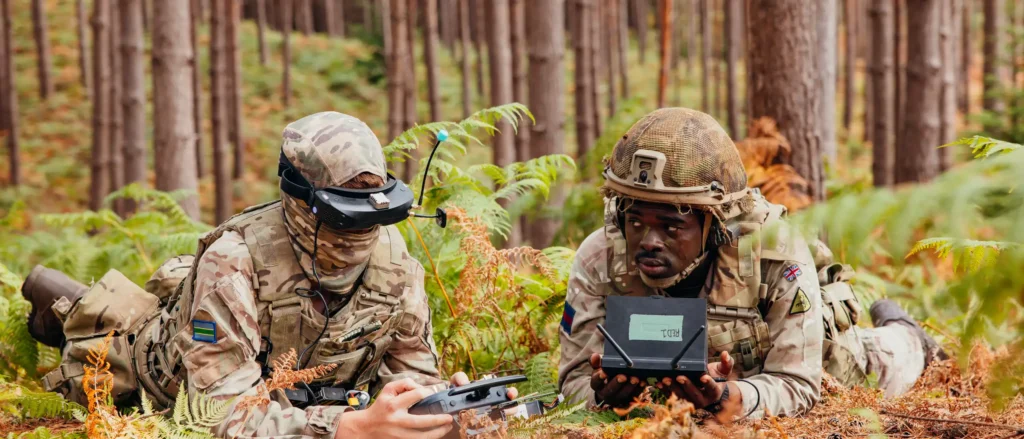
Tpr Harvey Chilman (left) and Tpr Darel Anderson (right) fly a FPV drone during the 'Drone Wars' competition. Image: MOD Crown Copyright/British Army
Image: MOD Crown Copyright/British Army

Chilman, who crews a FV4034 Challenger 2 main battle tank, said drones were being integrated into the Army’s armoured operations. “We’re integrating drones into how we operate under armour,” he said; adding that he had accumulated more than 170 flying hours as an FPV drone pilot.

“For me, there’s a similarity between flying drone missions and tank gunnery – both are about getting into the right position to line up on the target and hit it,” Chilman explained.

Alongside the tactical ‘Drone Wars’ competition, troops also took part in the Military International Drone Racing Tournament (MIDRT), bringing military teams from around the world to Sandhurst. The Australian Defence Force’s (ADF’s) Drone Racing Team won their eighth consecutive overall victory at the latest edition of the tournament, which was held from 14-18 September.

Ultimately, the inaugural ‘Drone Wars’ competition underlines the Army’s wider effort to make uncrewed and autonomous systems an integral part of battlefield reconnaissance, targeting and strike operations, while ensuring personnel across the force are able to exploit the technology and counter its use by adversaries.

Related

Ontic opens dedicated MRO facility in Tewkesbury
As part of its Maintenance, Repair and Overhaul (MRO) expansion plans, Ontic has opened a new 72,000sq ft facility in Tewkesbury, Gloucestershire.
Aerospace Member News

6 Oct 2026

McLaughlin & Harvey breaks ground on Rolls-Royce Derby facility
Integral to Rolls-Royce's £140 million investment at its Derby site, the new facility will support future growth of the UK’s advanced manufacturing sector and strengthen its aerospace and sovereign defence capability.
Manchester Airport opens new hi-tech sensory zone for autistic and neurodivergent passengers
Manchester Airport hi-tech sensory zone in T2
Manchester Airport opens new hi-tech sensory zone for autistic and neurodivergent passengers
The new Sunflower Room provides sensory and quiet spaces designed to support autistic and other neurodivergent passengers, as well as people with non-visible disabilities and additional assistance needs.
Aerospace

5 Oct 2026

Tories pledge £10bn for “Britannia Shield” missile and drone defence system
Live firing tests of precision missile
Tories pledge £10bn for “Britannia Shield” missile and drone defence system
Growing concern over drone and missile threats has intensified the debate around UK air defence, with "Britannia Shield" intended to strengthen protection for critical national infrastructure and military sites.
Defence

6 Oct 2026

Prime Minister considers delaying decision on UK defence spending, according to reports
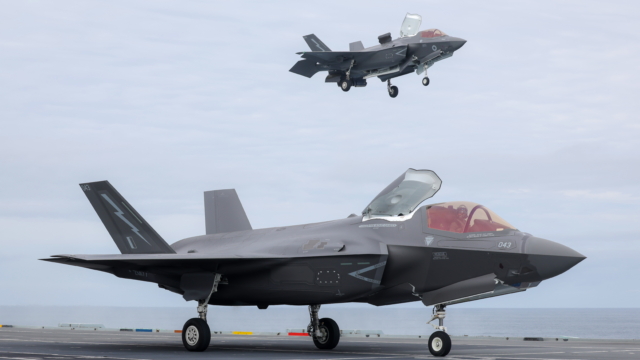
British F-35Bs land back on HMS Prince of Wales (R09) after completing a mission during Exercise Neptune Strike 26-3 on 19 July 2026. Image: MOD Crown Copyright/PO Phot Chris Sellars
Prime Minister considers delaying decision on UK defence spending, according to reports
A potential delay to the UK’s defence spending roadmap raises fresh questions over procurement, industrial investment and the UK government’s long-term funding commitments.
Defence

6 Oct 2026

GA-ASI demos disaster relief comms system
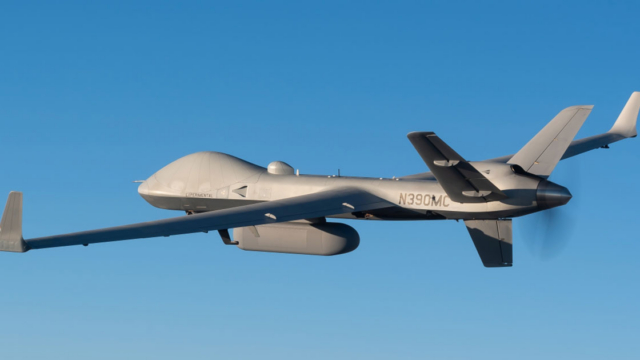
An MQ-9B
GA-ASI demos disaster relief comms system
Working with SoftBank Corp., General Atomics Aeronautical Systems, Inc. (GA-ASI) has demonstrated the successful integration of a new communications payload into its unmanned MQ-9B platform, designed for situations where cellular services are unavailable.
Excelerate Technology to build UK CNI robotic security solution
Satellite in Earth orbit
Excelerate Technology to build UK CNI robotic security solution
In a project co-funded by the European Space Agency Business Applications and Space Solutions (ESA BASS) and supported by the UK Space Agency, Excelerate Technology will build and demonstrate how space-enabled assets can provide innovative safety and security solutions, including protection of Critical National Infrastructure (CNI) at a site in the UK.
World Space Week: How British technology will help ESA return to the Moon
ESA Argonaut
World Space Week: How British technology will help ESA return to the Moon
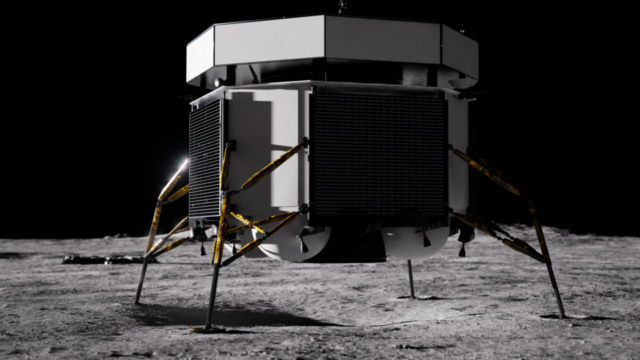
As Europe prepares to return to the Moon, British-developed LEIA LiDAR technology will help ESA's Argonaut lander autonomously identify safe touchdown zones on the lunar surface.
Space

5 Oct 2026

Airbus delivers first next-generation satellites for OneWeb constellation
OneWeb satellites in transport container at Airbus
Airbus delivers first next-generation satellites for OneWeb constellation
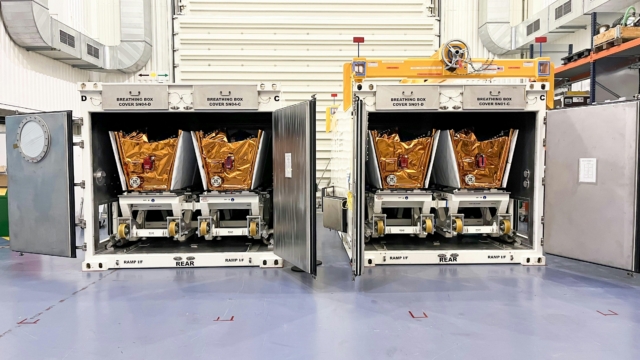
A new generation of OneWeb spacecraft is heading for launch, helping Eutelsat sustain and expand its low Earth orbit connectivity network for governments, businesses and institutions worldwide.
Member News Space

5 Oct 2026

Excelerate Technology to build UK CNI robotic security solution
Satellite in Earth orbit
Excelerate Technology to build UK CNI robotic security solution
In a project co-funded by the European Space Agency Business Applications and Space Solutions (ESA BASS) and supported by the UK Space Agency, Excelerate Technology will build and demonstrate how space-enabled assets can provide innovative safety and security solutions, including protection of Critical National Infrastructure (CNI) at a site in the UK.
GA-ASI demos disaster relief comms system
An MQ-9B
GA-ASI demos disaster relief comms system
Working with SoftBank Corp., General Atomics Aeronautical Systems, Inc. (GA-ASI) has demonstrated the successful integration of a new communications payload into its unmanned MQ-9B platform, designed for situations where cellular services are unavailable.
Leonardo DRS sets up UK subsidiary and launches tactical radar production
Tactical Expeditionary Radars
Leonardo DRS sets up UK subsidiary and launches tactical radar production
Leonardo DRS has established DRS UK and launched local production of tactical radars for counter-UAS, air defence and force protection.
Defence Security

6 Oct 2026