

UK-France MicroCarb satellite set to transform climate monitoring

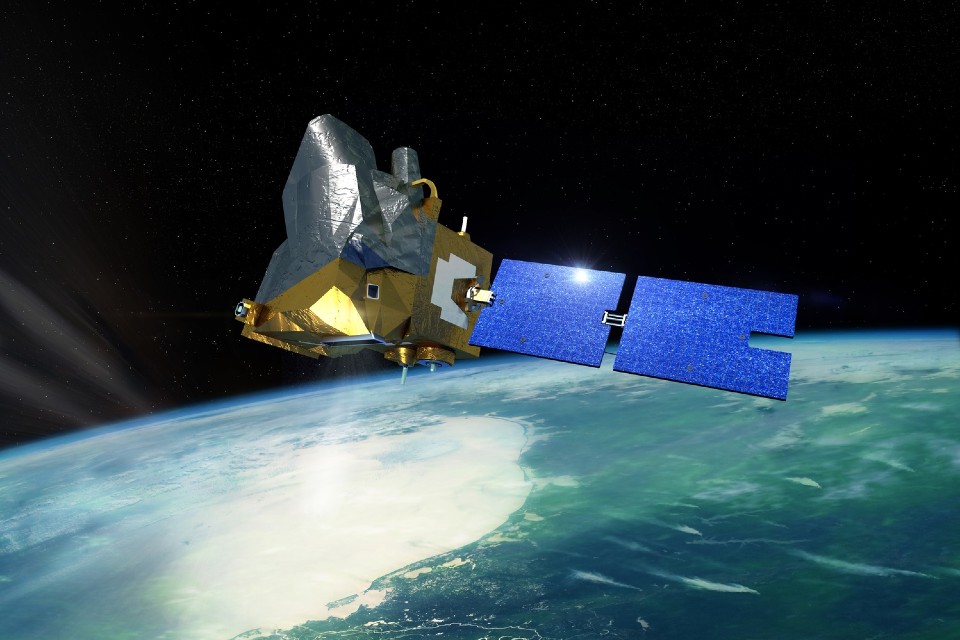
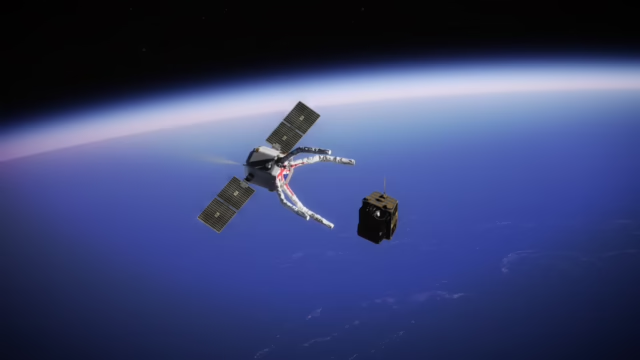
Above: Artist’s impression of MicroCarb in orbit.
© CNES/ill./SATTLER Oliver, 2021
The MicroCarb mission, developed in partnership with France’s space agency CNES, will become Europe’s first dedicated carbon dioxide monitoring satellite, marking a major milestone in the global fight against climate change.
Successfully launched aboard a Vega-C rocket from Kourou, French Guiana this morning, MicroCarb will join the international greenhouse gas (GHG) virtual constellation of satellites, significantly enhancing global climate monitoring capabilities.
Backed by a £15 million investment from the UK Space Agency, the mission strengthens Britain’s position as a global leader in both climate science and space technology. MicroCarb will orbit 650km above Earth, using revolutionary city-scanning technology to map CO₂ emissions across urban areas at an unprecedented 2km x 2km resolution – a level of detail never before achieved from space. This capability is vital for understanding emissions from cities, which are responsible for over 70% of global CO₂ output.
UK Minister for Space, Sir Chris Bryant, said: "This groundbreaking mission is proof of what can be achieved when we harness the strength of Britain’s burgeoning space industry, together with our deep scientific expertise. Bolstered with £15 million UK Government backing, the MicroCarb satellite will overhaul our ability to track carbon emissions – supporting the clean energy mission that’s key to this Government’s Plan for Change.
"It’s also further evidence of the value of our deep and unique relationship with France: a partnership which the Prime Minister reinforced, with President Macron, at the UK-France Summit earlier this month."
The satellite’s precise measurements will help verify climate targets and guide net zero strategies, providing governments with the data needed to track progress toward the Paris Agreement and develop effective carbon reduction policies.
Dr Paul Bate, Chief Executive of the UK Space Agency, said: "Satellites like MicroCarb are our eyes in the sky. Over half of the critical data we use to understand climate change comes from space, and MicroCarb’s successful launch is a major leap forward in our ability to track carbon emissions and absorption with unprecedented accuracy, from the world’s cities to its forests and oceans.
"Backed by UK and French investment and expertise, it’s a proud moment for both our space sectors and a powerful example of international collaboration in action."
In addition to urban emissions, MicroCarb will monitor natural carbon sinks such as forests and oceans, enhancing scientific understanding of how much carbon is absorbed by the planet and where. This data will be essential for improving national carbon inventories and identifying new opportunities for carbon capture and storage (CCS).
MicroCarb will measure Solar Induced Fluorescence (SIF), a faint glow plants give off during photosynthesis. This helps scientists track how much carbon plants absorb, offering valuable insights into the carbon cycle and supporting direct measurements of CO₂ in the atmosphere by helping to differentiate plant from anthropogenic CO₂ emissions.
UK scientists and industry have played a central role in the development and delivery of the MicroCarb mission. The National Physical Laboratory (NPL) provided the SI-traceable ground calibration facility to test the satellite’s performance before launch. NPL’s Paul Green is also working with the MicroCarb team to develop algorithms and quality metrics to ensure the accuracy of the data.
Thales Alenia Space in the UK were responsible for preparing Microcarb for launch and completed the satellite’s assembly, integration, and test activities at the Science and Technology Facilities Council’s RAL Space in Harwell. RAL Space also developed the pointing and calibration system that enables MicroCarb to take precise measurements at specific locations.
GMV UK, in collaboration with France’s Capgemini, is designing, implementing, and quality-assuring algorithms and operational processors for several of MicroCarb’s CO₂ data products, ensuring robust and reliable data delivery.
Professor Paul Palmer, from The National Centre for Earth Observation (NCEO) and the University of Edinburgh, is the UK lead for MicroCarb. He will translate the satellite’s CO₂ observations into detailed maps showing carbon absorption and emissions. Dr Rob Parker, also part of the NCEO team, is delivering the mission’s SIF retrieval algorithm, drawing on expertise from the University of Leicester.
Paul Palmer, UK lead for Microcarb said: "Currently, we are witnessing rapid and unprecedented changes in the global carbon cycle. MicroCarb will deliver SIF and atmospheric CO₂ data that are crucial for understanding those changes. It will also reinvigorate an aging virtual satellite constellation, providing high quality data to inform the next Global Stocktake of the Paris Agreement.
"More broadly, MicroCarb exemplifies the world-class capabilities of UK science and engineering, working closely with our French colleagues."
UK scientists have worked closely with their French counterparts as key members of the Mission Advisory Group (MAG), playing a vital role in preparing for the mission and continuing their involvement during the Calibration-Validation phases after launch.
MicroCarb is part of a bilateral agreement signed in 2014 and renewed in 2021, between France and the UK, showcasing a strong collaboration in space programmes.
The UK and France recently deepened their strategic partnership across space and security technologies, including with specific announcements in satellite communications and PNT.
As the world races to limit global warming to 1.5°C, MicroCarb represents a critical step forward in delivering the transparent, verifiable data needed to hold nations accountable and accelerate the transition to a low-carbon future. The first MicroCarb data products are expected to be released in roughly a year, offering insights into major urban emitters and the performance of natural carbon sinks. These findings will feed into international climate assessments and future satellite missions under the UK’s Earth observation roadmap.
Sign up for our newsletter and get our latest content in your inbox.
Similar Reads


Sign up for our newsletter. Select all sectors relevant to you.
Related