

MDA Space to provide lunar landing sensors for ESA’s Argonaut mission

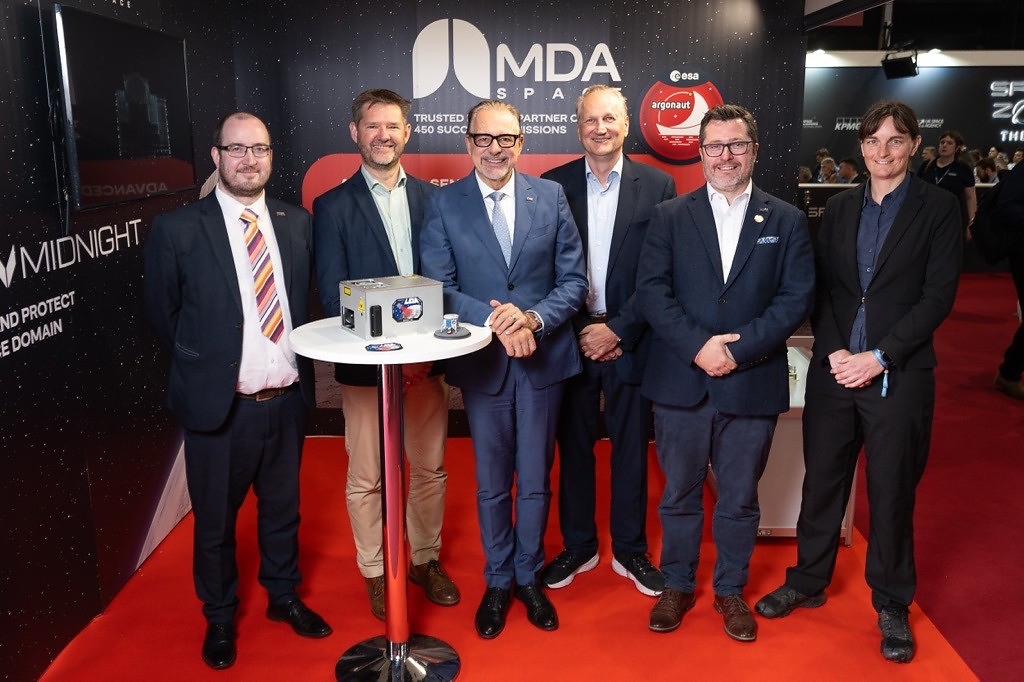
MDA Space UK has received a Pre-Authorisation to Proceed (PATP) contract from OHB System AG (OHB) to deliver critical lunar landing sensors for the European Space Agency’s (ESA) Argonaut spacecraft.
The PATP contract allows MDA Space to immediately begin engineering activities and procure long-lead items from its UK base of operations with support from the UK Space Agency, ahead of the anticipated full contract. Under the full contract with OHB, subject to execution of a definitive agreement, MDA Space is expected to supply two flight units of its LEIA Light Detection and Ranging (LiDAR) sensor for Argonaut’s inaugural mission to the Moon.
Collaborative lunar landing
The Argonaut programme, led by ESA, represents Europe’s first independent lunar landing capability. This flagship mission will transport cargo and scientific instruments to the Moon in support of a sustained lunar presence, in coordination with NASA’s Artemis programme.
The Lunar Descent Element is being developed under the prime contractorship of Thales Alenia Space, a joint venture between Thales (67%) and Leonardo (33%), together with a core industrial team that includes OHB System AG. OHB is responsible for delivering three critical subsystems for the success of the mission: Guidance, Navigation and Control (GNC); Telemetry, Tracking and Command (TT&C) and Electrical Power Subsystem (EPS).
Andrew Stanniland, Managing Director, MDA Space UK, said: “This partnership with OHB underscores our expertise in autonomous landing technologies and demonstrates the strength and innovation of the UK space sector.
“By providing LEIA, our advanced 3D sensor technology, MDA Space will contribute directly to enabling Europe’s independent access and sustained presence on the Moon for the first time.”
Precise real-time mapping
Developed in the UK with support from the UK Space Agency, LEIA will be a central component of the spacecraft’s Hazard Detection and Avoidance (HDA) system. The MDA Space sensor will enable Argonaut to identify and navigate surface hazards such as craters, boulders and rough terrain during descent to the lunar surface. LEIA’s 3D scanning LiDAR generates real-time terrain maps, allowing the spacecraft to autonomously select a safe landing site.
Unlike camera-based systems, LEIA provides fast and precise mapping regardless of lighting conditions, enhancing landing safety and mission assurance. The sensor’s adaptive scan pattern is able to compensate for lander motion, covering a 40-degree field of view in five seconds, with a compact, low-mass design that is designed to offer differentiation relative to comparable space LiDAR systems.
Liz Lloyd, UK Space Minister, said: “The selection of MDA Space for the Argonaut mission is a testament to Britain’s growing leadership in lunar technology and exploration. This milestone shows the UK has the expertise to underpin Europe’s lunar ambitions – from precision landing sensors developed in Didcot to descent engines tested in Buckinghamshire. We’re proud to back MDA Space to unlock new opportunities for the future for science and ultimately our economy.”
MDA Space lunar landing sensors, including LEIA and FLARE, the Full Wave Laser Range Finder, have been chosen for multiple commercial lunar missions.
Sign up for our newsletter and get our latest content in your inbox.
Similar Reads





Sign up for our newsletter. Select all sectors relevant to you.
Related