
General Atomics

Wargaming prompts changes to Royal Navy’s future minehunting motherships

How the Royal Navy is wargaming the Norwegian-designed OSVs and how the games suggest they will need some adjustments for British requirements.

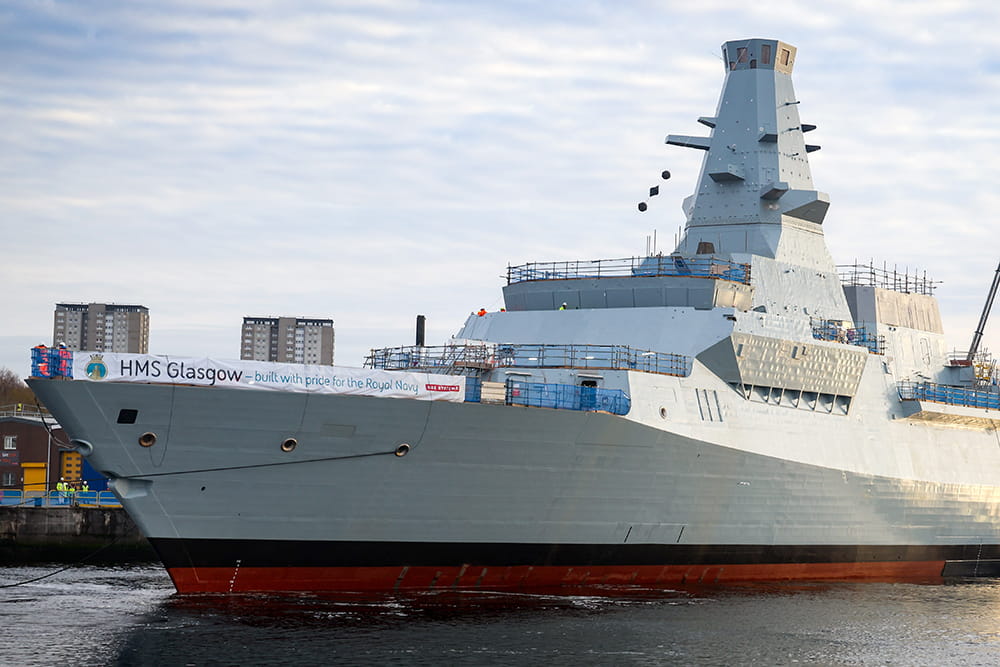
Type 26 Anti submarine Frigate
Photo: Royal Navy

British Government published a statement providing an update on the planned up to three new Offshore Support Vessels (OSVs), being developed in cooperation with Norway. These are to be motherships for the Royal Navy’s future autonomous mine-hunting systems.

In that statement, the UK government writes that it worked with Dstl to “design and implement realistic mine countermeasure scenarios and inputs, enabling Royal Navy subject matter experts to rigorously test operational concepts under realistic conditions.”

The proposed OSV concept was tested in a two-day table-top exercise, and it produced some needed changes. Wargaming on proverbial tables has been an important way for militaries to plan and structure their forces and de-risk for over 100 years.

The statement stresses that mine-hunting is particularly important for the UK as the country depends on secure maritime access for economic security and NATO obligations.

These vessels are being designed to tackle tomorrow’s threats: “As mines grow more sophisticated, autonomous systems and advanced modelling are vital to stay ahead.” The wargaming saw the use of 3D-printed models combined with traditional methods. In images released, the models appear similar to Lego models.
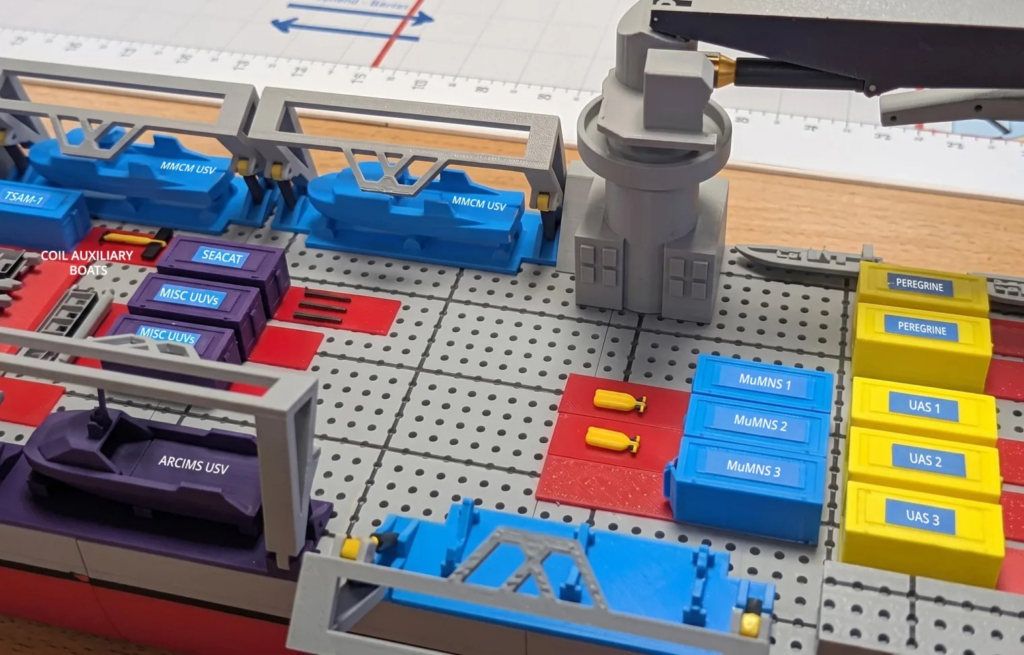
Model of Offshore Support Vessels (OSVs)
Photo: UK Government

New renders of Offshore Support Vessels

A new piece by Navy Outlook published yesterday helps to construct an image of what the future Royal Navy will look like, apparently leveraging the government’s 4 August statement.

These new OSVs look more similar to large commercial offshore vessels than more familiar conventional naval vessels, including auxiliary vessels. Officials have previously said the Royal Navy plans for three minimally modified commercial design OSV motherships to transport at least three USVs, UUVs and associated command-and-control equipment.

The concept represents a shift away from the Hunt and Sandown-class minehunters. HMS Stirling Castle and RFA Proteus provide useful points of comparison for the new mothership concept. The remaining conventional MCM vessels are due to disappear by 2032.

Navy Outlook noted that while earlier Royal Navy development work indicated a need for at least 1,000 square metres (up from 600 square metres on the HMS Stirling Castle), the Navy’s preference has evolved. Now it appears to be something closer to a “floating workshop, transport and command platform with considerable spare volume and deck area.”

Partnering with Norway in the Atlantic

The Defence Investment Plan allocates £1.3 billion to the Autonomous Mine Hunting Capability (MHC) Block 2 program for the period spanning 2026 to 2030. In addition, the plan has £90 million for offshore support vessel cooperation with Norway.

The OSVs are closely tied to Norway, along with wider naval cooperation. Britain formally joined Norway’s programme to develop OSVs for autonomous mine hunting in the 2025 Lunna House Agreement.

The major headline part of that agreement was for the Royal Norwegian Navy to operate at least five British-built Type 26 frigates and operate them as an integrated fleet with the Royal Navy’s planned eight Type 26 frigates. But the agreement also includes cooperation on the Naval Strike Missile, torpedoes, autonomous systems, and joint operations in the shared North Atlantic.

The purchase of the Norwegian-designed OSVs is seen as part of the wider strategic offset programmes and cooperation associated with Norway’s decision to purchase the frigates. It also leverages Norway’s strengths in offshore vessel design.

However, an interesting detail is that the two-day tabletop exercise produces changes needed for the Royal Navy. It remains unclear how much redesign these ships will need for British service.

Related

Airbus A350F takes flight for first time in major freighter milestone
A350F takes off on first flight
Airbus A350F takes flight for first time in major freighter milestone
Airbus’ new A350F has taken to the skies for the first time, beginning a 400-hour flight-test campaign for its next-generation large freighter.
Aerospace

29 Sep 2026

UK-Canada seabed to space programme adds The Structural Battery Company
The SB Co. Heavy-lift drone demo
UK-Canada seabed to space programme adds The Structural Battery Company
Innovate UK has brought The Structural Battery Company onboard its UK-Canada seabed to space programme.
Windracers ULTRA safely transports anti-doping blood sample in Alaska
Windracers ULTRA
Windracers ULTRA safely transports anti-doping blood sample in Alaska
Conducting its first BVLOS Windracers ULTRA flight in North America, flying an anti-doping blood test sample for several hours over 1,000km in Alaska, Windracers has shown autonomous flights are a reliable option for safely transporting time sensitive cargo in difficult conditions.
UK records largest share of European defence manufacturing investment since 2024
Former Defence Secretary John Healey MP is given a tour of the UK's Storm Shadow production line at MBDA's facility in Stevenage on 31 May 2025. Image: MOD Crown Copyright/Rosie Hallam
UK records largest share of European defence manufacturing investment since 2024
From munitions plants to drone production lines, the UK has attracted more defence manufacturing projects than any other European nation since 2024, according to new research.
Defence

29 Sep 2026

UK-Canada seabed to space programme adds The Structural Battery Company
The SB Co. Heavy-lift drone demo
UK-Canada seabed to space programme adds The Structural Battery Company
Innovate UK has brought The Structural Battery Company onboard its UK-Canada seabed to space programme.
Shield AI and Kraken demonstrate autonomous USV teaming in Portsmouth
Shield AI and Kraken Technology Group demonstrate Hivemind
Shield AI and Kraken demonstrate autonomous USV teaming in Portsmouth
Shield AI is trialling its Hivemind mission software, using teaming and swarming technology originally developed for autonomous aircraft in maritime roles.
Defence

29 Sep 2026

UK-Canada seabed to space programme adds The Structural Battery Company
The SB Co. Heavy-lift drone demo
UK-Canada seabed to space programme adds The Structural Battery Company
Innovate UK has brought The Structural Battery Company onboard its UK-Canada seabed to space programme.
KBR prepares to launch Trinzic as independent mission technology business
KBR's headquarters in Houston
KBR prepares to launch Trinzic as independent mission technology business
The planned January 2027 separation will create a publicly traded company focused on national security and space.
Member News Security Space

28 Sep 2026

NSSLGlobal Group acquires MetOcean Telematics (UK) Ltd
NSSLGlobal
NSSLGlobal Group acquires MetOcean Telematics (UK) Ltd
Through this acquisition, NSSLGlobal has expanded its communications and security capabilities with asset tracking by satellite, cellular and radio for blue light, border force and security services.
ACUA Ocean and Forssea Robotics integrate ARGOS ROV with USV Pioneer
USV-ROV deployment
ACUA Ocean and Forssea Robotics integrate ARGOS ROV with USV Pioneer
The culmination of three weeks of operations in Plymouth have proved that fully remote subsea inspection and light intervention from an uncrewed surface vessel can be conducted safely in weather that conventional crewed vessels struggle to operate.
KBR prepares to launch Trinzic as independent mission technology business
KBR's headquarters in Houston
KBR prepares to launch Trinzic as independent mission technology business
The planned January 2027 separation will create a publicly traded company focused on national security and space.
Member News Security Space

28 Sep 2026

First Turkish Typhoon pilots begin training at RAF Coningsby
Turkish Air Force Pilots Begin Typhoon Training in the UK
First Turkish Typhoon pilots begin training at RAF Coningsby
Two Turkish combat pilots have joined RAF Coningsby for Typhoon conversion and instructor training ahead of the first deliveries in 2030.
Aerospace Defence Security

28 Sep 2026