First autonomous mine hunting system delivered to Royal Navy
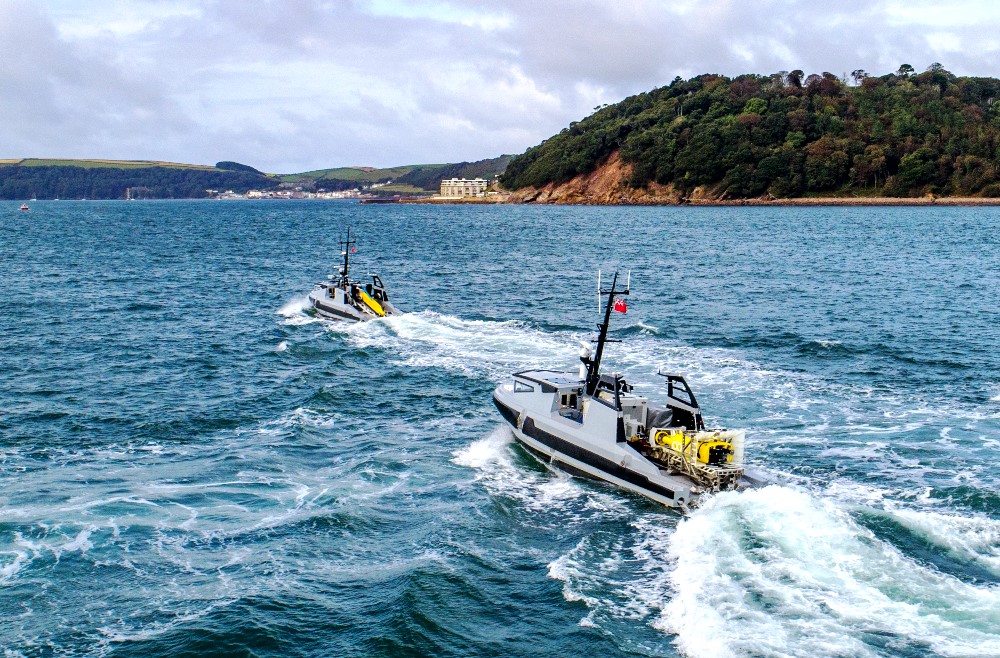
British Defence jobs have been boosted and sailors will be better protected as the UK’s first of a series of cutting-edge Maritime Mine Counter Measure (MMCM) systems has been delivered to the Royal Navy.


Image courtesy DE&S
 
The new capability consists of an Unmanned Surface Vessel (USV) – 12m long Royal Navy Motor Boat (RNMB) ARIADNE – as well as sophisticated off-board payloads and a Remote Command Centre (RCC).

With this advanced technology, mines can be rapidly detected in a more cost-effective and safer manner than previously, greatly increasing operational tempo and eliminating the need for sailors to enter mine danger areas.
 
The new vessel can be deployed from a harbour or a mother ship to hunt the seabed and water column for mines, using the Thales Towed Synthetic Aperture Multiviews (TSAM) system, one of the most sophisticated towed sonars in the world.  
 
Developments in sensor technology, data analytics, and machine learning have all significantly contributed to this innovation, allowing vessels to operate either fully autonomously or remote controlled by operators in a portable operations centre. Fitted with AI automatic target recognition, these vessels will filter and refine vast amounts of data allowing professional operators to speed up the process of classifying and neutralising mines.
 
The UK’s investment of £184 million into this programme has supported more than 200 jobs in Somerset, Plymouth, Portsmouth and Scotland, through Thales and its supply chain, with both the USVs and RCCs being manufactured in the country. This reflects the Government’s Plan for Change, by supporting jobs, boosting economic growth and improving the UK’s Defence capabilities.
 
The MMCM programme was set up to deliver cutting-edge mine hunting equipment to the navies in the UK and France, with the contracts managed by the Organisation for Joint Armament Co-operation (OCCAR). The total contract value for UK and France is €430m. The UK Royal Navy is set to receive its first four systems over the course of the year.

Minister for Defence Procurement and Industry, Rt Hon Maria Eagle MP, said: "This delivery marks a significant milestone in our mine-hunting capabilities and the autonomous technology will keep Britain and our Royal Navy sailors safer by identifying and removing mines.  

“It has also supported hundreds of skilled jobs across UK industry – a clear demonstration that defence is an engine for economic growth.”

This delivery is part of the Mine Hunting Capability (MHC) Programme led by the Ministry of Defence’s procurement arm, Defence Equipment and Support (DE&S), which aims to transition from conventional Mine Counter Measures Vessels to Maritime Autonomous Systems. The programme is focused on enhancing the UK’s ability to secure maritime operations by addressing static underwater threats.
 
Rear Admiral Steve McCarthy, Director of Maritime Environment at DE&S, said: “This is a significant first delivery for the Royal Navy and is a proud moment for all those involved in bringing this transformative capability into service. This project contributes to the growth and prosperity of our nation and will strengthen UK security through enhanced maritime operations.”
 
Both the UK and France have now taken delivery of MMCM systems, signifying advancements towards improving both countries’ mine hunting capability and increasing the safety of both Navies’ personnel.
 
Jonathan Reed-Beviere, Programme Director of the Mine Hunting Capability Programme in the Royal Navy, said: “This achievement is fundamental to the Royal Navy’s ambition to embrace Maritime Autonomous Systems, as the first Degree 3 autonomous vessel to be delivered into the hands of our sailors, furthering our dedication to removing personnel from the danger of operating within a minefield.”
 
Following the delivery of RNMB ARIADNE, Royal Navy personnel will undertake a period of training under Thales’ guidance, before independently conducting a rigorous Operational Evaluation of the equipment and beginning to utilise MMCM to fulfil operational duties.
 
Phil Siveter, CEO of Thales UK, added: “We are incredibly proud to deliver this world-first autonomous mine hunting system to the Royal Navy. With the introduction of AI and advanced sensor technology, this innovation represents a new era in maritime defence technology and demonstrates our unwavering commitment to providing cutting-edge solutions that enhance the capabilities of our defence forces. The Royal Navy will now have a powerful tool to safeguard national interests and maintain security at sea.”

In September 2024, a trial of the prototype MMCM vessel, RNMB APOLLO, successfully demonstrated the potential for this capability to be deployed flexibly and at pace by the Royal Navy. The trial took place at Scotland’s Firth of Clyde, a location which proved to be an effective testbed, paving the way for this delivery.

Related

Global commercial aircraft orders surge 88% in Q3 2026, says new ADS report
British Airways A319 taxis at London Heathrow, UK, 17 November 2010
Global commercial aircraft orders surge 88% in Q3 2026, says new ADS report
Global commercial aircraft orders surge as record demand creates major opportunities and production challenges for UK aerospace manufacturers.
Aerospace

17 Nov 2026

Farnborough Airshow 2028 reaches 93% capacity as earliest-ever sell-out looms
Farnborough International Airshow
Farnborough Airshow 2028 reaches 93% capacity as earliest-ever sell-out looms
With 93% of exhibition and chalet space already secured, the Farnborough International Airshow 2028 is heading towards a historic early sell-out.
Aerospace Defence Events

17 Nov 2026

First Light Fusion and STFC’s CLF partner on FLARE fast ignition
First Light Fusion team at STFC’s Central Laser Facility (CLF)
First Light Fusion and STFC’s CLF partner on FLARE fast ignition
A new collaboration between First Light Fusion and STFC’s Central Laser Facility (CLF) will develop the rapid heating stage of FLARE, advancing its progress towards low cost, high gain inertial fusion.
HM King Charles opens new National Cyber Force HQ
HM King Charles III opens new NCF HQ at Ribble House, Samlesbury, Lancashire.
HM King Charles opens new National Cyber Force HQ
The new headquarters of the National Cyber Force (NCF) at Ribble House in Lancashire has been officially opened by HM King Charles III, where he gained insights into the vital role of the NCF in strengthening the UK’s cyber capability.
Defence Security

17 Nov 2026

Tiberius Aerospace secures Series A funding to expand manufacturing partner network
Ramjet-powered artillery
Tiberius Aerospace secures Series A funding to expand manufacturing partner network
By securing $85 million financing, Tiberius Aerospace has become the latest defence technology unicorn and will use the investment to accelerate production of its long-range precision munitions and expand allied sovereign manufacturing capacity.
Defence Member News

17 Nov 2026

Farnborough Airshow 2028 reaches 93% capacity as earliest-ever sell-out looms
Farnborough International Airshow
Farnborough Airshow 2028 reaches 93% capacity as earliest-ever sell-out looms
With 93% of exhibition and chalet space already secured, the Farnborough International Airshow 2028 is heading towards a historic early sell-out.
Aerospace Defence Events

17 Nov 2026

First Light Fusion and STFC’s CLF partner on FLARE fast ignition
First Light Fusion team at STFC’s Central Laser Facility (CLF)
First Light Fusion and STFC’s CLF partner on FLARE fast ignition
A new collaboration between First Light Fusion and STFC’s Central Laser Facility (CLF) will develop the rapid heating stage of FLARE, advancing its progress towards low cost, high gain inertial fusion.
Airbus and Thales win €1.5bn IRIS military Earth observation satellites contract
The two IRIS optical Earth observation satellites are intended to progressively replace the three CSO satellites currently operating within the MUSIS system.
Airbus and Thales win €1.5bn IRIS military Earth observation satellites contract
France has selected Airbus and Thales Alenia Space to deliver its next-generation IRIS military satellites, with the programme remaining open to allies.
Defence Member News Space

16 Nov 2026

Construction begins on giant DUNE
A portion of the 2,600 steel beams destined for DUNE's cryostats were transported nearly a mile underground and staged in the South Detector Cavern ahead of the installation.
Construction begins on giant DUNE
UK researchers are playing a pivotal role in the Deep Underground Neutrino Experiment (DUNE), which will investigate some of the mysteries of the Universe, including how the Universe evolved after the big bang and why it contains so much more matter than antimatter.
Space

16 Nov 2026

HM King Charles opens new National Cyber Force HQ
HM King Charles III opens new NCF HQ at Ribble House, Samlesbury, Lancashire.
HM King Charles opens new National Cyber Force HQ
The new headquarters of the National Cyber Force (NCF) at Ribble House in Lancashire has been officially opened by HM King Charles III, where he gained insights into the vital role of the NCF in strengthening the UK’s cyber capability.
Defence Security

17 Nov 2026

Getlink plans drive-through biometric border checks at Eurotunnel terminals
Image: Getlink Group
Getlink plans drive-through biometric border checks at Eurotunnel terminals
Getlink plans camera-supervised biometric passport and fingerprint checks at Folkestone and Calais to prevent disruption as the EU’s new border system arrives.
Security

17 Nov 2026

UK power outage: How businesses can prepare for 72 hours without electricity
Electricity pylons near the River Great Ouse
UK power outage: How businesses can prepare for 72 hours without electricity
Government contingency planning warns that a prolonged UK power outage could disrupt card payments, communications, transport, fuel supplies and essential services. Here's how businesses can prepare for a 72-hour blackout and maintain operations.
Security

17 Nov 2026