First Light Fusion and STFC’s CLF partner on FLARE fast ignition
A new collaboration between First Light Fusion and STFC’s Central Laser Facility (CLF) will develop the rapid heating stage of FLARE, advancing its progress towards low cost, high gain inertial fusion.

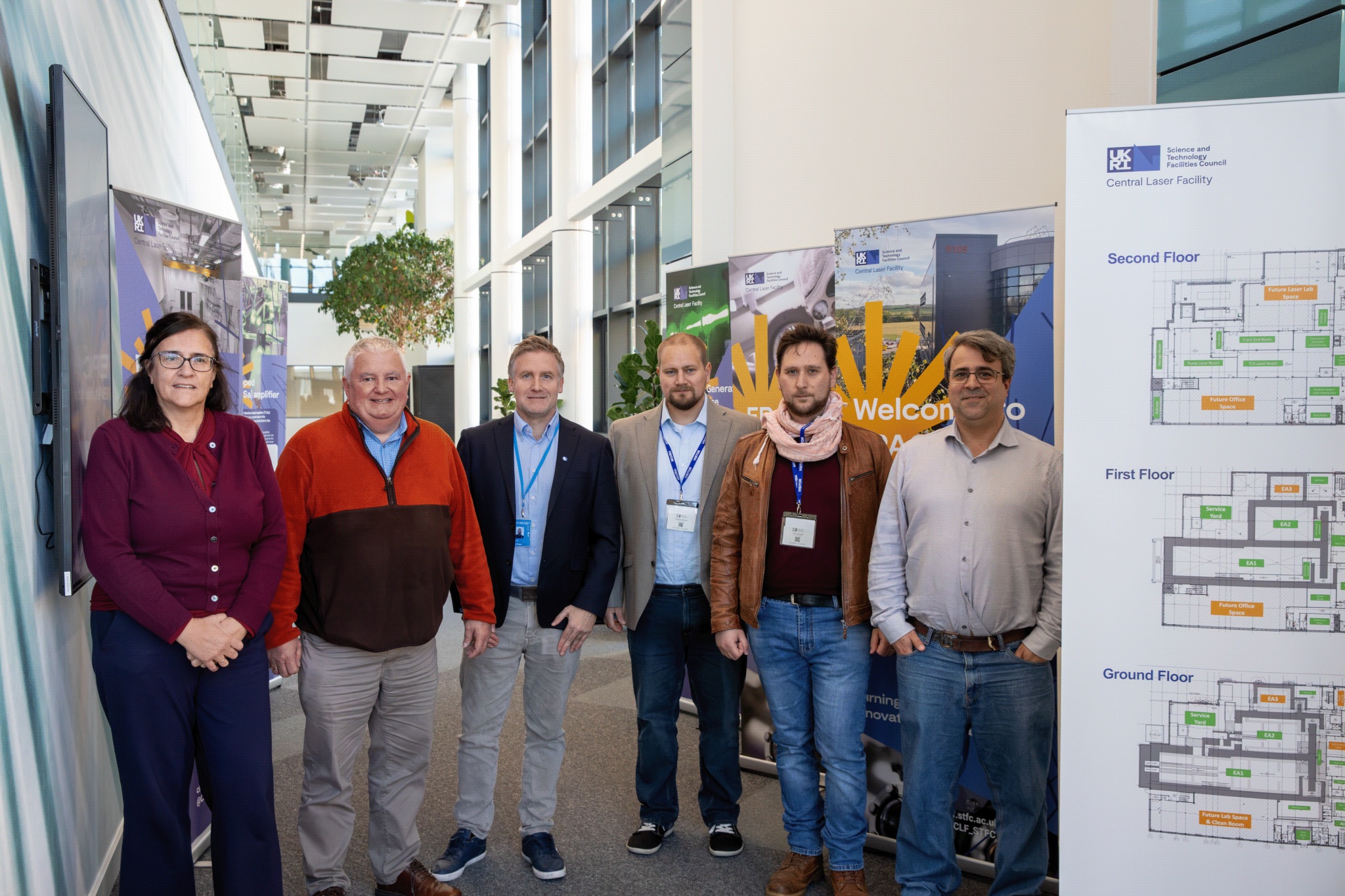
First Light Fusion team at STFC’s Central Laser Facility (CLF)
Photo: First Light Fusion

First Light Fusion and STFC’s Central Laser Facility (CLF) have launched a collaboration to advance the fast ignition physics at the heart of First Light’s FLARE approach to low cost, high gain inertial fusion.

First Light’s FLARE concept separates the two fundamental steps required for fusion: compressing the deuterium-tritium fuel to high density and then igniting it.

The partnership aims to accelerate the second step, harnessing CLF’s world leading expertise in short-pulsed laser technology to rapidly heat the compressed fuel.

This partnership shows how UK national laboratories and private fusion companies can combine capabilities to accelerate innovation and strengthen high power laser and high energy density physics expertise in the pursuit of commercial fusion energy.

How the collaboration aims to move from compression to ignition

First Light and CLF will investigate how a short, intense laser pulse can most effectively deliver energy into the compressed fuel.

CLF scientists will model the generation and transport of energetic electrons produced by the laser and how efficiently their energy can be deposited into dense fusion fuel.

The programme will explore approaches including engineered target structures and magnetic fields designed to guide energetic electrons into the ignition region, with the aim of further reducing the laser energy required already found in FLARE’s target concept.

Dr Jonathan Skidmore, Chief Scientist, First Light Fusion said: “We have validated the first half of the FLARE concept using the target itself to create the pressure history needed to assemble fuel at high density, with a relatively simple pulsed power driver.

“The next phase is to rapidly heat that dense fuel. The CLF has world leading expertise in laser and plasma physics to accelerate this step. Bringing these two phases together gives us a clear route towards integrated FLARE experiments.”

Designing fast ignition for a practical fusion system

Fast ignition has been studied internationally for several decades as a way of separating fuel compression from the energy required to initiate fusion burn.

For FLARE, the opportunity is to design the compression system, ignition system and target together from the outset.

The cylindrical FLARE geometry provides clean direct access to a large area of compressed fuel in comparison to standard laser Fast Ignition approaches, significantly opening up design parameters.

Rather than optimising laser performance in isolation, First Light and CLF will assess the physics alongside the efficiency, cost, engineering and scalability requirements of an eventual fusion system.

A central objective is to minimise the energy required to initiate burn while maintaining the high fusion gain needed for a practical power plant.
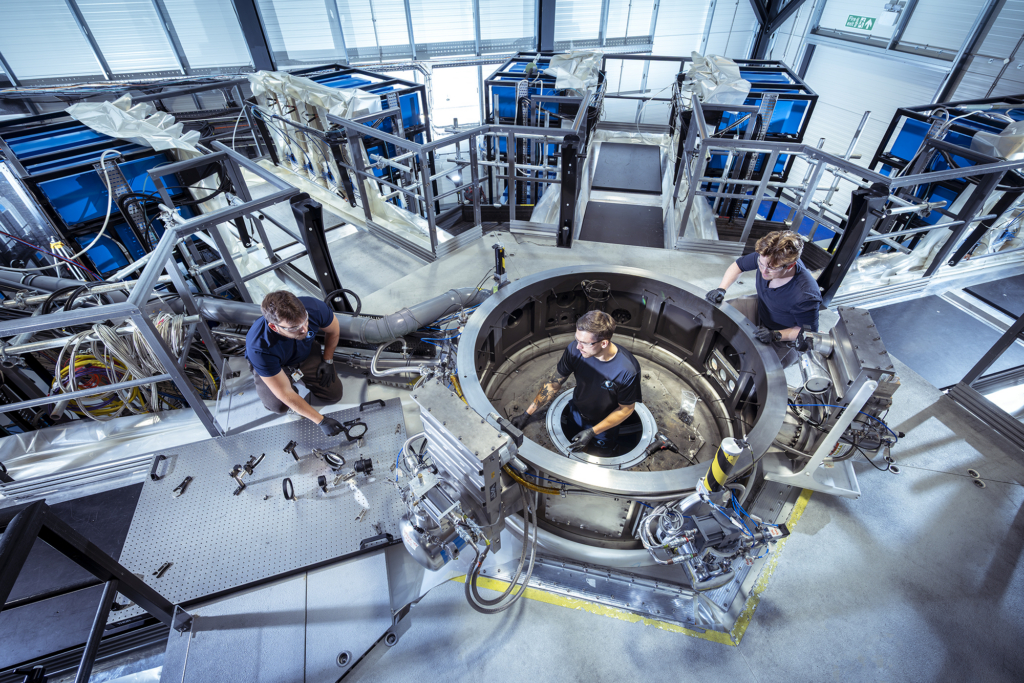
Machine 3 (M3) is one of the largest pulsed power facilities in the world, and the largest in Europe.
Photo: First Light Fusion


High gain reduces the required repetition rate and places less demanding requirements on the driver, chamber and fuel delivery systems. It is central to First Light’s approach to inertial fusion energy, delivering a lower cost route to commercial fusion power.

Combining UK capabilities lead global development of high gain inertial fusion

Based at STFC’s Rutherford Appleton Laboratory, CLF is a world-leading laser facility with expertise in high power lasers, plasma modelling, target fabrication, diagnostics and engineering, as well as extensive experience in fast ignition and energetic electron transport.

First Light brings its proprietary FLARE concept, derived from 15 years of development in inertial fusion energy including pulsed power technology, target design, machine learning and simulation capability.

The collaboration is already underway. Over the next year, the aim is to help define the laser requirements for ignition through modelling and, in the future, a potential high gain demonstrator.

Applying CLF’s foundational laser-plasma research to First Light’s FLARE creates a powerful pathway for the UK to lead the global development of low cost, high gain inertial fusion.

First Light’s pulsed power technology has industrial applications beyond energy in:

  • Defence systems and materials testing
  • Aerospace shock compression technologies
  • Advanced materials research and development
  • High-pressure physics research


Professor John Collier, Director, STFC Central Laser Facility said: “This collaboration applies CLF’s fast ignition modelling and experimental expertise to a clearly defined system challenge.

“By working together, we can identify the most robust approaches and target the experiments that will deliver the greatest value.”

Related

The Vickers VC10: The British airliner built for a different kind of flying
Vickers VC10
The Vickers VC10: The British airliner built for a different kind of flying
The VC10 remains a reminder of a time when British engineering took a different path from the competition and set a new level in design and comfort.
Aerospace

15 Nov 2026

Why the UK has so few domestic flights outside London
With fewer regional routes, strong competition from rail and airlines favouring more profitable international services, flying outside London has become increasingly difficult.
Aerospace

15 Nov 2026

UK flights impacted by US nationwide ground stop as knock-on effects continue
Heathrow Airport
UK flights impacted by US nationwide ground stop as knock-on effects continue
The US Transportation Secretary blamed ageing infrastructure and overloaded TDM routers for the nationwide FAA ground stop.
Aerospace Security

14 Nov 2026

First British special forces Chinook takes flight
The first flight of a Chinook Mark 6 on ground
First British special forces Chinook takes flight
The UK has ordered 14 of the helicopters to replace its oldest CH-47 Chinooks.
Defence

17 Nov 2026

British Army reservists target replica Russian and Iranian attack drones in Finland exercise
Live firing at Lohtaja during Exercise Mallet Strike 2/26.
British Army reservists target replica Russian and Iranian attack drones in Finland exercise
British Army reservists from 106 Regiment Royal Artillery are participating in NATO's Exercise Mallet Strike 2/26 in Finland, firing Starstreak and Martlet missiles at replicas of Russian and Iranian attack drones to test counter-drone capabilities in contested environments.
Defence Security

17 Nov 2026

217 days underwater: What it was like for the crew of HMS Vengeance
latest Vanguard-class boat to complete a deterrence patrol
217 days underwater: What it was like for the crew of HMS Vengeance
HMS Vengeance has returned having set a new record for Royal Navy submarine deployment and tested the limits of her crew.
Defence

16 Nov 2026

Airbus and Thales win €1.5bn IRIS military Earth observation satellites contract
The two IRIS optical Earth observation satellites are intended to progressively replace the three CSO satellites currently operating within the MUSIS system.
Airbus and Thales win €1.5bn IRIS military Earth observation satellites contract
France has selected Airbus and Thales Alenia Space to deliver its next-generation IRIS military satellites, with the programme remaining open to allies.
Defence Member News Space

16 Nov 2026

Construction begins on giant DUNE
A portion of the 2,600 steel beams destined for DUNE's cryostats were transported nearly a mile underground and staged in the South Detector Cavern ahead of the installation.
Construction begins on giant DUNE
UK researchers are playing a pivotal role in the Deep Underground Neutrino Experiment (DUNE), which will investigate some of the mysteries of the Universe, including how the Universe evolved after the big bang and why it contains so much more matter than antimatter.
Space

16 Nov 2026

MoD extends Skynet satellite competition amid UK jobs concerns
Skynet 6
MoD extends Skynet satellite competition amid UK jobs concerns
The Ministry of Defence has extended the competition for its Skynet 6 military satellite contract as implications for UK jobs are questioned.
Defence Space

16 Nov 2026

British Army reservists target replica Russian and Iranian attack drones in Finland exercise
Live firing at Lohtaja during Exercise Mallet Strike 2/26.
British Army reservists target replica Russian and Iranian attack drones in Finland exercise
British Army reservists from 106 Regiment Royal Artillery are participating in NATO's Exercise Mallet Strike 2/26 in Finland, firing Starstreak and Martlet missiles at replicas of Russian and Iranian attack drones to test counter-drone capabilities in contested environments.
Defence Security

17 Nov 2026

UK dangerously underprepared for cyberattacks and major emergencies, Lords warn
Server farm programmers seeing hacking warning, working to secure systems from cyberattack accessing confidential data. Team of data center coworkers fighting virus during security breach, camera
UK dangerously underprepared for cyberattacks and major emergencies, Lords warn
A cross-party House of Lords committee has warned that the UK is dangerously underprepared for cyberattacks, hostile state threats, and cascading crises, calling for a dedicated resilience minister and urgent supply chain reforms.
Security

16 Nov 2026

UK flights impacted by US nationwide ground stop as knock-on effects continue
Heathrow Airport
UK flights impacted by US nationwide ground stop as knock-on effects continue
The US Transportation Secretary blamed ageing infrastructure and overloaded TDM routers for the nationwide FAA ground stop.
Aerospace Security

14 Nov 2026