

Royal Navy demonstrates ship-busting firepower with Naval Strike Missile and Sea Venom


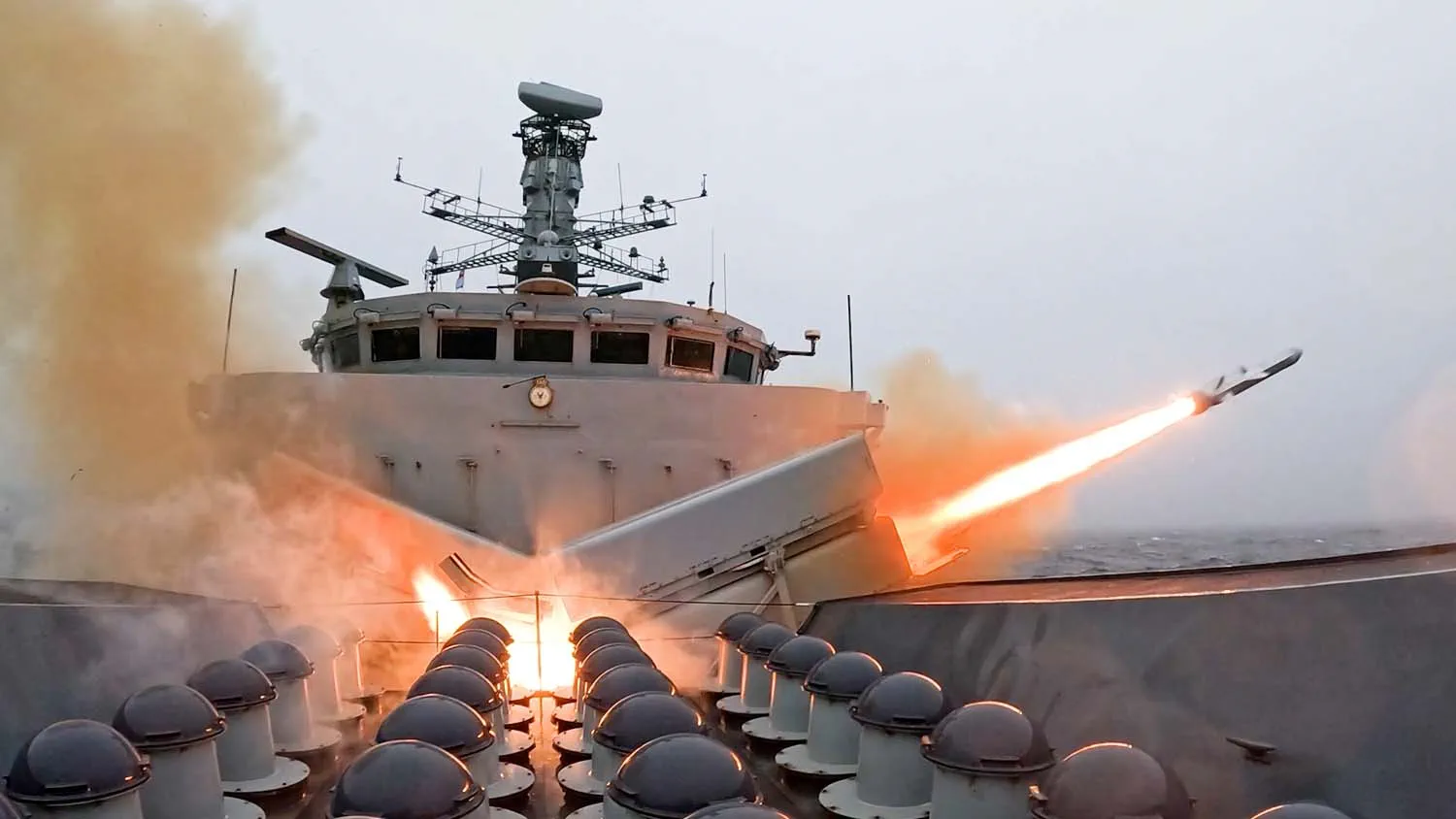
The Royal Navy has demonstrated its developing maritime strike capability with two of its newest anti-ship missiles, combining the destructive power of the ship-launched Naval Strike Missile (NSM) and air-launched Sea Venom against a warship-sized target.
The Type 23 frigate HMS Portland conducted the Navy’s first operational NSM firing against a target of this size, while its embarked Wildcat helicopter demonstrated the complete sequence of detecting, identifying and engaging a maritime target with an operational Sea Venom missile.
Both weapons struck the decommissioned US Navy frigate Klakring during Exercise Atlantic Thunder 2026, held at the MOD Hebrides Range off the north-west coast of Scotland from 17–21 September. The sinking exercise provided an opportunity to test the weapons and their crews in a realistic warfighting environment.
HMS Portland puts Naval Strike Missile through its destructive paces
The Kongsberg-developed NSM is designed to provide a long-range precision maritime strike capability. The ship-launched missile uses a sea-skimming flight profile and advanced guidance systems to locate and engage maritime targets at ranges exceeding 100nm (185km).
During the exercise, Portland fired an operational NSM at the former Oliver Hazard Perry-class frigate, testing the weapon against a representative warship target.
Lt Cmdr Louise Kirkaldy, the Principal Warfare Officer aboard HMS Portland, said the firing represented an important milestone for the Royal Navy, adding that it demonstrated “our ability to deliver credible, modern maritime strike capability.”
The firing followed more than a year of preparation and training by Portland’s sailors and provided an opportunity to test the weapon and associated procedures under demanding operational conditions.
Cmdr Dafydd Bryden, the commander of HMS Portland, added: “The opportunity to fire anti-ship missiles against a decommissioned warship is an important test of our warfighting capability. This engagement proved the effectiveness of these systems as well as the sailors and aircrew who operate them. We remain ready to fight and win at sea.”
Wildcat demonstrates Sea Venom’s airborne strike capability
Alongside Portland’s NSM firing, the frigate’s embarked Wildcat HMA2 conducted a live Sea Venom anti-ship missile firing.
Operated by the Royal Navy Fleet Air Arm’s 815 Naval Air Squadron, the multi-mission maritime helicopter demonstrated the complete maritime strike sequence, from detecting and identifying the target through to engaging it with Sea Venom.
The missile is carried on the helicopter’s Leonardo Weapon Wing, which can accommodate up to 20 Martlet Lightweight Multirole Missiles or four Sea Venom anti-ship missiles.
Developed by MBDA, Sea Venom provides the Royal Navy with a complementary airborne strike capability. It is designed to defeat corvette-sized warships and disable larger vessels, including frigates and destroyers, taking them out of the maritime fight.
Lt Cmdr Rhydian Edwards, Test and Evaluation Commander for the Royal Navy’s Maritime Aviation Strike Operational Advantage Group, described the firing as a “landmark moment” for the Wildcat fleet.
“For the first time, we demonstrated the live firing of an operational Sea Venom missile against a representative maritime target. More importantly, we proved our ability to execute the full maritime strike kill chain under realistic operational conditions,” Edwards said.
“This was about giving commanders confidence that Wildcat can find, fix and strike maritime targets using Sea Venom as part of a wider task group. The lessons learned from this activity will directly inform future tactics, training and operational capability development, ensuring Maritime Aviation Strike remains ready to fight and win when called upon,” he added.
The combination of NSM-equipped surface ships and Wildcat-launched Sea Venom missiles provides the Royal Navy with multiple options for engaging hostile vessels at different ranges and from different platforms. Atlantic Thunder allowed sailors and aircrew to put both weapons, and the procedures needed to employ them, to the test.
Sign up for our newsletter and get our latest content in your inbox.
Similar Reads


Sign up for our newsletter. Select all sectors relevant to you.
Related