

How Astroscale plans to remove a dead satellite from orbit


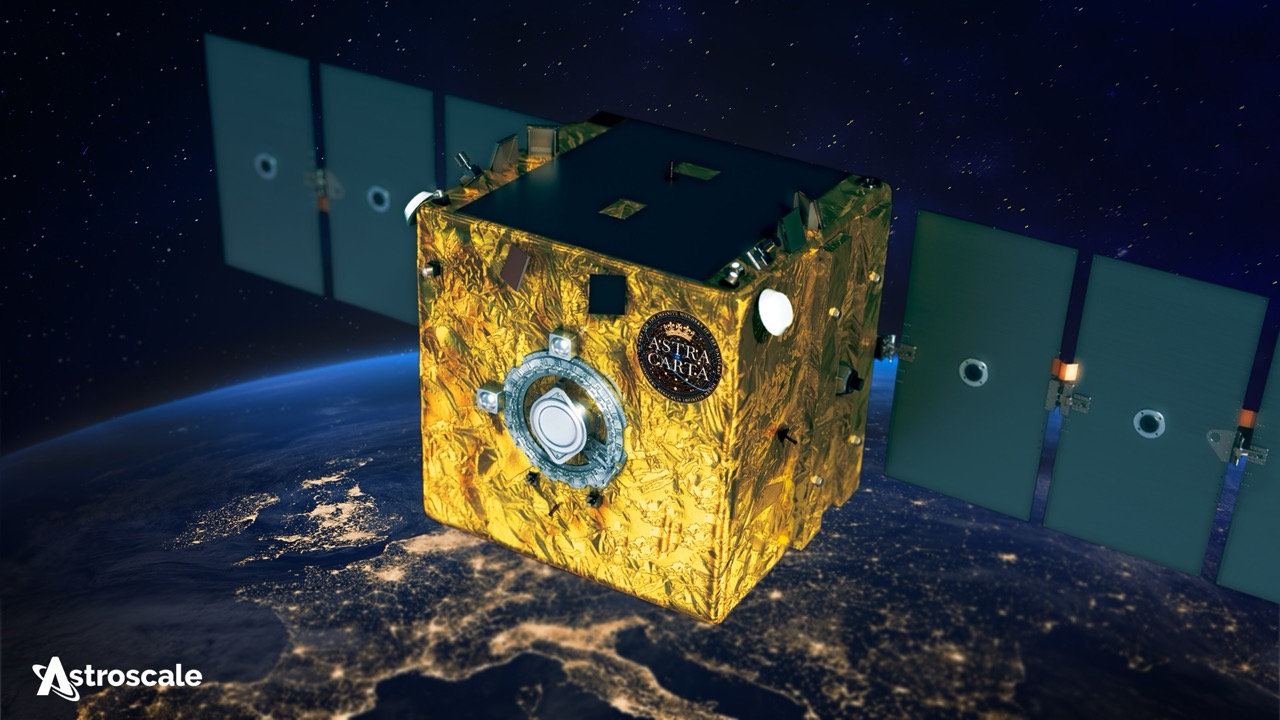
A UK-built spacecraft is preparing to chase down a dead satellite, attach itself to the object in orbit and pull it towards Earth.
Astroscale UK‘s ELSA-M mission will demonstrate a commercial end-of-life removal service for a full-size satellite, establishing a model for clearing retired spacecraft from congested orbits.
The mission comes as space debris surrounding Earth grows rapidly. The European Space Agency estimates there are 1.5 million pieces of debris between 1cm and 10cm across, plus around 230 million pieces measuring between 1mm and 1cm.
ELSA-M will demonstrate one way of tackling larger objects before collisions turn them into thousands of smaller fragments.
How will Astroscale remove a dead satellite from orbit?
ELSA-M – short for End-of-Life Services by Astroscale-Multi-client – is a 520kg servicing spacecraft developed by Astroscale UK.
Its first target will be an end-of-life Eutelsat OneWeb satellite. The UK Space Agency says ELSA-M has entered its final phase of development.
After launch, ELSA-M will perform controlled rendezvous and proximity operations. Sensors and navigation systems will determine the target satellite’s position and relative motion as the servicer closes the distance.
Once close enough, ELSA-M will dock with a purpose-built magnetic plate on the OneWeb satellite. The two spacecraft will become one object. ELSA-M will then use its propulsion system to lower their orbit, putting the retired satellite on a trajectory for atmospheric re-entry.
The OneWeb satellite is a “prepared client,” equipped with a compatible docking plate. Astroscale intends the technology to support services that would remove multiple satellites rather than requiring a dedicated servicer for each object.
In March, Astroscale selected Isar Aerospace to launch ELSA-M aboard its Spectrum rocket.
Astroscale has already practised catching satellites
ELSA-M builds on two previous missions that demonstrated some of the most difficult parts of the operation.
ELSA-d, launched in 2021, demonstrated rendezvous and magnetic capture using a servicing spacecraft and client satellite launched together. The UK government described it as a world-first commercial space-debris-removal demonstration mission.
In 2024, ADRAS-J approached and inspected a non-cooperative Japanese upper-stage rocket body, manoeuvring to within 15 metres. Astroscale UK’s team developed the ground segment and led flight-dynamics operations, including proximity manoeuvres and collision-risk monitoring.
ELSA-M takes those technologies closer to an operational commercial service.
Earth’s space debris problem is getting bigger
ESA’s latest space environment statistics show surveillance networks regularly track around 47,080 objects, but that represents only a fraction of the material orbiting Earth.
ESA estimates there are around 68,450 objects larger than 10cm, including 11,300 active payloads; 1.5 million debris objects between 1cm and 10cm; and 230 million between 1mm and 1cm.
More than 17,000 tonnes of artificial material is in orbit. ESA has recorded more than 660 break-ups, explosions, collisions or other fragmentation events since the beginning of the space age.
Objects in low-Earth orbit travel at several kilometres per second. Even small fragments can damage working spacecraft. Collisions involving large satellites or rocket bodies can create thousands of additional fragments.

That creates the risk of the Kessler syndrome, where collisions produce debris that triggers further collisions.
The ESA Space Environment Report 2026 warns that even without new launches, fragmentation would cause the debris population to continue increasing. Some orbital regions could become unsafe or unusable.
ESA’s long-term modelling has become so concerning that its modelling horizon was shortened from 200 to 100 years. Yet, it still produced higher numbers of objects and collisions than last year’s assessment.
The agency concludes that preventing new debris is no longer enough—it’s also necessary to remove existing objects.
Why target large objects?
Active debris removal does not mean collecting millions of tiny fragments. One priority is preventing large dead satellites and rocket bodies from colliding.
Removing a large spacecraft eliminates the object and reduces the risk that a future collision will turn it into thousands of smaller fragments.
ELSA-M is therefore closer to a space tow truck than an orbital rubbish collector: find a spacecraft that has reached the end of its useful life, dock with it and dispose of it safely.
The challenge is growing as launch rates accelerate. ESA says more than 300 launches placed over 4,000 payloads into orbit during 2025 alone.
Astroscale strengthens security ahead of ELSA-M
Astroscale UK announced on 30 September that it had achieved ISO/IEC 27001:2022 certification following an independent audit and a 20-month company-wide programme.
The international standard covers information-security risk management, an important consideration for missions that rely on sensitive navigation, command and operational information.
“Our missions combine frontier robotics and autonomous rendezvous with exacting operational discipline,” said Nick Shave, Managing Director of Astroscale UK. “As we prepare ELSA-M, the world’s first active debris removal mission, and advance the UK MOD Orpheus programme, we must give customers, government partners and suppliers confidence in the way we manage sensitive information across the business and response to evolving external risks.”
The certification also supports Orpheus, Astroscale UK’s programme developing sovereign UK in-orbit servicing and defence capabilities.
ELSA-M could lead to more ambitious debris missions
Capturing a satellite specifically designed for servicing is only one step.
Astroscale has also developed COSMIC for the UK’s national Active Debris Removal programme. The UK Space Agency says COSMIC is designed to capture and remove two defunct UK-registered satellites in low-Earth orbit.
Unlike ELSA-M’s prepared target, these spacecraft cannot communicate or cooperate with the servicer, making capture more difficult.
The UK government sees active debris removal as part of the emerging market for in-orbit servicing, assembly and manufacturing. Similar rendezvous, navigation and robotics technologies could let spacecraft inspect or relocate satellites, extend their lives or remove them after failure.
For ELSA-M, the immediate objective is to prove that instead of leaving a commercial satellite behind when its working life ends, another spacecraft can come and take it away.
Sign up for our newsletter and get our latest content in your inbox.
Similar Reads

Sign up for our newsletter. Select all sectors relevant to you.
Related