Could Moon dust provide propellant for spacecraft?

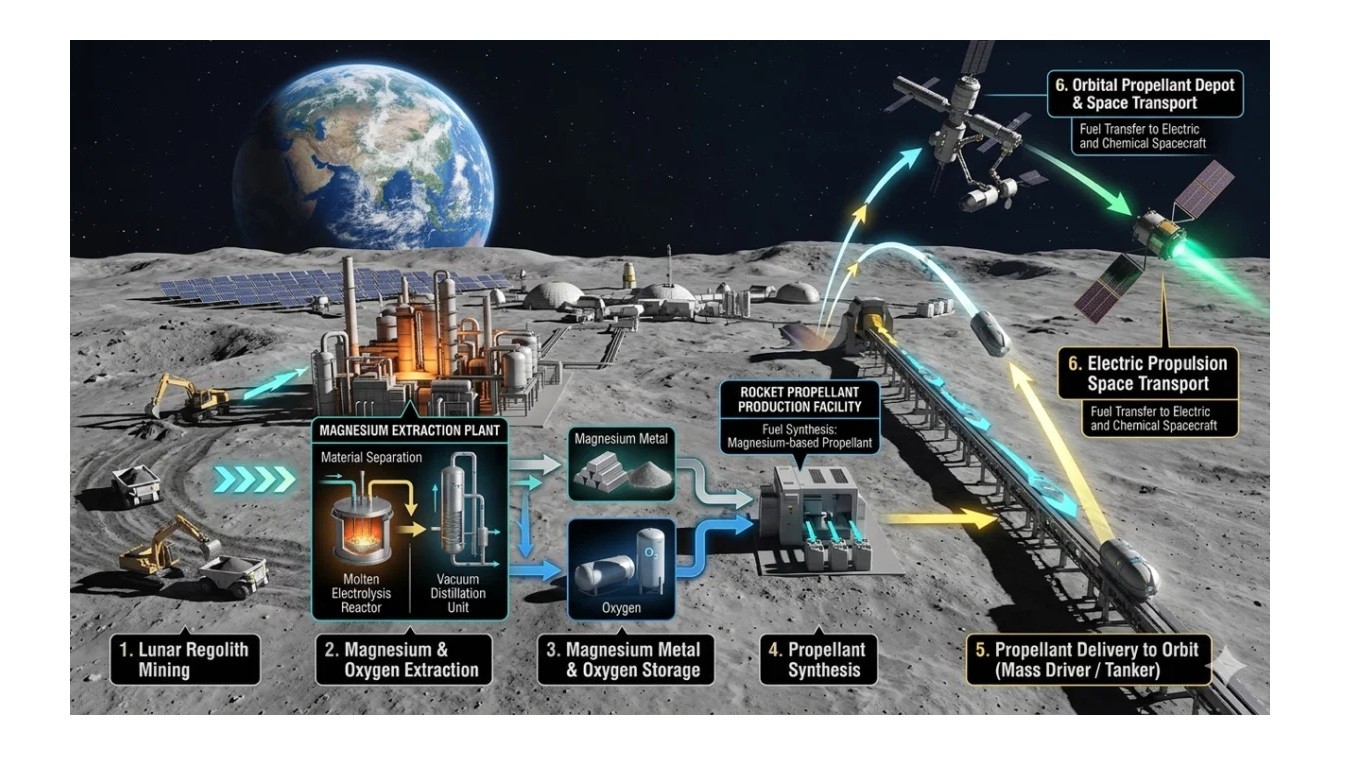
Could magnesium found in Moon dust help future spacecraft travel further into deep space? A new European Space Agency (ESA)-funded project led by the University of Surrey aims to find out.
Researchers at the prestigious Surrey Space Centre are working with UK propulsion company Eos Space Technology Ltd to investigate whether the metal magnesium can be extracted from lunar regolith (the loose rock and dust covering the Moon) and used as a solid propellant for electric propulsion.
Electric propulsion systems can use gases such as xenon and krypton but they would need to be transported from Earth. Producing propellant from materials already available on the Moon could reduce this reliance and potentially support future deep space exploration and cislunar commercial activity.
Why using magnesium as a propellant faces several challenges
However, using metals such as magnesium in conventional Hall-effect thrusters (a type of electric propulsion system that uses electrically charged particles to generate thrust) presents several challenges, including condensation, unstable plasma and erosion of the channel through which the plasma travels.
The nine-month MAGPIE project (MAGnesium Propulsion from In-Situ Extraction on the Moon) aims to tackle these barriers by testing a novel Hall thruster design and assessing, from extraction through to propulsion, whether lunar-sourced magnesium could become a viable propellant for future spacecraft.
Dr Sungwoo Lim, Principal Investigator of MAGPIE and Senior Lecturer in Space Applications, Exploration and Instrumentation at the Surrey Space Centre, University of Surrey, said: “The exciting question behind MAGPIE is whether spacecraft could one day use a resource that is already available on the Moon instead of having to carry all of their propellant from Earth.
“We are proposing to melt the regolith and dust to see if it is possible to extract usable magnesium on the Moon’s surface. Using the specialist facilities here at Surrey Space Centre, we will confirm the effect of changes on how thrusters perform and will develop a way of feeding in magnesium.”
Experimentation to define the feasibility of metallic-propellant electric propulsion for future lunar mobility
The research team will assess how much magnesium could be obtained from different types of lunar regolith, test ways of extracting it and develop a system for feeding the metal into an electric thruster. They will then test how the thruster performs with different propellants and how tolerant it is to impurities in the magnesium.
Dr Szymon Dworski, CEO and Co-Founder at Eos Space, said: “We will provide the first dataset grounded in actual experimentation which links lunar extraction pathways to a functional thruster architecture. We hope to define the feasibility envelope for metallic-propellant electric propulsion, which will enable future lunar mobility and orbital logistics concepts that do not rely on propellants that are launched from Earth.”
Running from September 2026 to May 2027, the MAGPIE project is backed by £112,795 in funding through the European Space Agency’s Open Space Innovation Platform (OSIP), which supports novel ideas for new space technologies and applications.
Sign up for our newsletter and get our latest content in your inbox.
Similar Reads