UK defence engineers showcase innovation at QinetiQ Powerboat Challenge


Engineering teams from across the UK’s defence and maritime industries put their design skills to the test at QinetiQ’s Industry Powerboat Challenge 2026.
Held at QinetiQ’s Haslar Marine Technology Park in Gosport on 12 November, the competition brought together 10 teams to design, build and race model powerboats.
Conrad Manning, Principal Naval Architect at QinetiQ, who organised the challenge, said the event encouraged teams to work collaboratively while developing their own solutions to a design brief. “It’s awesome to see how teams have been working together”, he said.
“We set specific rules – we defined a battery and motor and then it’s up to them. The team members have a wide-range of day jobs, which don’t necessarily involve naval architecture or designing vessels and so it was a good challenge to see how they could apply their specialist knowledge and expertise in different ways.”
The challenge gave teams – mostly made up of degree apprentices and early-career professionals – the chance to apply engineering principles in one of the UK’s leading maritime testing facilities.
BMT takes top prize with lightweight design
BMT’s winning boat, made from carbon fibre, used a 3D-printed mould, with the team focusing on reducing weight. Ollie Evans, from BMT, said: “Reliability was high on our list, and making sure the boat was lightweight. We were concerned about the potential for waves.”
With each team working within the same constraints, the challenge encouraged different approaches to hull design, performance and stability.
Connecting engineering innovation with defence capabilities
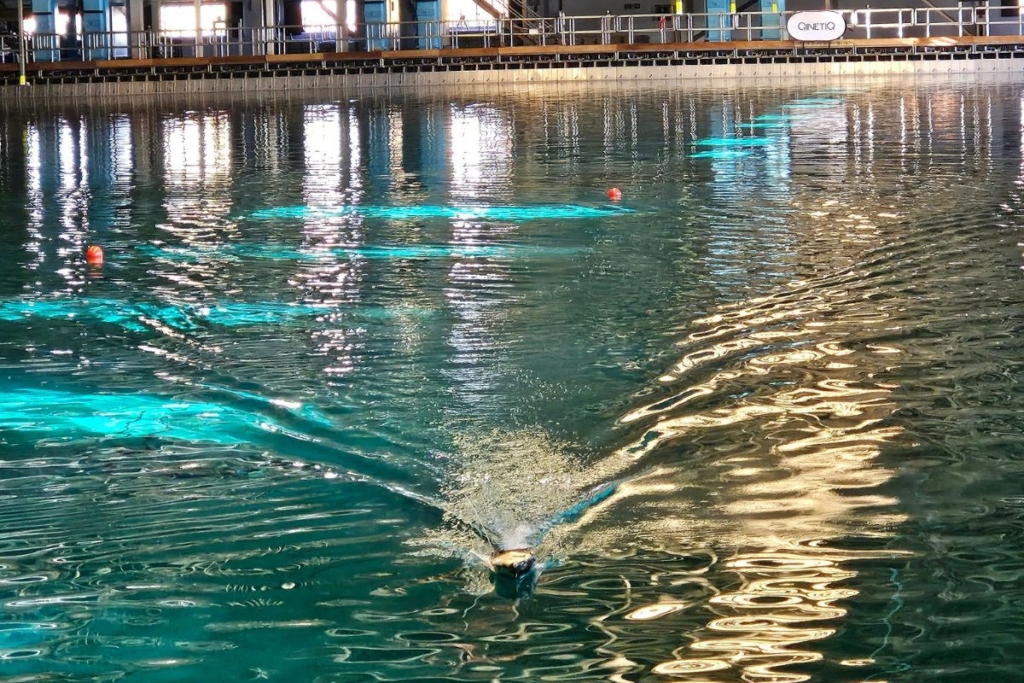
The competition took place in QinetiQ’s Ocean Basin, a specialist facility used to test the performance of commercial and military vessels.
Measuring 122m long, 61m wide and 5.5m deep, it’s equipped with technology to recreate conditions experienced by vessels at sea.
Chris Richardsen, Principal Consultant at QinetiQ, explained that physical testing remains essential to naval engineering. Its rotating arm for example is used to test submarine models, measuring the forces acting on them as they manoeuvre through the water.
“As computational methods are improving, the requirement for physical tests is becoming ever more sophisticated to provide validation data”, he said.
QinetiQ now uses advanced measurement techniques, including lasers, to analyse water flow around vessel models and compare the results with computer predictions.
Richardsen also highlighted the potential for artificial intelligence to unlock insights from decades of historical testing data held at Haslar, opening up new possibility for maritime research.
From school challenge to defence apprenticeship
For Qinetiq apprentice Paul Skinner, the competition marked a return to an event that helped introduce him to engineering.
Now in his second year of his degree apprenticeship, Skinner previously competed in QinetiQ’s Schools’ Powerboat Challenge before studying T Levels at college and securing his degree apprenticeship.
This year, he returned as a member of one of QinetiQ’s industry teams – highlighting how early exposure to engineering can lead to a career in the UK’s defence sector.
The industry event was followed on 13 November by the Schools’ Powerboat Challenge, bringing together nine schools from across southern England.
Sign up for our newsletter and get our latest content in your inbox.
Similar Reads





Sign up for our newsletter. Select all sectors relevant to you.
Related