General Atomics

ZeroAvia ships SuperStack Flex to defence customer

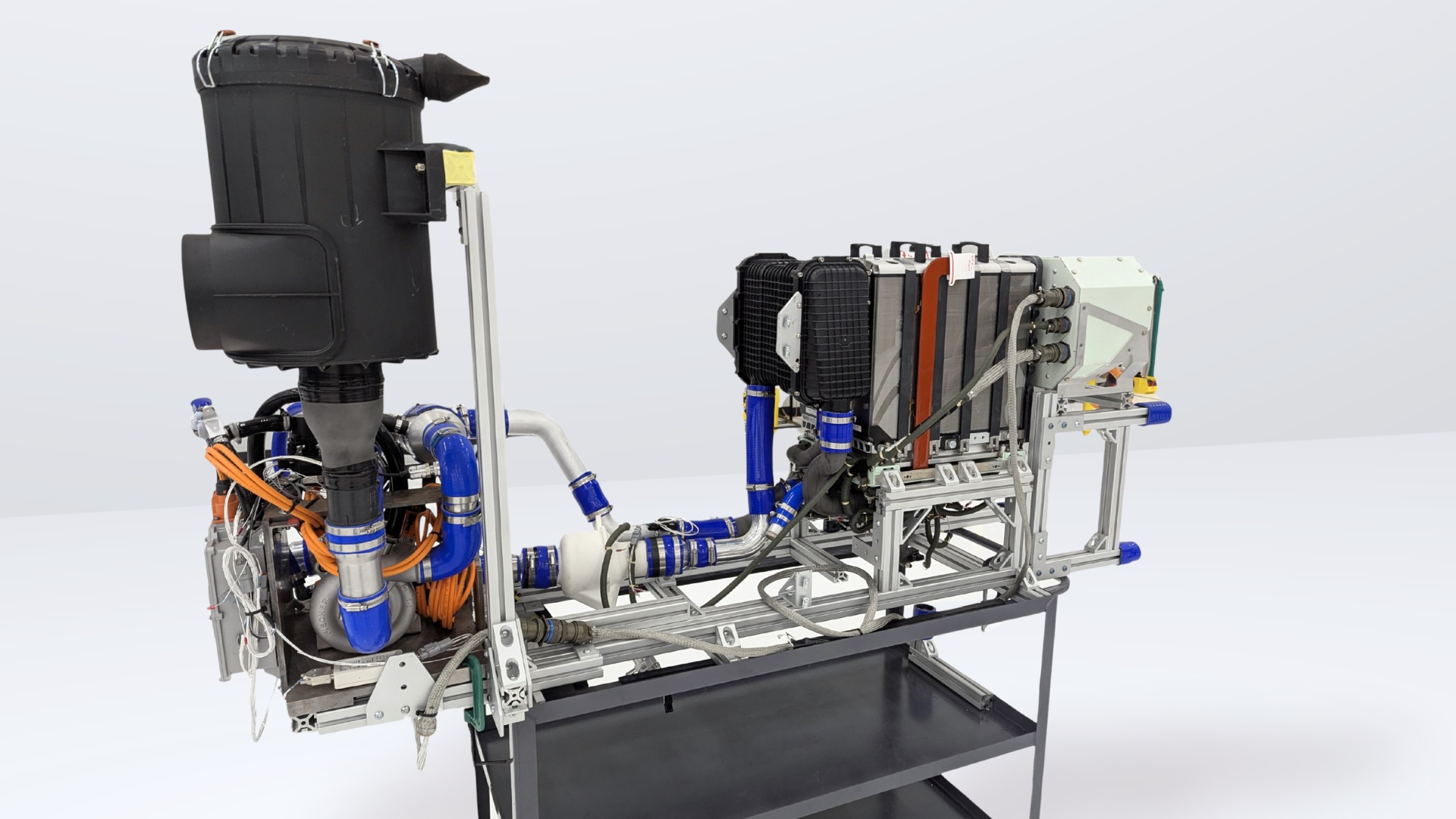
ZeroAvia has shipped its first flight intent SuperStack Flex modular low temperature proton exchange membrane (LTPEM) fuel cell system to a customer in the defence sector.


Image courtesy ZeroAvia 

The system has been fully qualified against the customer’s airworthiness requirements.

ZeroAvia’s SuperStack Flex is a modular fuel cell power generation system that can be configured to meet specific customer power needs while maintaining high power-to-weight ratio and highly flexible configuration.  

The lightweight, aerospace optimized balance-of-plant, has been developed to enhance the range of many Unmanned Air Vehicles (UAV), with further potential applicability across aerospace, maritime and ground use cases. The system can be used to provide propulsive power or to deliver enhanced onboard electrical capacity, opening up new capabilities in primary propulsion, auxiliary power systems and mission systems including ISR applications. The Superstack Flex is also an ideal system for the new FAA Mosaic Light Sport Category, providing more than enough power for a standard four-seater general aviation (GA) aircraft in this sector. 

The SuperStack Flex has demonstrated over 1.2kW/kg specific power and recently completed more than 100 hours of testing, consuming over 250 kg of hydrogen, and delivering continuous power at greater than 150 kW over long intervals, with peak power over 175 kW.   

Hydrogen and fuel cell technologies are becoming increasingly relevant to armed forces due to unique advantages in energy density, lower detectability thanks to reduced thermal and noise signatures, operational flexibility and lower maintenance costs. 

Using selective laser sintering (SLS) powder-bed additive manufacturing processes, ZeroAvia has been able to perform high velocity cycles of design, build and test, and quickly combine typical parts or their functions into new monolithic structures.

The key parts in the SuperStack Flex’s balance of plant – Anode, Cathode and Coolant Manifolds, thermal management, humidification and air compression systems – have been reduced from over 200 parts to less than 100, with ~50% weight and volume reductions. Fewer parts mean lighter, more compact, more reliable and less costly systems.

In the final stages of testing, the system was providing power back to ZeroAva’s Propulsion Center of Excellence in Everett, generating enough power to offset the entire building’s consumption. 

Val Miftakhov, Founder & CEO, ZeroAvia said: “Fuel cell systems are evolving to enable electric flight of unmanned aerial vehicles and a host of other vehicles. With lower noise and heat signatures, lower maintenance costs, increased endurance and the ability to generate fuel locally, there are enormous capability benefits.” 

“We can generate an amazing amount of electrical power at a really low weight, opening up all kinds of possibilities for new vehicles in both the civil and defense arenas.”

Related

UK backs quantum technology firms with £50m funding for defence, rail and GPS-free navigation
Quantum Growth Alliance
UK backs quantum technology firms with £50m funding for defence, rail and GPS-free navigation
A new Government package is set to develop advanced quantum sensors and communications systems aimed at boosting security, infrastructure resilience and economic growth.
GE Aerospace to create 150 jobs with £30m Prestwick expansion
GE9X engine
GE Aerospace to create 150 jobs with £30m Prestwick expansion
As part of a £57 million partnership with the Ayrshire Growth Deal, GE Aerospace is making a £30 million investment in its Maintenance, Repair and Overhaul (MRO) facility in Prestwick, Scotland.
Aerospace Member News

13 Oct 2026

Riyadh Air suspends flagship London and Manchester flights following airport attacks
Riyadh Air Boeing 787 at London Heathrow Airport in the sun
Riyadh Air suspends flagship London and Manchester flights following airport attacks
The closure of Riyadh’s main airport has disrupted the Saudi carrier’s UK connections, just weeks after it added Manchester to its growing network.
Aerospace

12 Oct 2026

UK backs quantum technology firms with £50m funding for defence, rail and GPS-free navigation
Quantum Growth Alliance
UK backs quantum technology firms with £50m funding for defence, rail and GPS-free navigation
A new Government package is set to develop advanced quantum sensors and communications systems aimed at boosting security, infrastructure resilience and economic growth.
UK to flight test hypersonic target vehicle at Hebrides Range in 2027
Missile launch
UK to flight test hypersonic target vehicle at Hebrides Range in 2027
The demonstration is planned as part of Project Bowline, a programme aimed at improving the country’s ability to assess emerging high-speed threats.
Defence

13 Oct 2026

Royal Navy seeks suppliers for Type 93 uncrewed submarine under AUKUS programme
The Royal Navy's experimental XLUUV, XV Excalibur, conducts a trial at sea. Image: MSubs Ltd via LinkedIn
Royal Navy seeks suppliers for Type 93 uncrewed submarine under AUKUS programme
With the XV Excalibur uncrewed submarine now in service, the Royal Navy is seeking industry partners for its Type 93 XLUUV programme, supporting future AUKUS capabilities.
Defence

13 Oct 2026

UK and Germany back SaxaVord in new European space launch deal
SaxaVord Spaceport, Shetland
UK and Germany back SaxaVord in new European space launch deal
The UK and Germany have agreed to deepen space launch cooperation, with Scotland's SaxaVord Spaceport securing European access to orbit.
Aerospace Defence Space

9 Oct 2026

Excelerate Technology to build UK CNI robotic security solution
Satellite in Earth orbit
Excelerate Technology to build UK CNI robotic security solution
In a project co-funded by the European Space Agency Business Applications and Space Solutions (ESA BASS) and supported by the UK Space Agency, Excelerate Technology will build and demonstrate how space-enabled assets can provide innovative safety and security solutions, including protection of Critical National Infrastructure (CNI) at a site in the UK.
World Space Week: How British technology will help ESA return to the Moon
ESA Argonaut
World Space Week: How British technology will help ESA return to the Moon
As Europe prepares to return to the Moon, British-developed LEIA LiDAR technology will help ESA's Argonaut lander autonomously identify safe touchdown zones on the lunar surface.
Space

5 Oct 2026

UK backs quantum technology firms with £50m funding for defence, rail and GPS-free navigation
Quantum Growth Alliance
UK backs quantum technology firms with £50m funding for defence, rail and GPS-free navigation
A new Government package is set to develop advanced quantum sensors and communications systems aimed at boosting security, infrastructure resilience and economic growth.
UK steps up AI cyber defences as minister warns dependence is a national security risk
Engineering team implements digital guardrails on autonomous AI agent to limit risk, Teamworking tech startup colleagues apply artificial intelligence safety constraints, brainstorming, camera A.
UK steps up AI cyber defences as minister warns dependence is a national security risk
The UK plans to expand AI-powered cyber protection and prepare for incidents involving autonomous systems, while calling for stronger UK technology capabilities.
Security

12 Oct 2026

UK opens weapons test ranges to SMEs as hypersonic testing investment advances
Project Safari hypersonics testing opens at QinetiQ MOD Hebridies for UK defence SMEs
UK opens weapons test ranges to SMEs as hypersonic testing investment advances
The MoD is easing SME access to UK weapons test ranges through Project Safari while advancing hypersonic missile testing plans at MOD Hebrides.
Defence Security

12 Oct 2026