General Atomics

UK steps up AI cyber defences as minister warns dependence is a national security risk

The UK plans to expand AI-powered cyber protection and prepare for incidents involving autonomous systems, while calling for stronger UK technology capabilities.

Engineering team implements digital guardrails on autonomous AI agent to limit risk, Teamworking tech startup colleagues apply artificial intelligence safety constraints, brainstorming, camera A.
Photo: stock.adobe.com

The UK government will expand its use of frontier AI to protect public services and examine stronger protections against autonomous systems escaping human oversight, as AI Minister Kanishka Narayan warned that dependence on overseas technology has become a national security issue.

Announcing the measures at Imperial College London on 12 October, Narayan said increasingly capable AI demanded stronger technical expertise, incident response capabilities and domestic industrial capacity.

The package includes wider deployment of AI to identify weaknesses in government systems, consideration of incident and near-miss reporting measures, and work to prepare for failures involving autonomous AI agents.

For the UK’s security and advanced technology industries, the announcement signals growing government interest in AI assurance, cyber protection and the capabilities needed to investigate systems acting with limited human supervision.

AI to strengthen cyber defences

According to the government, two pilots using frontier AI have helped identify and address more than 1,000 potential vulnerabilities across government systems.

Narayan also said the government’s central vulnerability-monitoring service had reduced the time taken to fix identified weaknesses from 50 days to eight. He announced an urgent expansion of frontier AI use to find vulnerabilities before attackers exploit them and improve responses to emerging threats.

“I want cybersecurity discussed in every boardroom in Britain, rather than simply delegated to middle management,” he said.

Kanishka Narayan MP, minister for artificial intelligence
Kanishka Narayan MP, minister for artificial intelligence. Photo: Crown Copyright

Alongside this operational work, ministers will explore whether the Cyber Security and Resilience Bill and its wider regime should be strengthened to address AI-driven threats and loss-of-control risks.

Potential measures include identifying and reporting serious incidents and near misses, reducing risks across essential services and enabling reviews of serious AI incidents. Detailed requirements remain to be developed with parliamentarians, technical experts and operators.

Preparing for autonomous AI incidents

The National Cyber Security Centre and AI Security Institute will help develop government responses to incidents involving AI agents, including containment and support for those affected.

Narayan warned that failures could spread rapidly across connected systems, requiring investigative capabilities beyond those traditionally needed by government.

“When that happens, government must be able to establish quickly what an agent was asked to do, what it accessed, why it acted as it did and whether the same failure could occur elsewhere,” he said.

Big data technology Data science analysing artificial intelligence generative AI deep learning machine learning algorithm Neural flow network analytics innovation abstract futuristic. 3d rendering.
Photo: stock.adobe.com

The government also intends to support AI verification, which tests whether claims about systems’ development, testing and assessment withstand scrutiny. Narayan highlighted early research into hardware-enabled verification as an opportunity to draw on UK semiconductor design expertise.

UK capability becomes a security priority

The minister linked these protective measures to a wider argument for retaining domestic technological capability and influence.

“Much of the technology that will shape our economy, our public services, our national security is being developed outside this country,” he said.

Pointing to the government’s Sovereign AI programme and AI Hardware Plan, Narayan argued that attracting international investment must be accompanied by greater UK control over strategically important technologies.

“We want the world’s leading companies investing here, but we will not accept dependence as the price of that investment.”

Related

NCC to lead business support for Greater South West robotics hub
GSWRAH
NCC to lead business support for Greater South West robotics hub
The UK's National Composites Centre (NCC) is to going to help businesses across the Greater South West navigate the challenges and opportunities of robotics and automation through a new £9.8 million regional programme.
Aerospace Defence

12 Oct 2026

Edgewing opens engineering hub in Italy with UK site to follow
The GCAP fighter jet
Edgewing opens engineering hub in Italy with UK site to follow
The first of three engineering hubs designed to support the development of the future GCAP fighter has opening, with similar sites in the UK and Japan coming soon.
Aerospace Defence

9 Oct 2026

Marshall Aerospace begins new chapter as Aurelius acquisition completes
Marshall Aerospace C-130s
Marshall Aerospace begins new chapter as Aurelius acquisition completes
The completion of AURELIUS' acquisition of Marshall Aerospace marks a new chapter in the company's illustrious history, which spans more than a century of engineering excellence, innovation and service.
ITURRI unveils GRITSTONE for British Army Light Mobility Vehicle programme
ITURRI GRITSTONE for the british army LMV programme
ITURRI unveils GRITSTONE for British Army Light Mobility Vehicle programme
The proposal has been developed specifically to meet the future mobility requirements of the British Armed Forces for an LMV to replace its existing Land Rovers.
Defence

12 Oct 2026

BAE Systems to produce new ACV variant for US Marine Corps
ACV
BAE Systems to produce new ACV variant for US Marine Corps
Under a $230 million contract, BAE Systems will adapt its modular Amphibious Combat Vehicle (ACV) design to produce a new variant that will complement the US Marine Corps’ advanced amphibious capabilities.
Defence Member News

12 Oct 2026

Voyant demonstrates GNSS-denied navigation in MoD maritime trial
Kraken K3 Scout
Voyant demonstrates GNSS-denied navigation in MoD maritime trial
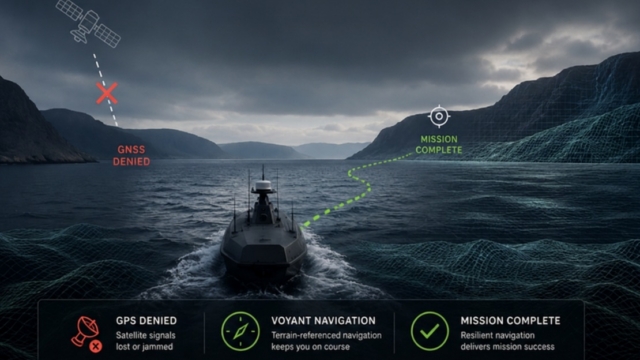
Could autonomous vessels operate without GPS? A UK Ministry of Defence trial saw a Kraken K3 Scout navigate the Solent using Voyant's PNT software.
Defence Member News

12 Oct 2026

UK and Germany back SaxaVord in new European space launch deal
SaxaVord Spaceport, Shetland
UK and Germany back SaxaVord in new European space launch deal
The UK and Germany have agreed to deepen space launch cooperation, with Scotland's SaxaVord Spaceport securing European access to orbit.
Aerospace Defence Space

9 Oct 2026

Excelerate Technology to build UK CNI robotic security solution
Satellite in Earth orbit
Excelerate Technology to build UK CNI robotic security solution
In a project co-funded by the European Space Agency Business Applications and Space Solutions (ESA BASS) and supported by the UK Space Agency, Excelerate Technology will build and demonstrate how space-enabled assets can provide innovative safety and security solutions, including protection of Critical National Infrastructure (CNI) at a site in the UK.
World Space Week: How British technology will help ESA return to the Moon
ESA Argonaut
World Space Week: How British technology will help ESA return to the Moon
As Europe prepares to return to the Moon, British-developed LEIA LiDAR technology will help ESA's Argonaut lander autonomously identify safe touchdown zones on the lunar surface.
Space

5 Oct 2026

UK opens weapons test ranges to SMEs as hypersonic testing investment advances
Project Safari hypersonics testing opens at QinetiQ MOD Hebridies for UK defence SMEs
UK opens weapons test ranges to SMEs as hypersonic testing investment advances
The MoD is easing SME access to UK weapons test ranges through Project Safari while advancing hypersonic missile testing plans at MOD Hebrides.
Defence Security

12 Oct 2026

Avon Protection secures US military order for MITR System
Avon Protection’s MITR System
Avon Protection secures US military order for MITR System
The United States Department of War (DoW) has placed an order for Avon Protection’s MITR System for its Special Operations Forces, becoming the second Five Eyes (FVEY) nation to adopt the system.
Sentinel Photonics brings multiple laser detection sensors into one hub
Sentinel Photonics' LASARD MAX Connect
Sentinel Photonics brings multiple laser detection sensors into one hub
With one single hub that joins up laser detection sensors, operators can now see, share and act on laser threats across a wide area in real time.