
General Atomics

Blighter boosts stealth of e-scan radars

Blighter Surveillance Systems has further boosted the stealth characteristics of its e-scan radars to better serve the growing number of developers of crewed and autonomous multisensor surveillance vehicles and platforms.


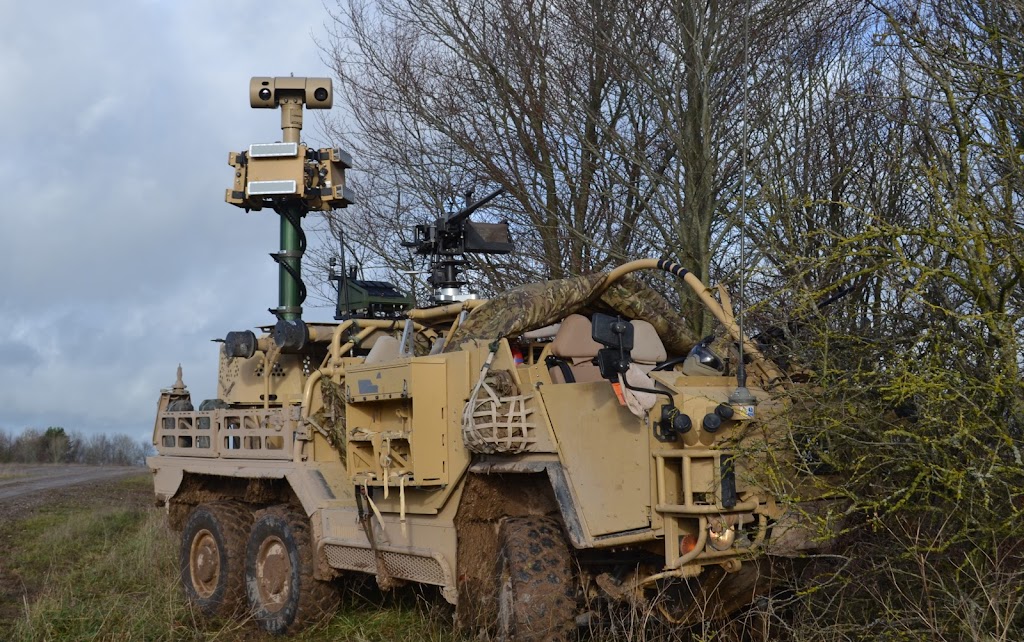
Above: Blighter’s A400 aerial threat detection radars on a 6×6 Supacat.
Courtesy Blighter

According to Blighter, the growing sophistication of electronic counter-countermeasures (ECCM) means that demand for Low-Probability-of-Intercept (LPI) radars is increasing rapidly. The need for covert radars that can see but not be seen is particularly strong in the mobile surveillance market where stealth, information superiority and data security are paramount. 

Blighter radars, including its B400 series, feature Low-Probability-of-Intercept (LPI) waveforms, which makes the radar signal difficult to detect and therefore difficult to jam. Radar performance remains exceptional, with Blighter’s industry-leading capability in the detection and classification of people, vehicles and near-ground airborne threats.  

Mark Radford, co-founder and chief technology officer (CTO) at Blighter said: “Our radars are inherently covert due to the design choices we made at the outset. We were first to market with a solid-state, non-rotating electronic scanning ground radar and our adoption of the dual antenna FMCW (frequency modulated continuous wave) architecture and the decision to operate in the Ku-band spectrum have led to an exceptionally tough, EMC robust and stealthy radar design.”

Blighter continues to fine-tune its technology to improve detection, tracking and classification of targets while staying covert. 

"For example, new fast scanning modes, featuring sub-second update rates, result in even less radar energy being transmitted in any specific direction. Furthermore, when the radar is used with BlighterNexus’ ‘Scan-Manager Application Module’, the radar can operate in a Multi-Function Radar (MFR) mode with greater randomisation of the low-power waveforms being transmitted.

“Developers of crewed and autonomous surveillance vehicles and platforms are already benefitting from Blighter’s LPI credentials,” said Mark Radford. “The radar’s solid-state design and extremely low transmit power (four watts) reduces the EMC and acoustic signatures and results in a smaller safety zone around the radar to aid sensor integration. But fundamentally, it’s the complexity and length of the combined e-scan, FMCW and Doppler chirp waveforms that make the Blighter radar so difficult to detect and jam.”

In 2025, Blighter radars were integrated into a fleet of custom-built multisensor mobile surveillance vehicles for on-the-go monitoring of a European land border; by Allen-Vanguard for its SECURIS rapid deployable counter drone system and by a SE Asian military customer for mobile border surveillance vehicles.

“Our radar is probably the stealthiest and most resilient ground radar in its class and an excellent fit for developers in the multisensor mobile surveillance space,” said Mark Radford. “A great fit for customers wanting to add a covert radar into modernisation programmes, for electric and hybrid autonomous vehicles, as well as for patrol and target designator vehicles.”

Low-Probability-of-Intercept (LPI) is a radar design concept that emerged at the end of the Cold War as radar engineers sought ways to prevent emissions from being detected by increasingly sensitive electronic support receivers. An LPI radar transmits in a way that makes its emissions extremely difficult for enemy receivers to detect, using low peak power, complex coded waveforms, frequency agility, advanced scan patterns, all combined with high processing gain and very low side lobe antennas to keep energy tightly confined to the main beam. Demand for LPI radars is being driven by a combination of threat evolution, defence modernisation and rapid advances in radar technology.

Blighter’s non-rotating, solid-state, low SWaP (size, weight and power) electronic scanning radars provide uninterrupted rapid surveillance over a wide area detecting moving vehicles/vessels, persons (including ‘crawlers’) and near ground aerial threats at ranges of up to 32 km. The radars’ compact and modular design enables rapid deployment on towers and vehicles and as dismounted portable systems on tripods. 
 

Related

Edgewing opens engineering hub in Italy with UK site to follow
The GCAP fighter jet
Edgewing opens engineering hub in Italy with UK site to follow
The first of three engineering hubs designed to support the development of the future GCAP fighter has opening, with similar sites in the UK and Japan coming soon.
Aerospace Defence

9 Oct 2026

Marshall Aerospace begins new chapter as Aurelius acquisition completes
Marshall Aerospace C-130s
Marshall Aerospace begins new chapter as Aurelius acquisition completes
The completion of AURELIUS' acquisition of Marshall Aerospace marks a new chapter in the company's illustrious history, which spans more than a century of engineering excellence, innovation and service.
UK and Germany back SaxaVord in new European space launch deal
SaxaVord Spaceport, Shetland
UK and Germany back SaxaVord in new European space launch deal
The UK and Germany have agreed to deepen space launch cooperation, with Scotland's SaxaVord Spaceport securing European access to orbit.
Aerospace Defence Space

9 Oct 2026

Edgewing opens engineering hub in Italy with UK site to follow
The GCAP fighter jet
Edgewing opens engineering hub in Italy with UK site to follow
The first of three engineering hubs designed to support the development of the future GCAP fighter has opening, with similar sites in the UK and Japan coming soon.
Aerospace Defence

9 Oct 2026

UK open to Germany joining GCAP as Burnham unveils wider defence and technology partnership
GCAP
UK open to Germany joining GCAP as Burnham unveils wider defence and technology partnership
Britain opens the door to German participation in GCAP as London and Berlin deepen cooperation on space, AI, quantum technology and hybrid threats.
Defence

9 Oct 2026

Why military trauma awareness matters in the workplace
Combat Stress session - therapist offering psychological therapy
Why military trauma awareness matters in the workplace
For World Mental Health Day, Combat Stress explains why military trauma awareness can help employers support veterans, strengthen workplace culture and retain talent.
Defence Insights

9 Oct 2026

UK and Germany back SaxaVord in new European space launch deal
SaxaVord Spaceport, Shetland
UK and Germany back SaxaVord in new European space launch deal
The UK and Germany have agreed to deepen space launch cooperation, with Scotland's SaxaVord Spaceport securing European access to orbit.
Aerospace Defence Space

9 Oct 2026

Excelerate Technology to build UK CNI robotic security solution
Satellite in Earth orbit
Excelerate Technology to build UK CNI robotic security solution
In a project co-funded by the European Space Agency Business Applications and Space Solutions (ESA BASS) and supported by the UK Space Agency, Excelerate Technology will build and demonstrate how space-enabled assets can provide innovative safety and security solutions, including protection of Critical National Infrastructure (CNI) at a site in the UK.
World Space Week: How British technology will help ESA return to the Moon
ESA Argonaut
World Space Week: How British technology will help ESA return to the Moon
As Europe prepares to return to the Moon, British-developed LEIA LiDAR technology will help ESA's Argonaut lander autonomously identify safe touchdown zones on the lunar surface.
Space

5 Oct 2026

Big cargo drones complete first BVLOS delivery to North Sea wind farm
Skyports and Ørsted North Sea wind farm cargo drone trial
Big cargo drones complete first BVLOS delivery to North Sea wind farm
Skyports and Ørsted conducted a complex North Sea cargo drone trial, illustrating how heavy loads can safely and efficiently be delivered offshore beyond visual line of sight (BVLOS).
Aerospace Security

9 Oct 2026

UK Government and UKRI invest £54m to prevent future disease outbreaks
Poultry facility
UK Government and UKRI invest £54m to prevent future disease outbreaks
The UK Government and UKRI are investing £54 million in biosecurity research to tackle antimicrobial resistance, improve disease outbreak preparedness, develop next-generation vaccines and strengthen protection against emerging biological threats.
Security

8 Oct 2026

London Fire Brigade Cadets gain practical skills at firefighting weekend
Capita Fire Service College, Moreton-in-Marsh, firefighting weekend.
London Fire Brigade Cadets gain practical skills at firefighting weekend
Continuing its longstanding support for London Fire Brigade’s Fire Cadets, Securitas UK has given 16 young people practical training at its ninth annual firefighting weekend, held at the Capita Fire Service College in Moreton-in-Marsh.
Member News Security

7 Oct 2026