
General Atomics

Dstl leads on NATO emerging disruptive tech competition

The Defence Science and Technology Laboratory (Dstl) is leading a NATO research project called ‘Youth Perspective on Emerging and Disruptive Technologies’.


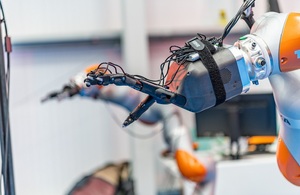
Image courtesy Dstl

The goal is to gather ideas from young people across NATO countries about how emerging and disruptive technologies might affect the future.

What the competition is asking for
To gather these future ideas, the requirement is to write an original think piece, which answers the question: ‘What do you think are the opportunities and risks of emerging and disruptive technologies?’

Eligibility

The competition (reference SAS-AVT-SET-HFM-205) is open to citizens of NATO member countries, as well as Australia, Japan, South Korea, Switzerland and Ukraine. You must also be aged between 18 and 34.

Background information on emerging and disruptive technologies

Emerging and disruptive technologies are just starting to develop and could have a big impact in the future. They might change markets and industries so much that current practices, tools, or even companies become outdated.

Key characteristics of emerging and disruptive technologies include:

  • rapid development
  • societal impact
  • transformation of existing paradigms

Historical example of emerging and disruptive technologies: The Ford Model T
The first affordable car made motoring publicly accessible. This new innovation transformed the transportation market, but became disruptive, making horse-drawn vehicles old-fashioned and drove significant societal change on a large scale.

How to present your think piece

You can choose to write about opportunities or risks, or both.

There is no right or wrong format for your think piece but any of the following are suggested:

  • essays
  • news articles
  • advocacy briefs
  • bullet point lists
  • brainstorms

Themes to think about
You could include any of the following themes:

  • legal, ethical, technical, moral or policy implications of these technologies
  • societal reactions to advancements in technology or changes in policy
  • potential benefits for society
  • potential harm for society
  • implications on industry
  • potential misuse of these technologies
  • impact on individual privacy
  • strategic advantage and competition arising from these technologies
  • prosperity and economic strength arising from these technologies

Word count
There is a 1,000 word limit (10% allowance, not including references or abstract).

Including a short abstract to explain your think piece is also recommended.

Marking criteria
Use of AI is not allowed. If it is detected, your entry will be dismissed.

Think pieces will be marked based on the following factors:

  • how original your ideas are
  • whether you include real-world examples or case studies (including your own experiences)
  • how credible and relevant your ideas are
  • how convincing your arguments are
  • the level of academic quality and accuracy

How to enter
Email your think pieces to: [email protected] by Friday 6th February 2026. Winners will be announced in May 2026.

If your submission makes the top 10, you will need to submit a picture of your ID.

Next steps
Writers of the three best think pieces will be invited to present their entry at a future NATO event. The overall winner will be determined by a panel at this event.

Writers of the top 10 think pieces will receive certificates of commendation that can be included as part of a curriculum vitae.

The top 10 think pieces may be published in the NATO Journal for Science and Technology.

Related

Edgewing opens engineering hub in Italy with UK site to follow
The GCAP fighter jet
Edgewing opens engineering hub in Italy with UK site to follow
The first of three engineering hubs designed to support the development of the future GCAP fighter has opening, with similar sites in the UK and Japan coming soon.
Aerospace Defence

9 Oct 2026

Marshall Aerospace begins new chapter as Aurelius acquisition completes
Marshall Aerospace C-130s
Marshall Aerospace begins new chapter as Aurelius acquisition completes
The completion of AURELIUS' acquisition of Marshall Aerospace marks a new chapter in the company's illustrious history, which spans more than a century of engineering excellence, innovation and service.
UK and Germany back SaxaVord in new European space launch deal
SaxaVord Spaceport, Shetland
UK and Germany back SaxaVord in new European space launch deal
The UK and Germany have agreed to deepen space launch cooperation, with Scotland's SaxaVord Spaceport securing European access to orbit.
Aerospace Defence Space

9 Oct 2026

RAF Marham runway repairs strengthen its operational resilience
RAF F-35B 207 sqdrn
RAF Marham runway repairs strengthen its operational resilience
The resilience of RAF Marham’s airfield infrastructure has been reinforced following the completion of vital runway repairs, whilst maintaining support for Lightning Force operations.
Defence Member News

11 Oct 2026

Sentinel Photonics brings multiple laser detection sensors into one hub
Sentinel Photonics' LASARD MAX Connect
Sentinel Photonics brings multiple laser detection sensors into one hub
With one single hub that joins up laser detection sensors, operators can now see, share and act on laser threats across a wide area in real time.
AI to help SMEs win defence contracts: Inside Strategical’s solution
Aerospace SME using AI to win defence contracts
AI to help SMEs win defence contracts: Inside Strategical’s solution
Smaller suppliers can struggle to turn technical capability into defence orders. Strategical is using AI to make specialist bidding expertise more accessible and help businesses focus on work they can realistically secure.
Defence Member News

10 Oct 2026

UK and Germany back SaxaVord in new European space launch deal
SaxaVord Spaceport, Shetland
UK and Germany back SaxaVord in new European space launch deal
The UK and Germany have agreed to deepen space launch cooperation, with Scotland's SaxaVord Spaceport securing European access to orbit.
Aerospace Defence Space

9 Oct 2026

Excelerate Technology to build UK CNI robotic security solution
Satellite in Earth orbit
Excelerate Technology to build UK CNI robotic security solution
In a project co-funded by the European Space Agency Business Applications and Space Solutions (ESA BASS) and supported by the UK Space Agency, Excelerate Technology will build and demonstrate how space-enabled assets can provide innovative safety and security solutions, including protection of Critical National Infrastructure (CNI) at a site in the UK.
World Space Week: How British technology will help ESA return to the Moon
ESA Argonaut
World Space Week: How British technology will help ESA return to the Moon
As Europe prepares to return to the Moon, British-developed LEIA LiDAR technology will help ESA's Argonaut lander autonomously identify safe touchdown zones on the lunar surface.
Space

5 Oct 2026

Sentinel Photonics brings multiple laser detection sensors into one hub
Sentinel Photonics' LASARD MAX Connect
Sentinel Photonics brings multiple laser detection sensors into one hub
With one single hub that joins up laser detection sensors, operators can now see, share and act on laser threats across a wide area in real time.
Big cargo drones complete first BVLOS delivery to North Sea wind farm
Skyports and Ørsted North Sea wind farm cargo drone trial
Big cargo drones complete first BVLOS delivery to North Sea wind farm
Skyports and Ørsted conducted a complex North Sea cargo drone trial, illustrating how heavy loads can safely and efficiently be delivered offshore beyond visual line of sight (BVLOS).
Aerospace Security

9 Oct 2026

UK Government and UKRI invest £54m to prevent future disease outbreaks
Poultry facility
UK Government and UKRI invest £54m to prevent future disease outbreaks
The UK Government and UKRI are investing £54 million in biosecurity research to tackle antimicrobial resistance, improve disease outbreak preparedness, develop next-generation vaccines and strengthen protection against emerging biological threats.
Security

8 Oct 2026