

AI to help SMEs win defence contracts: Inside Strategical’s solution



Smaller businesses pursuing UK defence contracts are being offered specialist business-winning expertise through an AI platform with a monthly subscription costing less than a day of high-end consultancy.
Strategical’s Business Winning Platform combines artificial intelligence with the company’s defence advisory methodology to help suppliers find opportunities, assess their competitive position and build a strategy for securing work.
Managing director Shane Mason tells Advance that the approach can put expertise within reach of companies unable to afford sustained support from specialist advisers. His argument is that a smaller budget need not be such a commercial handicap.
“Competitive advantage no longer belongs automatically to the biggest organisations; it belongs to those making the best business-winning decisions,” he said. “Artificial intelligence does not replace judgement. It strengthens it.”
For a specialist supplier, a good product is only part of the battle. Knowing who needs it, understanding the competition and deciding how much time and money to stake on a potential contract can determine whether technical promise becomes paying work.
Using AI to find the right defence contracts
The platform combines Anthropic’s Claude AI with Strategical’s 45,000-word playbook and a suite of specialist tools. According to the company, its underlying methodology has supported more than £1bn of successful UK defence business.
“We built intellectual property into the company by capturing what good business winning looks like, and what business winning looks like in the defence sector,” Mason told Advance.
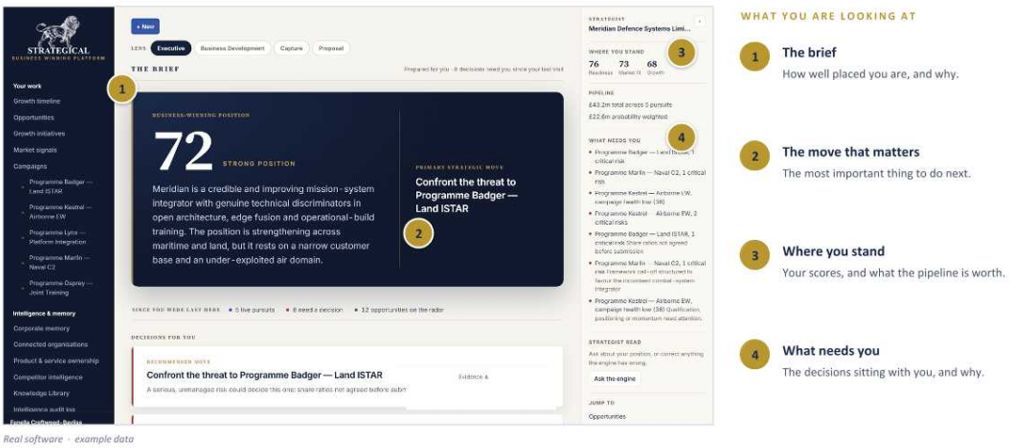
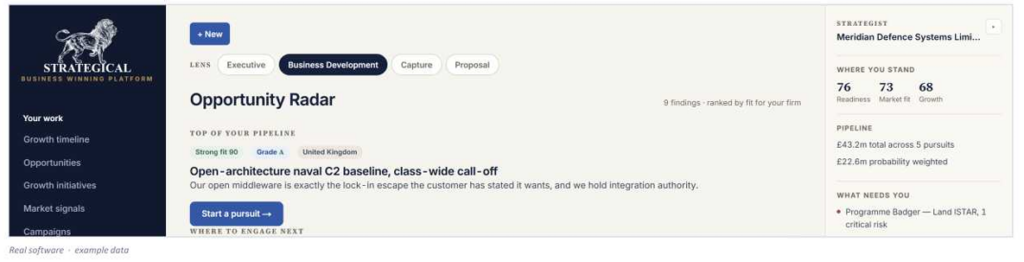
Users supply information about their products, services and capabilities. The platform searches for relevant opportunities, then assesses how closely the requirements match what the business can offer.
That could bring an overlooked opportunity into view. It could also expose a poor fit before an appealing contract absorbs weeks of work.
“Rather than guesswork, it will help you work out whether that opportunity actually is for you or not,” Mason said.
The system scores opportunities against set criteria, helping teams examine their readiness, market fit and competitive position. The aim is to give businesses a firmer basis for deciding where to invest, what needs improving and when to walk away.
For an SME whose senior engineers or directors also shoulder the bidding workload, avoiding the wrong competition can free up capacity for one it has a credible chance of winning.
A month’s access for the cost of a consultancy day
Strategical’s proposition is to make specialist advice available on a monthly subscription basis, at a price that is less than the typical fee for a single day of high-end consultancy.
The subscription provides continuing access to the software’s methodology and tools. Users can return to an opportunity as it develops, test their assumptions and update their strategy as new information emerges.
Much of that work happens before anyone sits down to write a proposal. Understanding the customer, identifying competitors’ strengths and establishing a convincing reason to choose one supplier over another can shape a campaign long before submission day.
The platform’s tools include competitor war-gaming, which lets teams examine how rivals might approach a competition, and evaluation simulation, which tests a bid against the customer’s scoring criteria. It also tracks the cost of pursuing work, helping businesses weigh the potential prize against the resources being committed.
Together, these functions are intended to reveal weaknesses while there is still time to address them.
Users retain responsibility for the decisions. The system is designed to challenge assumptions, highlight thin evidence and identify the work still needed; the people running the business decide how to proceed.
Keeping defence expertise inside the business
In a small company, years of customer knowledge can reside in a few inboxes, a collection of spreadsheets and the head of one experienced colleague.
That makes expertise valuable but vulnerable. When someone leaves, their understanding of why a bid succeeded, which customer priorities mattered or why an opportunity was abandoned can leave with them.

Strategical aims to retain that history in one place, keeping the intelligence, decisions and lessons associated with each pursuit.
For leadership, it offers a clearer view of the pipeline and the reasoning behind individual bids. For less experienced staff, it provides a framework for understanding how a defence campaign develops and what evidence is needed at each stage.
“It’s not just about winning the business; it’s about helping them understand how business winning is done,” Mason said.
The ambition is for each pursuit to leave the company better equipped for the next, whether or not it ends in a contract.
Giving SMEs stronger bid governance
Strategical is also building Pursuit Assurance into the platform, with the aim of creating a governance and evidence trail as teams work on an opportunity.
Mason said the platform “automatically builds the governance and evidence trail, highlights any gaps and can generate an assurance record if needed”. The intention is to achieve this “without creating another compliance process for the bid team”.

For smaller businesses, he sees an opportunity to provide “the governance infrastructure of a much larger organisation” without the associated time and administrative costs.
That would help directors explain why a contract was pursued, what evidence supported the decision and where further investment is justified, without having to reconstruct the story from emails months later.
A broader pool of UK defence suppliers
The wider argument is that making these capabilities more accessible could help more small businesses remain credible competitors in the defence market.
Major General Jonathan Shaw, a former Director Special Forces and now a senior adviser at Strategical, believes the quality and speed of commercial decisions are becoming increasingly important.
“Defence development is truly Darwinian now, where advantage comes from making better decisions than the competition and making them faster,” he said.
For Shaw, the benefit extends beyond any individual company’s order book. Keeping smaller suppliers in contention helps preserve the range of expertise available to defence as its requirements change.
“The country needs the full range of industry, and particularly its SMEs, kept in the market and available as the threat evolves.”
Sign up for our newsletter and get our latest content in your inbox.
Similar Reads





Sign up for our newsletter. Select all sectors relevant to you.
Related