RAF confirms GCAP will require sovereign boom refuelling capability


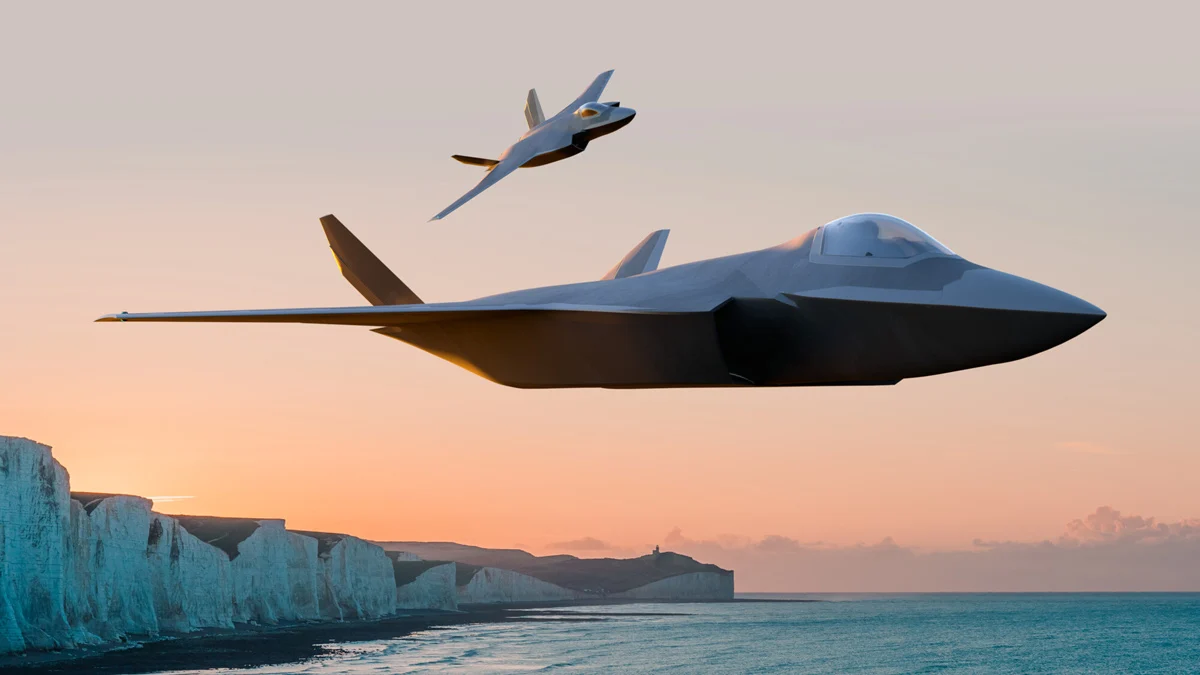
The Royal Air Force (RAF) has confirmed that the United Kingdom’s future Global Combat Air Programme (GCAP) fighter will use boom air-to-air refuelling rather than the probe-and-drogue system employed by today’s RAF fast jets, a decision that will require Britain to introduce a sovereign boom refuelling capability for the first time.
The confirmation, made by an RAF official during the Global Air & Space Chiefs’ Conference in London and first reported by Janes, provides the clearest indication yet of how the sixth-generation fighter is being configured as the trilateral programme enters its next phase of development.
It also highlights a capability gap within the RAF’s existing tanker fleet that will need to be addressed before the aircraft enters service in 2035.
Speaking during a question-and-answer session, the official said the future combat aircraft would use the Universal Aerial Refuelling Receptacle Slipway Installation (UARRSI), which requires a boom-equipped tanker rather than the hose-and-drogue system currently used by the RAF.
“We currently do not have boom in the UK. We have a requirement for boom from GCAP. We have to resolve that requirement, and that is what we’re now looking at,” the official said, adding that the service is examining the timelines and procurement approach needed to deliver a sovereign boom capability.
GCAP exposes the RAF’s boom tanker gap
The announcement represents more than a technical design decision for GCAP.
The RAF’s Voyager KC2 and KC3 tanker fleet, based on the Airbus A330 Multi Role Tanker Transport (MRTT), provides the UK’s current air-to-air refuelling capability using wing-mounted hose-and-drogue pods, with the KC3 also equipped with a centreline hose unit. Neither variant carries a refuelling boom.
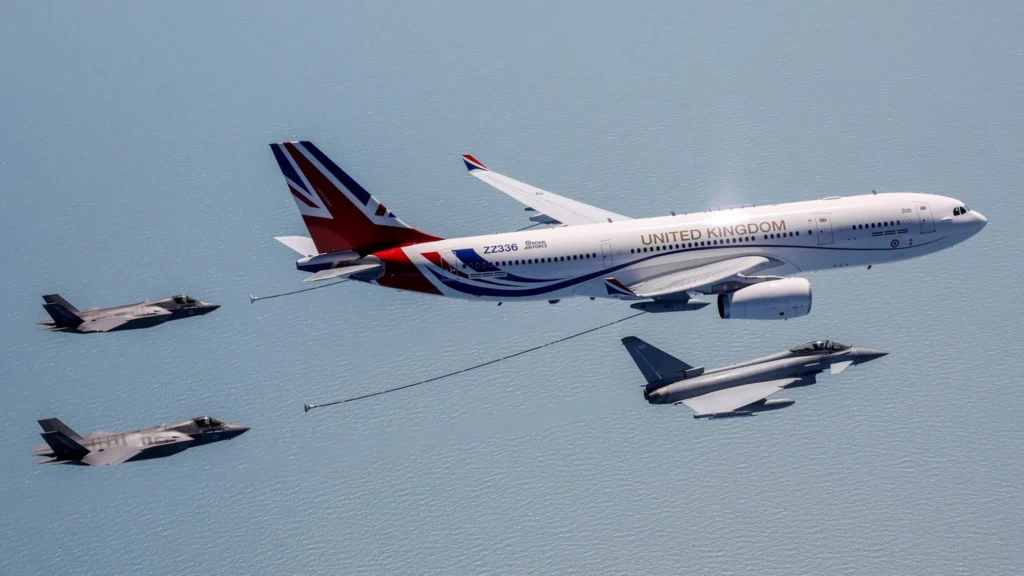
As a result, the RAF relies on allied aircraft whenever boom refuelling is required for platforms such as the RC-135 Rivet Joint intelligence aircraft, C-17 Globemaster III transport, and P-8A Poseidon maritime patrol aircraft, all of which are equipped with boom receptacles.
The issue is expected to become even more significant if Britain proceeds with plans to acquire the conventional take-off and landing F-35A for NATO’s nuclear mission, as that variant also uses boom refuelling.
The confirmation that GCAP will adopt the same system suggests future RAF combat aviation will increasingly align with a boom-equipped refuelling architecture rather than the probe-and-drogue arrangement that has characterised British fast-jet operations for decades.
GCAP funding moves programme into full-scale development
The refuelling decision comes only weeks after the UK government reaffirmed its commitment to GCAP through the long-awaited Defence Investment Plan (DIP), ending months of uncertainty over funding for the programme.
The government has allocated around £8.6 billion (approximately $12 billion) over the next four years to support the development of the sixth-generation fighter, allowing a £4.6 billion ($6.2 billion) contract to be awarded earlier this month to Edgewing, the industrial joint venture bringing together BAE Systems, Leonardo and Japan Aircraft Industrial Enhancement Co.
The funding enables the programme to complete its advanced concept and assessment phase while continuing detailed design and technology development.
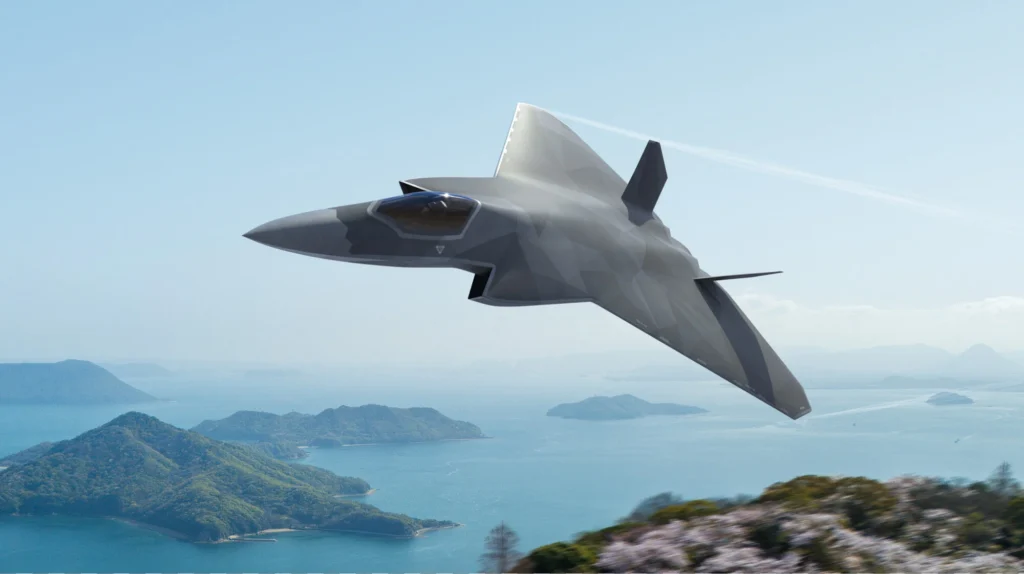
The investment also reassured Italy and Japan, which had expressed concern over delays to the UK’s funding decisions. Japan has maintained a firm objective of bringing the aircraft into operational service by 2035, while Italy has already committed substantial national funding to the programme.
The Defence Investment Plan effectively shifted GCAP from political uncertainty into full-scale development, with work now focused on technology maturation, industrial readiness and the supporting capabilities required to field the aircraft.
Boom refuelling offers clues to GCAP’s size and mission
Although the RAF has not disclosed detailed design specifications, the decision to adopt boom refuelling offers another indication of the type of aircraft GCAP is expected to become.
Previous programme briefings have suggested the aircraft will be substantially larger than today’s Eurofighter Typhoon, with greater internal fuel capacity, extended range and larger internal weapon bays.
Industry officials have consistently described long range, endurance and payload as higher priorities than the close-range manoeuvrability that defined earlier generations of combat aircraft.
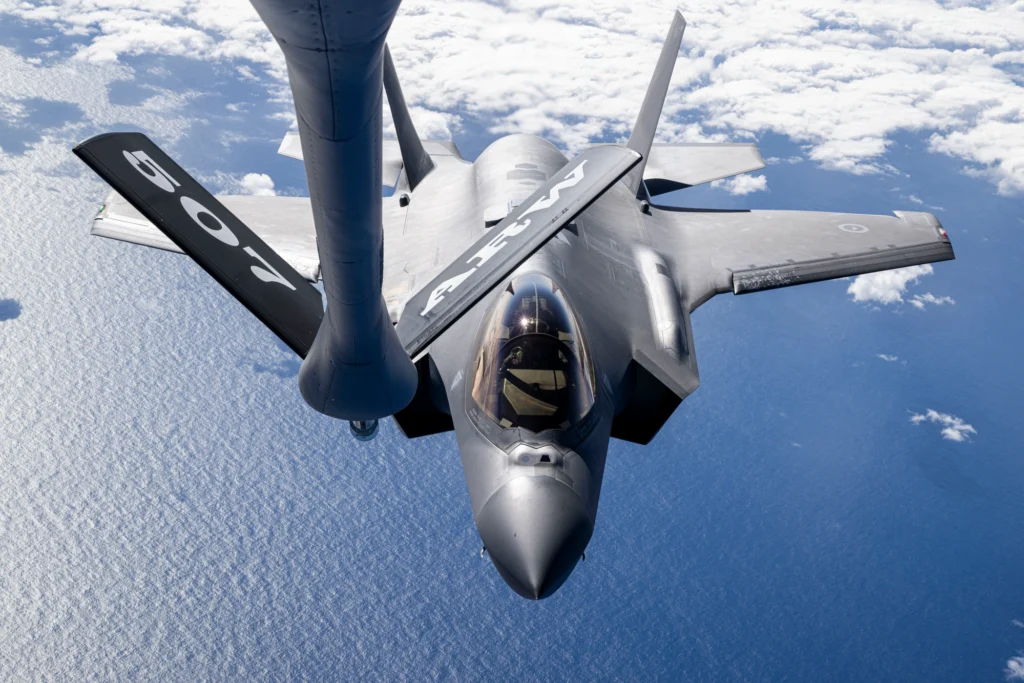
Boom systems typically transfer fuel significantly faster than hose-and-drogue systems, making them well-suited to larger aircraft carrying greater fuel loads.
The arrangement is also standard across several allied air forces, including Japan and Italy, the UK’s partners in GCAP.
While the RAF has yet to announce how it intends to establish a sovereign boom capability, the confirmation suggests future tanker requirements will need to evolve alongside the aircraft itself.
Air Chiefs Conference highlights deeper GCAP cooperation
The announcement came during the two-day Global Air & Space Chiefs’ Conference, which brought together senior military leaders to discuss the future of air and space power.
The importance of GCAP to the gathering was reflected in Japan’s participation.
According to Japan’s Air Staff Office, Chief of Staff Gen. Hiroaki Uchikura travelled to the United Kingdom to attend the conference before continuing to the Royal International Air Tattoo and the Farnborough International Airshow, where he is scheduled to participate in discussions highlighting cooperation between Japan, the UK and Italy under GCAP.
That growing level of engagement reflects how the programme has evolved beyond a collaborative aircraft project into a long-term strategic partnership spanning industrial development, technology sharing and operational integration.
For now, the confirmation of boom refuelling represents only one design choice.
But it illustrates how GCAP is steadily moving beyond concept studies and funding announcements towards defining the operational architecture that will shape Britain’s next-generation combat air capability.
As the programme progresses towards its 2035 service target, decisions on tankers, infrastructure and sustainment are becoming just as important as the aircraft itself.
Sign up for our newsletter and get our latest content in your inbox.
Similar Reads


Sign up for our newsletter. Select all sectors relevant to you.
Related