UK Government partners with Google in world-first contrail trial



The UK Government is partnering with Google and British aviation researchers on a £5 million trial to test whether artificial intelligence can help aircraft avoid climate-warming contrails.
Operation Blue Skies will test small altitude changes on commercial flights crossing the North Atlantic. The 30-month programme would be the world’s first contrail-avoidance trial conducted at an oceanic-airspace scale.
The Department for Transport is providing £2.65 million towards the programme. Google UK will contribute £1.4 million of AI expertise, engineering time and computing infrastructure on a pro bono basis.
“We’re partnering with Google to back British experts and innovators to find practical ways to make flying cleaner. This is a world-first, and it’s British ingenuity leading the way,” said UK Aviation Minister Keir Mather. “By testing small tweaks to flight paths over the Atlantic, we can cut the vapour trails left behind by planes.”
How Operation Blue Skies will work
The project brings together Google, the Department for Transport, Met Office, NATS, Contrails.org, Imperial College London and the University of Cambridge.
Two operational trials will take place during the winters of 2026-27 and 2027-28 in Shanwick Oceanic airspace. This covers the eastern half of the North Atlantic corridor controlled by NATS.
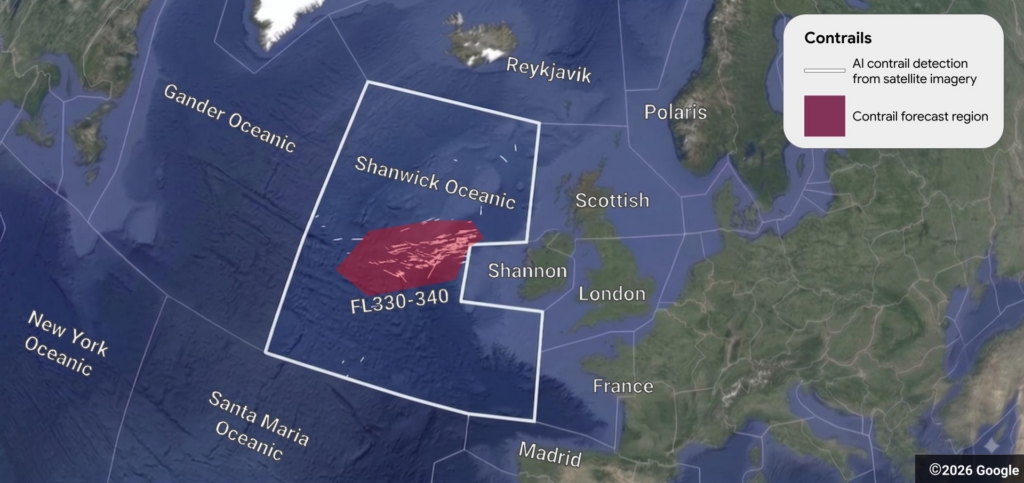
Testing will take place over around 20 to 40 days each winter and during periods of low traffic. Aircraft will make minor altitude adjustments using existing air traffic control communication procedures.
AI will help identify when an intervention could have the greatest effect, reducing the likelihood of contrails.
Google will develop models to predict and avoid warming contrails. Machine learning and satellite imagery will help researchers track and verify the impact. The Met Office will also develop a new UK contrail forecasting capability.
“Contrail avoidance has reached a pivotal moment. The question is no longer whether we can mitigate contrails, but whether we can make that mitigation work at the scale of the global aviation system,” said Kemal Armada, Product Manager at Google.
He described the trial as “an important step toward making that a reality.”
Focusing on contrails in the North Atlantic
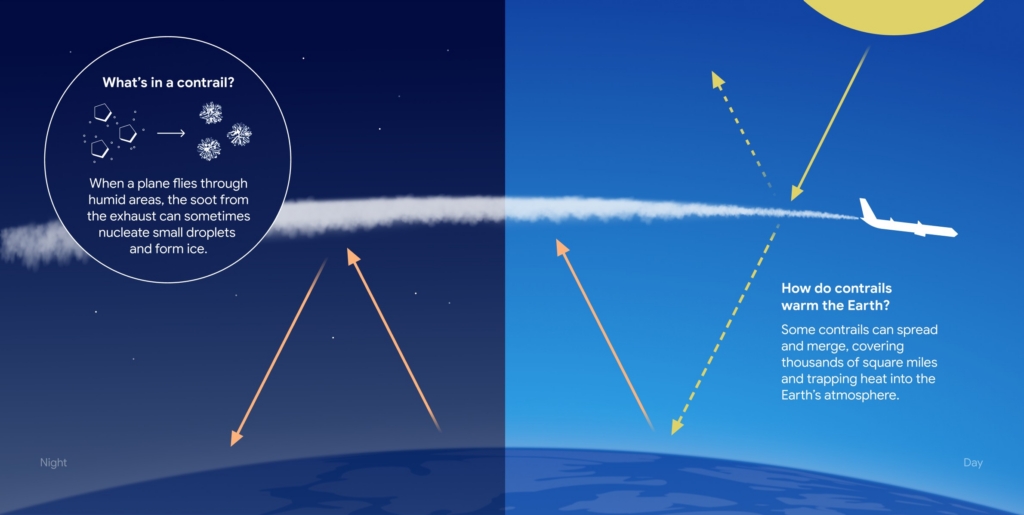
Contrails form when water vapour from jet-engine exhaust freezes around soot particles and other aerosols in cold, humid air at altitude. While some contrails dissipate quickly, others persist and form cirrus-like clouds that trap outgoing heat.
The consortium says persistent warming contrails account for around one-third of aviation’s overall climate impact. However, their climate impact is not evenly distributed across all flights or regions.
Atmospheric modelling suggests Shanwick airspace accounts for approximately 5% of global contrail warming. A significant proportion of that effect is concentrated between November and February.
That makes the North Atlantic a useful testing ground for targeted contrail avoidance.
Rather than requiring major diversions, aircraft could avoid some of the atmospheric conditions that produce persistent contrails by adjusting altitude.
The challenge is determining whether those adjustments can be made safely and efficiently across busy airspace without creating significant additional fuel burn or disrupting air traffic operations.
NATS will test contrail avoidance in real-world operations
NATS will be responsible for trial airspace operations, air traffic control coordination, safety assessments and controller training.
Ian Jopson, Director of Sustainability at NATS, said the trial would provide evidence of how the concept works in operational air traffic management.
“This trial will allow us to test how contrail avoidance could work within the complex, highly coordinated environment of air traffic management,” he said.
“By bringing together world-leading science and operational expertise, we can start to build the real-world evidence needed to understand whether this could make a meaningful contribution to reducing aviation’s overall climate impact.”
Contrails.org will assess and integrate forecasts, help design the trial and analyse its data. Imperial College London and the University of Cambridge will independently evaluate the results and climate benefits.
Could airlines eventually avoid contrails routinely?
The longer-term question is whether contrail avoidance can become part of normal airline and air traffic management operations.
Professor Marc Stettler of Imperial College London said research published in 2020 had already suggested that small flight-path changes could reduce the climate impact of contrails.
“Operation Blue Skies is a chance to test that idea in the real world and on a scale we’ve never seen before,” he said.
Imperial will examine the effects, ranging from airline operations to climate benefits, and provide evidence to determine whether contrail avoidance “could become part of everyday aviation.”
Professor Steven Barrett, Regius Professor of Engineering at the University of Cambridge, said contrail avoidance “could drastically reduce the global climate impact of aviation, at minimal cost to passengers and companies.”
He described Operation Blue Skies as “a big step forward,” testing the UK’s ability to reduce contrail coverage across an entire airspace region under real-world conditions.
Unlike future technologies that require new aircraft or propulsion systems, contrail avoidance could reduce aviation’s climate impact using existing aircraft.
Operation Blue Skies will now test whether AI predictions are accurate enough to identify the most damaging contrails and inform safe and practical changes to commercial flight operations across one of the world’s busiest long-haul corridors.
Sign up for our newsletter and get our latest content in your inbox.
Similar Reads


Sign up for our newsletter. Select all sectors relevant to you.
Related