
General Atomics

Teledyne passes 1,000 sensors in orbit with NASA Roman Telescope launch

The launch of NASA's Nancy Grace Roman Space Telescope marks a major milestone for Teledyne, whose detector technology will enable the mission to investigate dark energy, hunt for exoplanets and survey billions of galaxies.

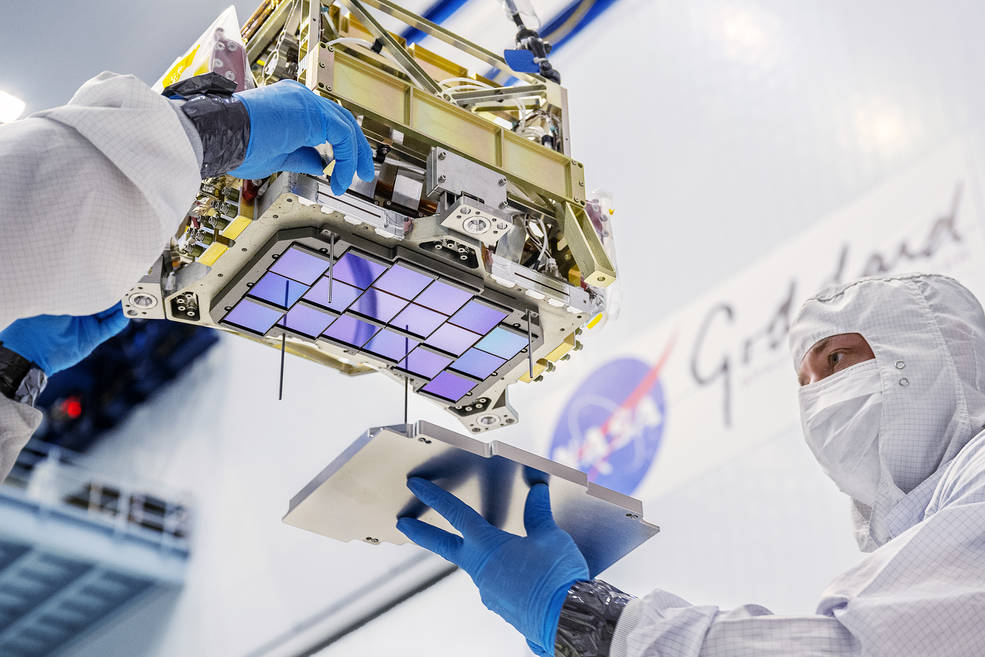
The infrared focal plane with H4RG-10 detector
Photo: Chris Gunn / © NASA

Teledyne Space Imaging, marked a major milestone following the successful launch of NASA‘s Nancy Grace Roman Space Telescope, which lifted off on 30 August aboard a SpaceX Falcon Heavy rocket from Kennedy Space Center in Florida.

With the launch of Roman, there are now more than 1,000 Teledyne scientific imaging sensors in space, including those aboard the Hubble and James Webb missions. The detector technologies supplied by Teledyne support both of Roman’s primary scientific instruments, enabling investigations into dark energy, exoplanets and a broad range of astrophysical phenomena, reinforcing the company’s position as a supplier of advanced detector technologies for scientific, commercial and governmental space missions.

In 2018, Teledyne was awarded a $23 million contract by NASA to provide 24 flight quality sensor chip assemblies for the Roman mission, later expanded to 28. Each delivered detector surpassed performance specifications for quantum efficiency, low noise and image persistence, while also enabling a 20% increase in the instrument’s spectral bandwidth.

Why infrared detector arrays will increase Roman’s field of view

For the mission’s Wide Field Instrument (WFI), Teledyne supplied the H4RG-10 infrared detector arrays that form Roman’s distinctive focal plane, the largest infrared focal plane ever flown in space. Each detector contains more than 16 million pixels arranged in a 4096 × 4096 format. Together, 18 H4RG-10 detectors create a mosaic of more than 300 million pixels, with a unique shape that inspired the iconic Roman mission logo selected by NASA.
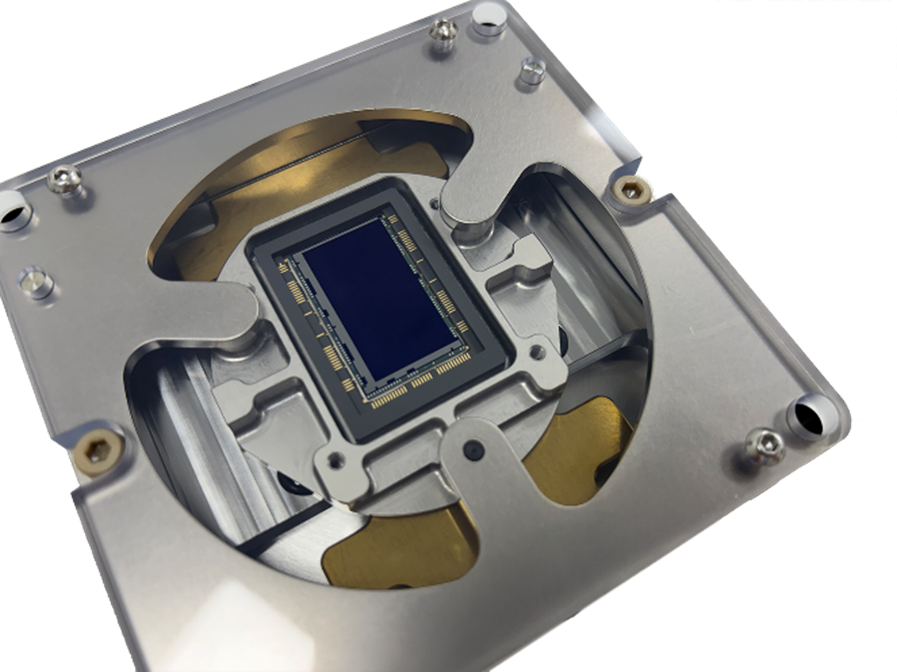
Teledyne-CCD311-20 detector-01092026
Photo: Teledyne

Teledyne also supplied three CCD311-20 detectors for Roman’s Coronagraph Instrument, one of the most advanced high-contrast imaging systems ever flown in space. The Coronagraph Instrument combines precision coronagraph masks, deformable mirrors, wavefront sensing and control systems and electron-multiplying CCD technology to suppress starlight and directly observe much fainter planetary systems. The technology demonstration is expected to help pave the way for future missions capable of directly imaging Earth-like planets around nearby stars.

Teledyne’s imaging sensors support many of the world’s important scientific and Earth observation missions, including the Hubble Space Telescope, James Webb Space Telescope, Euclid Space Telescope, ESA’s Sentinel missions and NOAA’s and NASA’s GOES programme. Megan Tremer, President of Teledyne Space Imaging, said: “Reaching more than 1,000 scientific, space-qualified imaging sensors in orbit is a proud achievement for everyone at Teledyne. It reflects our long-standing commitment to advancing imaging technology and supporting the world’s most ambitious space missions. Roman is another important chapter in that story and we are excited to see how it expands our understanding of the Universe.”

How NASA plans to increase our understanding of the distant Universe

Roman is NASA’s latest flagship astrophysics observatory, designed to survey billions of galaxies and observe distant stellar explosions to help scientists investigate dark energy, the mysterious force driving the accelerating expansion of the Universe. The mission will also identify thousands of exoplanets beyond our solar system, including planetary systems that have never previously been studied on such a scale. It combines a field of view around 200 times larger than the Hubble Space Telescope’s infrared observations.

Beyond these primary objectives, Roman will support a broad range of astronomical research, from studying star formation in neighbouring galaxies and supermassive black holes in the distant Universe, to investigating the environments where stars and planetary systems are born. The observatory will also contribute to our understanding of objects within our own solar system.

Related

NATS launches nationwide search for future air traffic controllers
Heathrow Tower.
NATS launches nationwide search for future air traffic controllers
One in four jobseekers have never been encouraged to consider air traffic control as a career, according to new research released as NATS reopens applications for trainee controllers.
Aerospace Member News

1 Sep 2026

Donite Plastics appoints Des Hassett as General Manager
Des Hassett
Donite Plastics appoints Des Hassett as General Manager
Experienced manufacturing professional Des Hassett, has been appointed General Manager for Donite Plastics, based at their Saintfield facility in County Down, Northern Ireland, to lead operations and enhance productivity.
ADS cyclists battle crashes, climbs and forest fires to raise over £5,000
ADS Charity Cycle
ADS cyclists battle crashes, climbs and forest fires to raise over £5,000
Industry riders covered 334 miles from Belfast to Bristol in support of Combat Stress, O2e and Air Ambulance Northern Ireland.
Donite Plastics appoints Des Hassett as General Manager
Des Hassett
Donite Plastics appoints Des Hassett as General Manager
Experienced manufacturing professional Des Hassett, has been appointed General Manager for Donite Plastics, based at their Saintfield facility in County Down, Northern Ireland, to lead operations and enhance productivity.
ADS cyclists battle crashes, climbs and forest fires to raise over £5,000
ADS Charity Cycle
ADS cyclists battle crashes, climbs and forest fires to raise over £5,000
Industry riders covered 334 miles from Belfast to Bristol in support of Combat Stress, O2e and Air Ambulance Northern Ireland.
Inside Babcock’s plans to turn the Type 31 into a four-ship hybrid task force
Babcock ARMOR Force four ship formation
Inside Babcock’s plans to turn the Type 31 into a four-ship hybrid task force
Babcock’s ARMOR Force would combine a Type 31 command ship with large uncrewed vessels carrying modular weapons and sensors. Sir Nick Hine says the technology has finally caught up with the concept.
Defence Insights

30 Aug 2026

ADS cyclists battle crashes, climbs and forest fires to raise over £5,000
ADS Charity Cycle
ADS cyclists battle crashes, climbs and forest fires to raise over £5,000
Industry riders covered 334 miles from Belfast to Bristol in support of Combat Stress, O2e and Air Ambulance Northern Ireland.
Scottish space tech to power self-consuming rocket engine
Alpha Impulsion
Scottish space tech to power self-consuming rocket engine
Aurora Avionics is to supply crucial electronic systems that will deliver key electrical power functions for a pioneering new rocket engine, that aims to cut propulsion costs and support next-generation spacecraft.
Space

27 Aug 2026

STFC reveals latest Ernest Rutherford Fellows
space nebula
STFC reveals latest Ernest Rutherford Fellows
Backed by an investment of £6 million, seven early-career physicists have been awarded Ernest Rutherford Fellowship’s by the Science and Technology Facilities Council (STFC), supporting research, from the search for dark matter to the physics of black holes.
Space

25 Aug 2026

Metropolitan Police Force expands its fleet of crime-fighting e-bikes
Met Sur-Ron eBikes at New Scotland Yard
Metropolitan Police Force expands its fleet of crime-fighting e-bikes
As it continues to address the challenge posed by criminals using e-bikes and mopeds to commit crime and evade the law, the Metropolitan Police Force has substantially increased its own fleet of Sur-Ron e-bikes, to tackle the perpetrators.
Security

31 Aug 2026

ADS cyclists battle crashes, climbs and forest fires to raise over £5,000
ADS Charity Cycle
ADS cyclists battle crashes, climbs and forest fires to raise over £5,000
Industry riders covered 334 miles from Belfast to Bristol in support of Combat Stress, O2e and Air Ambulance Northern Ireland.
ZeroUSV unveils first of its new Oceanus17 USV
Oceanus17 class of USV
ZeroUSV unveils first of its new Oceanus17 USV
ZeroUSV’s brand new Oceanus17 class of unmanned surface vessel (USV) has been unveiled, officially named The Lady of the Lake, marking a key advance in the development of British autonomous maritime capabilities.
Defence Security

28 Aug 2026