RAF to develop sovereign boom refuelling capability, confirms minister


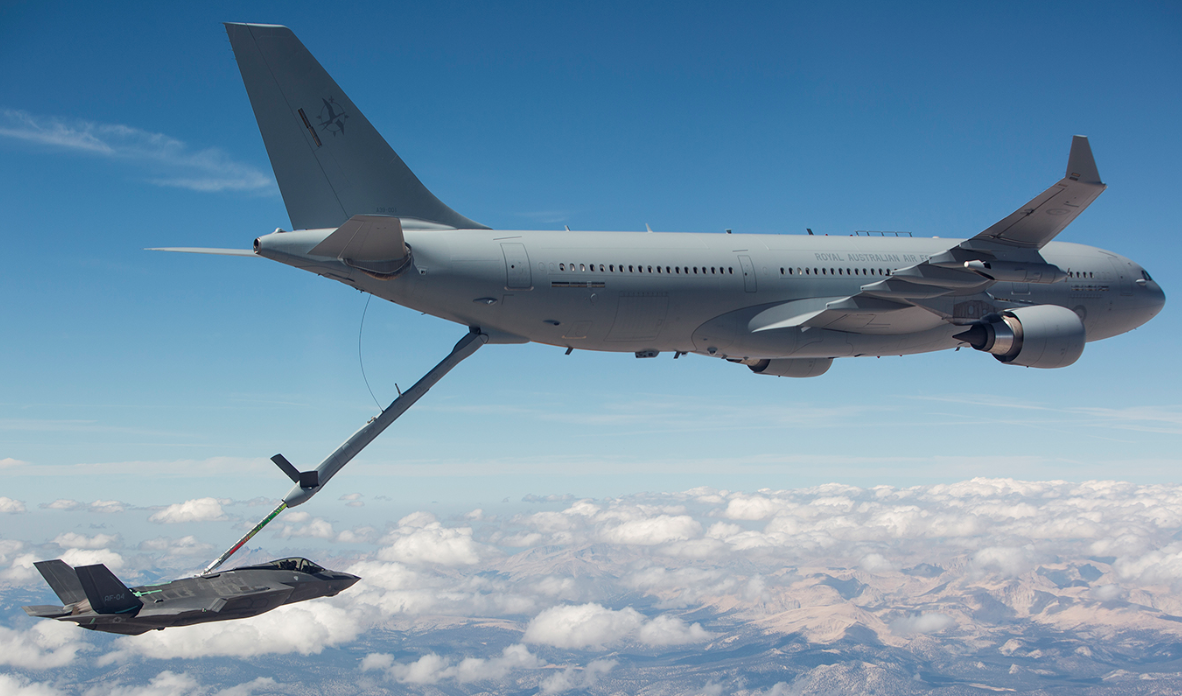
The UK will develop a boom air-to-air refuelling capability for the Royal Air Force, Defence Minister Luke Pollard has confirmed, moving a long-discussed requirement into government policy as the service prepares for a future fleet increasingly dependent on boom-refuelled aircraft.
Pollard, Minister of State for Defence Readiness and Industry, confirmed the move in a written parliamentary answer to Conservative MP Ben Obese-Jecty, who asked about the requirement to refuel the F-35A, E-7 Wedgetail, P-8A Poseidon and RC-135 Rivet Joint.
“The Royal Air Force currently operates a probe and drogue air-to-air refuelling system and will complement this with the development of a boom system. This will ensure we have a sovereign air-to-air refuelling capability for the future Royal Air Force fleet that enhances interoperability with NATO Allies and partners,” Pollard said.
The confirmation takes the issue a step beyond the position outlined by the RAF in July. As ADVANCE reported at the time, an RAF official had confirmed that the Global Combat Air Programme (GCAP) fighter would also use boom refuelling and said the service was examining how to meet that requirement.
“We currently do not have boom in the UK. We have a requirement for boom from GCAP. We have to resolve that requirement, and that is what we’re now looking at,” the official said during the Global Air & Space Chiefs’ Conference in London.
Pollard’s parliamentary answer now makes clear that Britain intends to develop the capability rather than continue relying solely on allied tankers.
The UK already operates aircraft its own tankers cannot refuel
The gap is not a future problem created solely by GCAP.
Several of the RAF’s most important aircraft already depend on the flying boom method of air-to-air refuelling. The RC-135W Rivet Joint intelligence aircraft, P-8A Poseidon maritime patrol aircraft and C-17 Globemaster III transport cannot receive fuel from the RAF’s current Voyager tankers because they use boom receptacles rather than refuelling probes.
The incoming E-7 Wedgetail is also boom-refuelled.
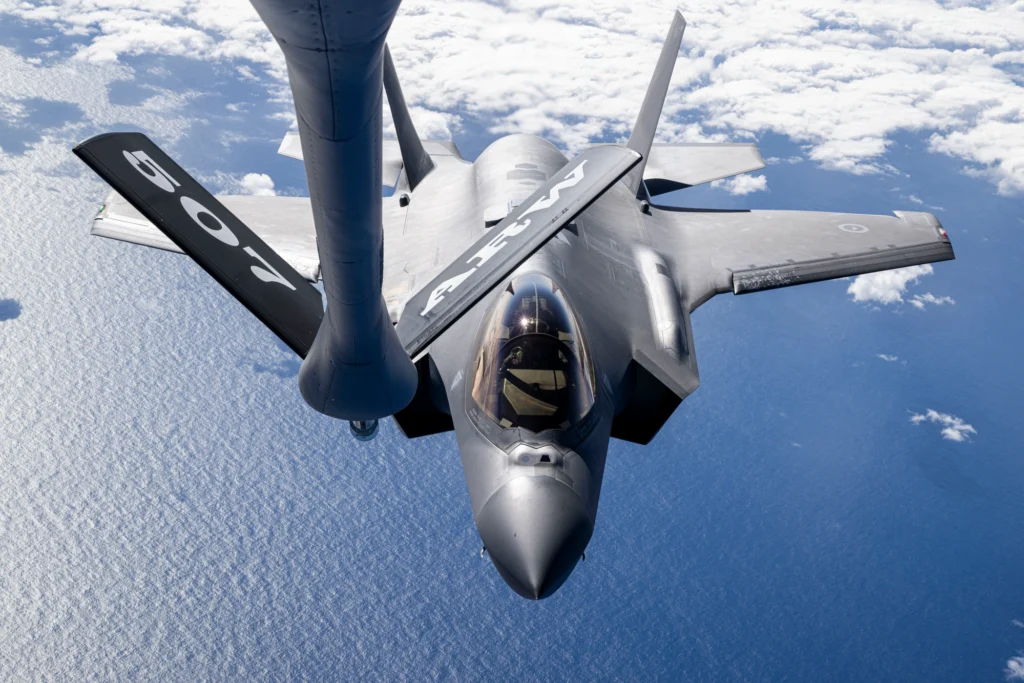
UK’s decision to acquire F-35A fighters adds another aircraft to that group. Unlike the carrier-capable F-35B, which uses probe-and-drogue refuelling, the conventional take-off F-35A receives fuel through a boom receptacle.
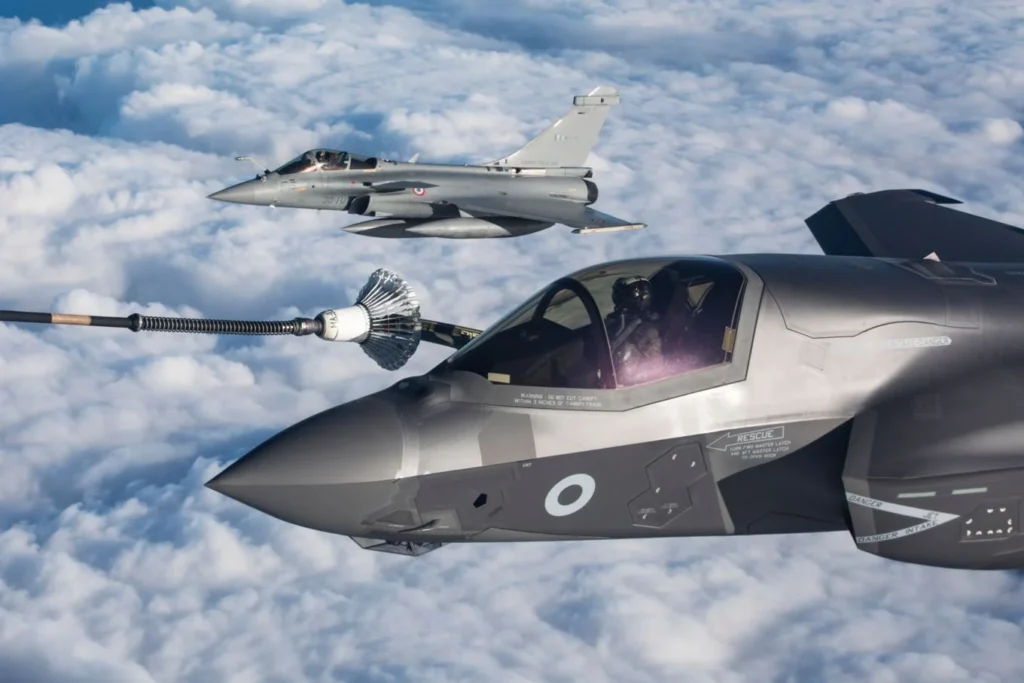
That leaves the RAF with an unusual situation: it operates, or is preparing to operate, several strategically important aircraft that cannot be refuelled in the air by UK’s own tanker fleet.
At present, the RAF relies on allied tankers when those aircraft require air-to-air refuelling.
The distinction becomes particularly important during national operations, when allied tanker support cannot automatically be assumed.
Pollard’s use of the word “sovereign” therefore goes to the heart of the requirement. Britain wants the ability to support its own aircraft without depending on another country to provide the tanker.
GCAP turned a longstanding gap into a requirement that could no longer be deferred
The future GCAP combat aircraft makes the issue more pressing.
ADVANCE reported in July that the aircraft being developed by UK, Italy and Japan will use the Universal Aerial Refuelling Receptacle Slipway Installation, or UARRSI, requiring a boom-equipped tanker.
Without a change to the tanker fleet, UK could therefore enter the GCAP era with a new-generation combat aircraft that its own Voyagers could not refuel.
The choice also provides a clue to the operational thinking behind the new fighter.
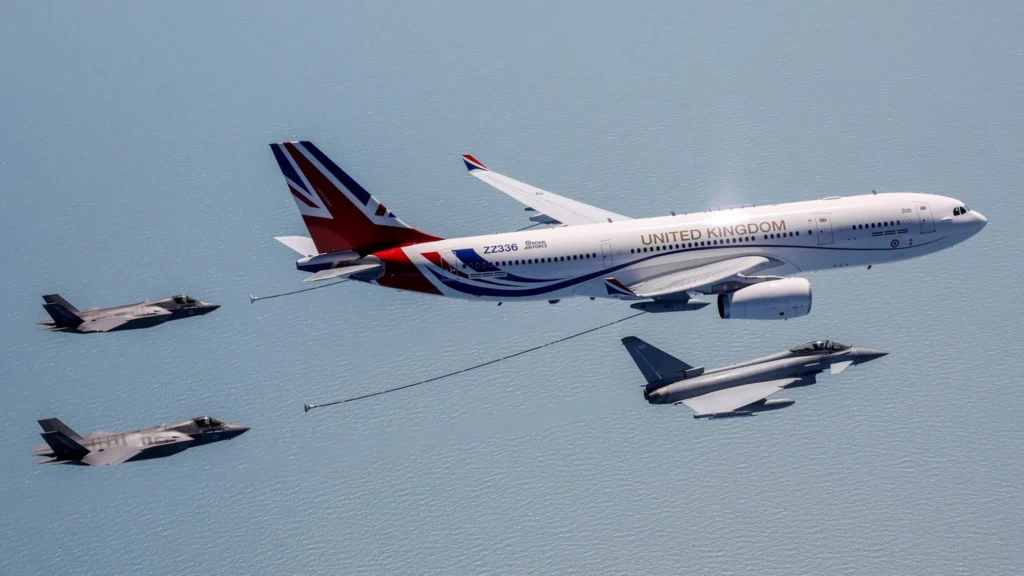
GCAP is expected to be substantially larger than the Eurofighter Typhoon, with greater internal fuel capacity, longer range and larger internal weapons bays. Long range, endurance and payload have been identified as priorities for the programme.
A boom is particularly suited to aircraft requiring large quantities of fuel because it can transfer fuel considerably faster than a hose-and-drogue system. It is also widely used among NATO air forces and by the US Air Force. Japan and Italy, Britain’s two GCAP partners, already operate boom-equipped tanker architectures.
The tanker decision therefore has implications well beyond a modification to the RAF’s support fleet. It will form part of the operating architecture required to keep Britain’s future combat aircraft airborne at long range.
Boom and probe-and-drogue solve the same problem in different ways
The two refuelling systems are mechanically very different.
Under the probe-and-drogue method used by today’s RAF fast jets, a flexible hose trails behind the tanker with a basket at the end. The receiving aircraft’s pilot manoeuvres a probe into the basket to establish the fuel connection.
A flying boom instead uses a rigid telescopic tube extending from the tanker. The boom is guided into a receptacle on the receiving aircraft and can deliver fuel at a higher rate.
An aircraft configured only with a boom receptacle cannot simply take fuel from a drogue, which is why the absence of a British boom capability matters.
The RAF’s Voyager KC2 and KC3 aircraft are based on the Airbus A330 Multi Role Tanker Transport. Both use wing-mounted hose-and-drogue pods, while the KC3 also carries a centreline hose unit. Neither RAF variant has a boom.
The underlying A330 MRTT, however, can be configured with a flying boom and is operated that way by other air forces.
That leaves UK with options, but the government has not yet said which one it will take.
How UK will introduce the boom remains unanswered
Pollard confirmed development of the capability, but his answer did not set out the aircraft, procurement route, number of tankers or timetable.
The existing Voyager fleet is tied to UK’s AirTanker arrangement, rather than being a conventional fleet owned outright and operated solely by the RAF.
When ADVANCE reported on the issue in July, the RAF had identified GCAP’s boom requirement and was considering the timelines and procurement approach needed to establish a sovereign capability.
The requirement now stretches across a much broader part of the future fleet. The P-8A and RC-135 are already in service. E-7 is entering the force. F-35A is planned, and GCAP is being developed for service from 2035.
Sign up for our newsletter and get our latest content in your inbox.
Similar Reads


Sign up for our newsletter. Select all sectors relevant to you.
Related