Could Moon dust provide propellant for spacecraft?
The University of Surrey is leading a research project funded by the European Space Agency (ESA), to evaluate whether metal magnesium can be extracted from Moon dust, to propel future spacecraft.

Moon Dust extraction
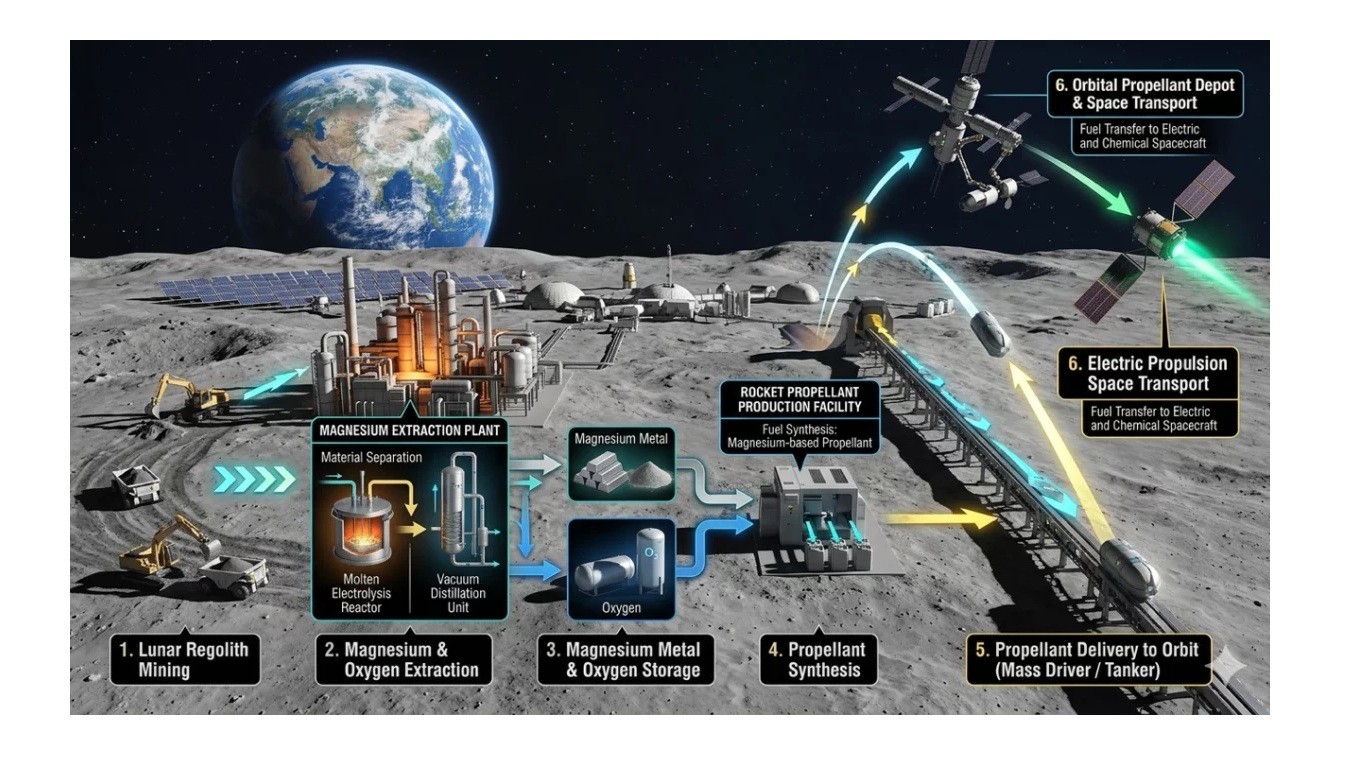
Above: This image was generated using Gemini Nano Banana 2 to illustrate the concept of magnesium extraction and its application to electric propulsion on the Moon. The image has been verified by the research team. Photo: University of Surrey

Could magnesium found in Moon dust help future spacecraft travel further into deep space? A new European Space Agency (ESA)-funded project led by the University of Surrey aims to find out.

Researchers at the prestigious Surrey Space Centre are working with UK propulsion company Eos Space Technology Ltd to investigate whether the metal magnesium can be extracted from lunar regolith (the loose rock and dust covering the Moon) and used as a solid propellant for electric propulsion.

Electric propulsion systems can use gases such as xenon and krypton but they would need to be transported from Earth. Producing propellant from materials already available on the Moon could reduce this reliance and potentially support future deep space exploration and cislunar commercial activity.

Why using magnesium as a propellant faces several challenges

However, using metals such as magnesium in conventional Hall-effect thrusters (a type of electric propulsion system that uses electrically charged particles to generate thrust) presents several challenges, including condensation, unstable plasma and erosion of the channel through which the plasma travels.

The nine-month MAGPIE project (MAGnesium Propulsion from In-Situ Extraction on the Moon) aims to tackle these barriers by testing a novel Hall thruster design and assessing, from extraction through to propulsion, whether lunar-sourced magnesium could become a viable propellant for future spacecraft.

Dr Sungwoo Lim, Principal Investigator of MAGPIE and Senior Lecturer in Space Applications, Exploration and Instrumentation at the Surrey Space Centre, University of Surrey, said: “The exciting question behind MAGPIE is whether spacecraft could one day use a resource that is already available on the Moon instead of having to carry all of their propellant from Earth.

“We are proposing to melt the regolith and dust to see if it is possible to extract usable magnesium on the Moon’s surface. Using the specialist facilities here at Surrey Space Centre, we will confirm the effect of changes on how thrusters perform and will develop a way of feeding in magnesium.”

Experimentation to define the feasibility of metallic-propellant electric propulsion for future lunar mobility

The research team will assess how much magnesium could be obtained from different types of lunar regolith, test ways of extracting it and develop a system for feeding the metal into an electric thruster. They will then test how the thruster performs with different propellants and how tolerant it is to impurities in the magnesium.

Dr Szymon Dworski, CEO and Co-Founder at Eos Space, said: “We will provide the first dataset grounded in actual experimentation which links lunar extraction pathways to a functional thruster architecture. We hope to define the feasibility envelope for metallic-propellant electric propulsion, which will enable future lunar mobility and orbital logistics concepts that do not rely on propellants that are launched from Earth.”

Running from September 2026 to May 2027, the MAGPIE project is backed by £112,795 in funding through the European Space Agency’s Open Space Innovation Platform (OSIP), which supports novel ideas for new space technologies and applications.

Related

Hexagon and Red Bull look beyond engineering degrees to find manufacturing’s future talent
Formula 1 car at Red Bull's MK7 campus
Hexagon and Red Bull look beyond engineering degrees to find manufacturing’s future talent
At Red Bull’s Milton Keynes campus, Hexagon brought students and employers together to explore how interests in gaming, data and problem-solving could become a route into manufacturing — and what industry needs to do to open those doors.
Birmingham’s Brandauer continues expansion following MBO
Rowan Crozier, Stuart Berry and Harry Champman
Birmingham’s Brandauer continues expansion following MBO
New contract wins across Europe and the US have seen Brandauer mark the first anniversary of its management buy-out with record £10 million sales for the first time in its 164-year history, underpinning its ambitious expansion plans.
Thompson Aero Seating completes inspection of China Southern Airlines’ A350-900 Business Class
Thompson Aero Seating group photo
Thompson Aero Seating completes inspection of China Southern Airlines’ A350-900 Business Class
Northern Ireland based Thompson Aero Seating has completed the First Article Inspection (FAI) for the new Business Class seating, cabin monuments and branding panel system of China Southern Airlines' Airbus A350-900.
Aerospace Member News

19 Nov 2026

Roke appoints Chris Edwards as its first ever Chief Product Officer
Chris Edwards
Roke appoints Chris Edwards as its first ever Chief Product Officer
As part of its plans to drive product-led growth, Roke has appointed Chris Edwards as its first Chief Product Officer (CPO), to focus on transforming the company's intellectual property into deployable frontline capabilities at pace.
Defence Member News

19 Nov 2026

BAE Systems launches XTS Tactical solutions suite
XTS ecosystem
BAE Systems launches XTS Tactical solutions suite
A multidomain solution has been launched by BAE Systems to protect sensitive intelligence data in high threat environments, being sent across networks operating at different security levels.
Defence Member News

19 Nov 2026

UK pledges 1,000-plus strike drones and two UK-built fast attack boats for Ukraine
Callen Lenz Nyan drone launching from Royal Navy ship
UK pledges 1,000-plus strike drones and two UK-built fast attack boats for Ukraine
More than £208 million of the drone funding is set to be spent in the UK, while Norway will meet half the cost of the vessels that will help protect Ukraine’s Black Sea exports.
Defence

19 Nov 2026

Hexagon and Red Bull look beyond engineering degrees to find manufacturing’s future talent
Formula 1 car at Red Bull's MK7 campus
Hexagon and Red Bull look beyond engineering degrees to find manufacturing’s future talent
At Red Bull’s Milton Keynes campus, Hexagon brought students and employers together to explore how interests in gaming, data and problem-solving could become a route into manufacturing — and what industry needs to do to open those doors.
University of Surrey develops electronic eye to monitor solar storms
HEPI prototype ‘electronic eye’ sensor
University of Surrey develops electronic eye to monitor solar storms
Under a £400,000 contract with the European Space Agency (ESA) and the UK Space Agency (UKSA), a team of researchers at the University of Surrey will develop an ultra-compact monitor to reveal the effects of radiation from solar storms on space infrastructure, aircraft and terrestrial systems like satellites.
Aerospace Space

18 Nov 2026

BAE Systems selected as NASA PRIMA partner
NASA’s PRIMA far-infrared space observatory, built on BAE Systems’ Evolve+ platform.
BAE Systems selected as NASA PRIMA partner
Alongside a number of international space industry providers, BAE Systems will support NASA’s PRIMA mission to survey the history and evolution of the universe and bridge current scientific gaps.
Member News Space

18 Nov 2026

Hexagon and Red Bull look beyond engineering degrees to find manufacturing’s future talent
Formula 1 car at Red Bull's MK7 campus
Hexagon and Red Bull look beyond engineering degrees to find manufacturing’s future talent
At Red Bull’s Milton Keynes campus, Hexagon brought students and employers together to explore how interests in gaming, data and problem-solving could become a route into manufacturing — and what industry needs to do to open those doors.
Expert shares what SMEs should do in the first two hours of an energy or cyber disruption
Server racks creating data center corridor 3d
Expert shares what SMEs should do in the first two hours of an energy or cyber disruption
Cyber attacks, grid failures and rising electricity demand are creating new business risks. Dr Phil Wu explains the three actions SMEs should take in the first two hours of a disruption.
Security

19 Nov 2026

UK seeks emergency Border Force cutters as ageing fleet faces service gap
Babcock Type 31
UK seeks emergency Border Force cutters as ageing fleet faces service gap
The UK Home Office is seeking two or three interim Border Force cutters to prevent a "critical capability gap" as its ageing fleet faces mounting maintenance issues ahead of permanent replacements arriving in 2032.
Defence Security

19 Nov 2026