General Atomics

Royal Navy adds suspected counter-drone launchers to HMS Dauntless

HMS Dauntless has received two unidentified launchers potentially designed for drone interception, amid the Royal Navy’s efforts to strengthen shipborne C-UAS defences.

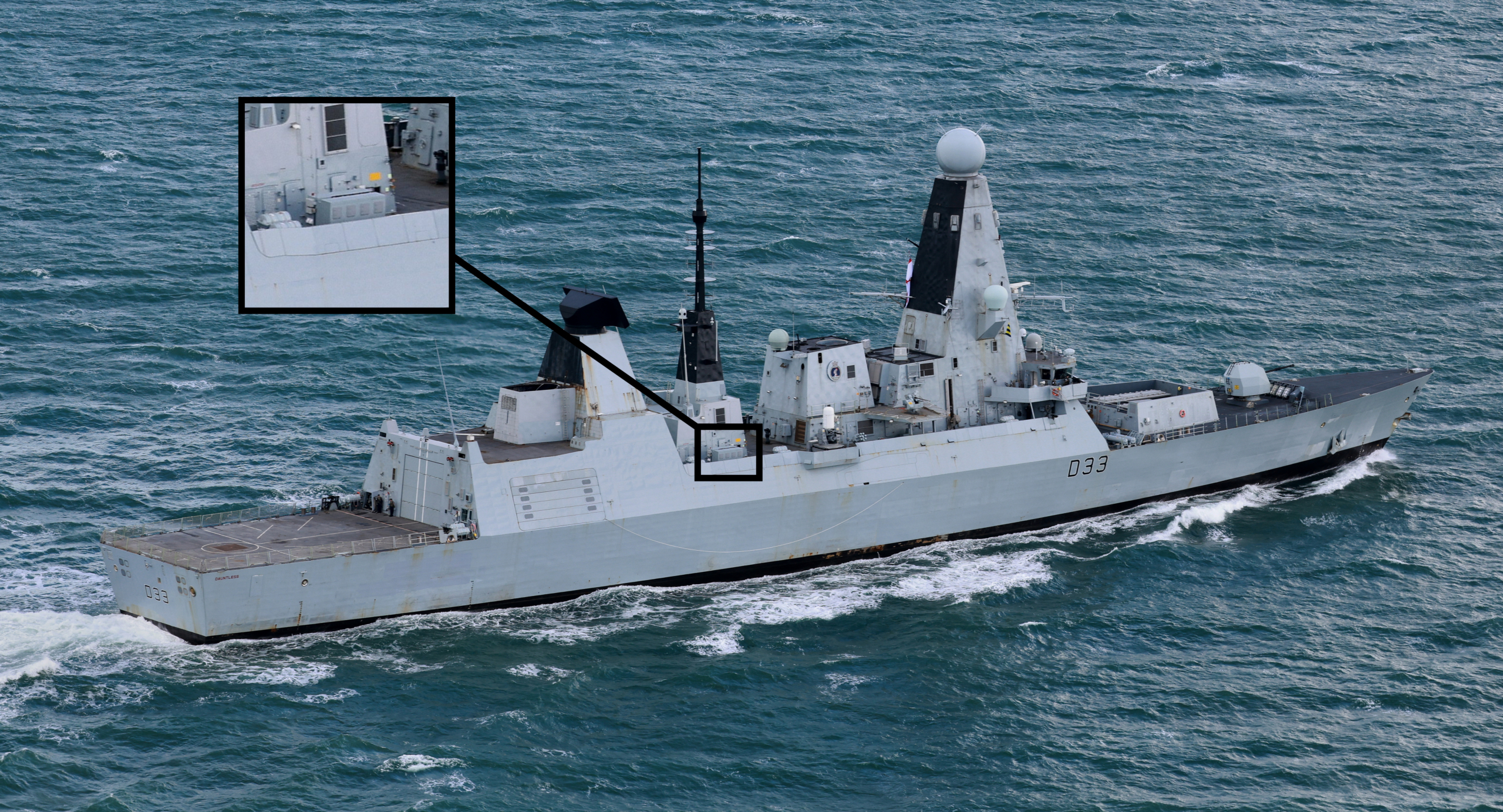
HMS Dauntless (D33) conducts a PASSEX with Ukrainian minehunters off the Isle of Wight on 10 October 2026. The inset image offers a closer look at the warship's new suspected C-UAS launcher. Image: MOD Crown Copyright/PO Phot Belinda Alker

The Royal Navy’s Type 45 destroyer, HMS Dauntless (D33), has been equipped with two unidentified launcher units that are believed to house a new counter-uncrewed aerial system (C-UAS) capability, potentially providing the warship with an additional layer of defence against sophisticated hostile drone threats.

Images released by the UK Ministry of Defence (MOD) on 10 October show two box-shaped containers positioned on the port and starboard sides of the ship’s main communications mast.

Naval News and Navy Lookout reported the installation on 14 October, assessing that the units are likely multi-cell vertical launch systems (VLS) designed to deploy drone interceptors.
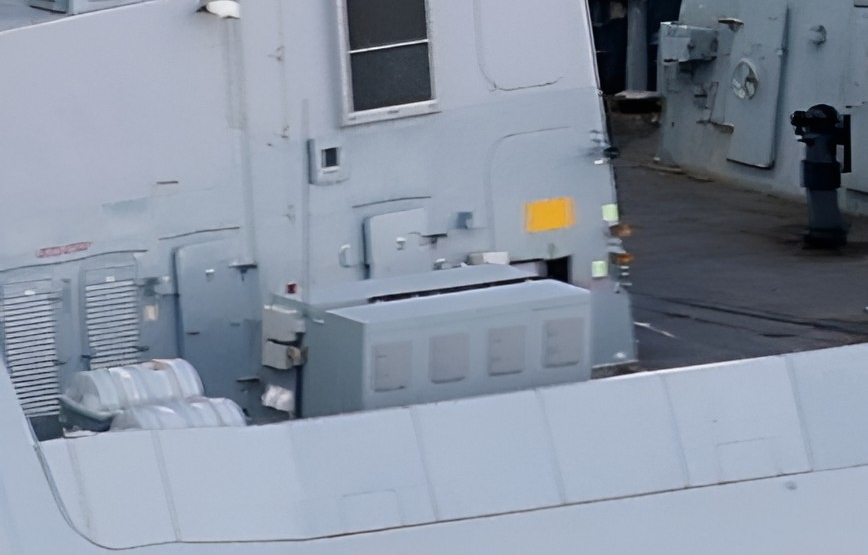
The new launch containers are thought to house vertical-launched drone interceptors against hostile threats during C-UAS operations. Image: MOD Crown Copyright/PO Phot Belinda Alker

The installation was reportedly completed in August 2026, with each unit appearing to measure approximately 2m by 1m. However, the Royal Navy has yet to confirm the equipment’s identity, purpose or operational status. A service spokesperson declined to discuss the addition of these two containers and their purpose, citing operational sensitivities.

This development comes as the Royal Navy seeks to strengthen its ability to counter increasingly capable uncrewed platforms, such as one-way attack (OWA) drones, which can be deployed in large numbers and are designed to overwhelm conventional air defence systems.

Layered defences against a growing drone threat

Equipped with the Sea Viper Principal Anti-Air Missile System (PAAMS), a Sampson multifunction active electronically scanned array (AESA) radar and S1850M long-range search radar, the UK’s six Type 45 warships currently serve as the Royal Navy’s principal air defence destroyers.

Meanwhile, the ship’s 48-cell Sylver A43 VLS carries Aster 15/30 surface-to-air missiles (SAMs) to protect against hostile aircraft and missile threats. The Royal Navy is currently working to replace the Aster 15 SAM with the Sea Ceptor Common Anti-Air Modular Missile (CAMM) in a process that began in 2026.

For engagements at closer range, each vessel is also equipped with two 20mm Phalanx Close-In Weapon Systems (CIWS), as well as six 7.62mm General-Purpose Machine Guns (GPMGs) and two Browning .50-calibre heavy machine guns.
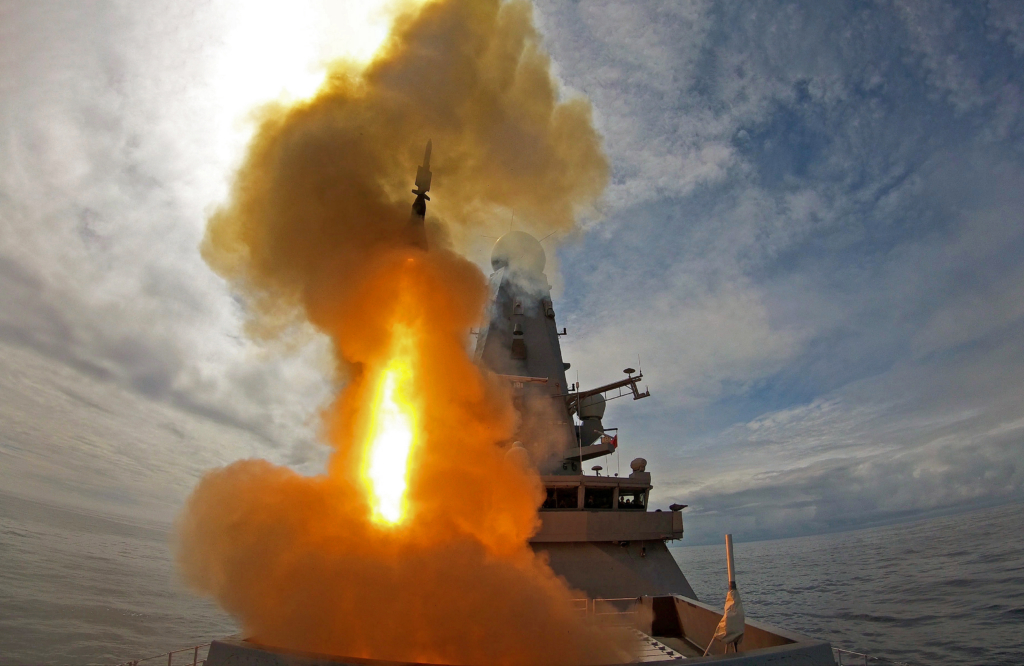
HMS Defender (D36) launches an Aster 15 SAM during Exercise Formidable Shield on 20 May 2019. Image: MOD Crown Copyright/LPhot Ben Shread

From 2027, the Royal Navy’s new DragonFire laser-based directed energy weapon (DEW) will start to become operational, with two Type 45 warships due to receive the system before the end of next year.

However, the growing use of relatively inexpensive OWA drones presents a challenge for warships equipped primarily for high-value missions. While the Aster 15/30 can engage suitable aerial targets, repeatedly using sophisticated interceptors against low-cost OWA drones risks depleting finite and expensive ammunition stocks, thus creating an unfavourable cost exchange.

Dedicated drone interceptors could provide a more proportionate response to suitable threats, allowing the warship to reserve its primary air-defence missiles for more demanding engagements. These new C-UAS launchers would therefore complement – rather than replace – existing short-range weapons, like the Phalanx CIWS and upcoming DragonFire DEW system.

Project TALON points to a possible solution?

The installation closely matches the objectives of Project TALON (Target Acquisition, Localisation and Operational Neutralisation of Uncrewed Aerial Systems).

The Royal Navy issued a request for information (RFI) to industry on 3 March 2026 as part of an urgent operational requirement to add a mature C-UAS capability that could be introduced aboard British warships with little or no integration work required.
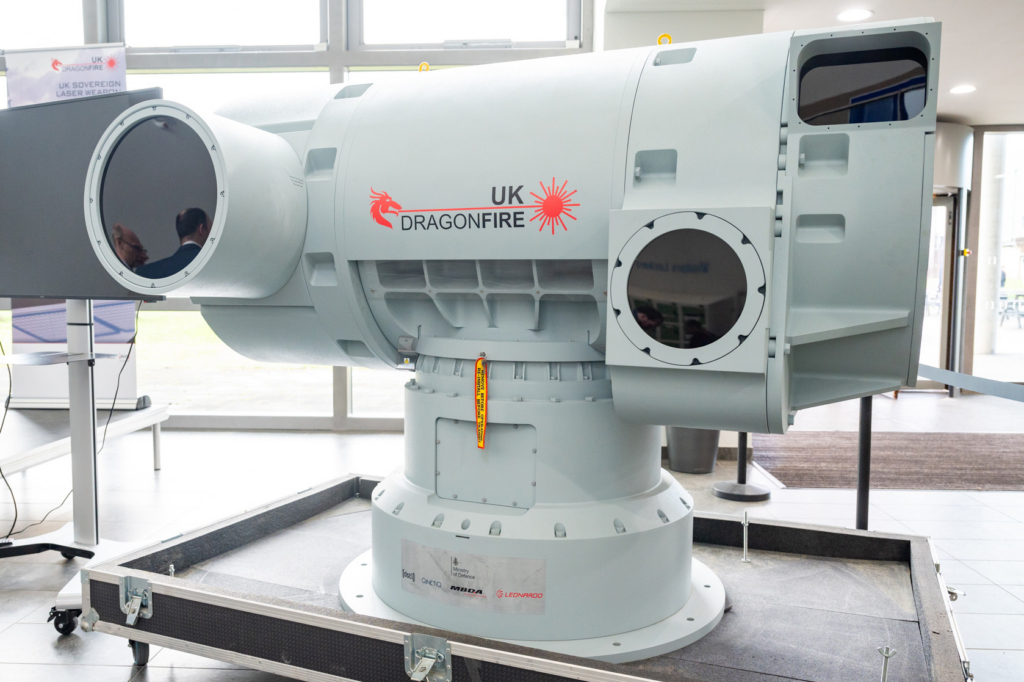
The Royal Navy seeks to field its first two DragonFire-equipped Type 45 destroyers before the end of 2027. Image: MOD Crown Copyright/Jon Fletcher

As per the solicitation, its requirements include defeating NATO Class 2 uncrewed aircraft weighing between 150- 600 kg, including Iranian-made Shahed-type OWA drones.

TALON specified a defended area ranging from 100 km² to a preferred 2,500 km², which is equivalent to a radius of approximately 6- 28 km. It also called for the ability to engage at least 25 targets before reloading, with 100 being maintained as the preferred figure.

These are programme requirements, not confirmed performance specifications for the launchers that have recently been spotted on Dauntless. No public contract award has established a definitive link between the installation and Project TALON.

A potential boost for the Royal Navy’s air defence capabilities?

No additional dedicated sensor suite has been identified alongside the new launchers. The system may therefore draw on existing shipboard sensors – including both the Sampson and S1850M radars and relevant electro-optical (EO) equipment – to identify and track potential targets.

One possibility is that the interceptors receive an initial launch cue from the ship’s sensors before using onboard seekers for terminal guidance. This could reduce integration demands, although the actual guidance method, engagement envelope and interfaces with the destroyer’s combat management system remain unknown.

The launchers could also help increase the number of engagements available to the warship without consuming cells in its principal missile systems. Their actual capacity and reload arrangements have not been confirmed.

Equipped with up to 20 Martlet LMMs, the Royal Navy's fleet of Wildcat HMA2 helicopters can also be used in C-UAS role. Image: MOD Crown Copyright/AS1 Joshua Whiting
Equipped with up to 20 Martlet LMMs, the Royal Navy’s fleet of Wildcat HMA2 helicopters can also be used in a C-UAS role. Image: MOD Crown Copyright/AS1 Joshua Whiting

The timing remains significant: Dauntless has completed operational sea training and participated in Exercise Sharpshooter 2026 off Wales in February 2026, which included live-fire operations against air- and surface-based drone targets. In early October, Dauntless conducted a week-long passing exercise (PASSEX) with five Ukrainian minehunters off the Isle of Wight.

Dauntless is now preparing to escort the Royal Navy’s Queen Elizabeth-class aircraft carrier, HMS Prince of Wales (R09), during its upcoming Firecrest 2026 deployment to the High North, where NATO forces are focused on protecting the alliance’s northern flank amid rising tensions with Russia.

If confirmed, the installation would represent a practical addition to the Royal Navy’s layered approach to air defence, alongside the Wildcat HMA2-launched Martlet lightweight multi-role missiles (LMMs) and DragonFire’s planned introduction aboard Type 45 destroyers in 2027.

For now, Dauntless provides the clearest indication that the Navy may be moving towards a dedicated shipboard drone interceptor capability, although further details will depend on official confirmation and evidence of operational testing.

Related

Airport chiefs urge government to tackle business rates
Manchester Airport
Airport chiefs urge government to tackle business rates
AirportsUK chair Baroness Ruby McGregor-Smith has warned rising costs risk holding back future investment.
Aerospace

15 Oct 2026

Unions oppose £5.7bn easyJet takeover by Apollo over job security concerns
easyJet A320
Unions oppose £5.7bn easyJet takeover by Apollo over job security concerns
European employee representatives have opposed Apollo’s £5.7bn easyJet takeover, citing concerns over job security and long-term employment protections.
Aerospace

15 Oct 2026

UK airport drop-off charges face government review after sharp increases
A passenger with luggage walks next to a travelator in a London Heathrow Airport Central Terminal Area.
UK airport drop-off charges face government review after sharp increases
The UK Government will review airport drop-off fees after sharp increases, with some airports now charging £10 for short stops.
Aerospace

15 Oct 2026

ISTEC partners with NP Aerospace to advance defence programmes in Canada
James Kempston and Anne Quelch
ISTEC partners with NP Aerospace to advance defence programmes in Canada
As it expands its industry cooperation worldwide, Hertford-based ISTEC Services has teamed up with NP Aerospace to provide in-country integration, assembly and support services for Canadian defence platforms.
Defence Member News

15 Oct 2026

NAD and CDS want accelerated capability as DSEI UK 27 launched
NAD and CDS launch DSEI UK 27
NAD and CDS want accelerated capability as DSEI UK 27 launched
As the National Armaments Director (NAD) and the Chief of the Defence Staff (CDS) launched DSEI UK 2027 yesterday, they said faster capability delivery, greater innovation and improved readiness are required to ensure the UK and its allies are suitably prepared for any future conflict.
UK targets 22 barriers keeping space firms out of defence contracts
SMALL ARMS AND SUPPORT WEAPONS
UK targets 22 barriers keeping space firms out of defence contracts
The UK Space Agency has identified 22 barriers facing commercial space firms seeking defence contracts and outlined plans to improve procurement and funding access.
Defence

15 Oct 2026

Cornwall Space Cluster launches £15k legal support programme for space SMEs
Goonhilly satellite near Cornwall Space Cluster
Cornwall Space Cluster launches £15k legal support programme for space SMEs
Cornwall Space Cluster has partnered with Stephens Scown to offer specialist legal advice to space businesses, helping them protect intellectual property, prepare for investment and support future growth.
Space

15 Oct 2026

ClearSpace selected to deliver UK’s first active debris removal mission
ClearSpace removing space debris
ClearSpace selected to deliver UK’s first active debris removal mission
The UK-led programme will remove two defunct satellites while creating specialist jobs, supporting supply chains and building capability in the growing in-orbit services sector.
Space

15 Oct 2026

UK Connect Defence launches Rapid Broadband Kit
UK Connect Defence's RBK
UK Connect Defence launches Rapid Broadband Kit
A new solution designed and manufactured in the UK, is set to deliver resilient integrated 5G and LEO satellite services broadband connectivity via a single rugged unit, connecting people, systems and services for defence, humanitarian and remote operations, with no external supporting infrastructure.
NAD and CDS want accelerated capability as DSEI UK 27 launched
NAD and CDS launch DSEI UK 27
NAD and CDS want accelerated capability as DSEI UK 27 launched
As the National Armaments Director (NAD) and the Chief of the Defence Staff (CDS) launched DSEI UK 2027 yesterday, they said faster capability delivery, greater innovation and improved readiness are required to ensure the UK and its allies are suitably prepared for any future conflict.
Warwickshire Police turns to AI to review the quality of investigations
Chat with AI or Artificial Intelligence technology. Man touching chatting virtual with an intelligent artificial intelligence asks for the answers he wants. Smart assistant futuristic, Chatbot,
Warwickshire Police turns to AI to review the quality of investigations
An eight-agent system checks investigation records against policing standards, with officers retaining responsibility for decisions.
Security

14 Oct 2026

UK Connect Defence launches Rapid Broadband Kit
UK Connect Defence's RBK
UK Connect Defence launches Rapid Broadband Kit
A new solution designed and manufactured in the UK, is set to deliver resilient integrated 5G and LEO satellite services broadband connectivity via a single rugged unit, connecting people, systems and services for defence, humanitarian and remote operations, with no external supporting infrastructure.