General Atomics

Royal Navy deploys Merlin HM2 helicopters to protect UK nuclear deterrent

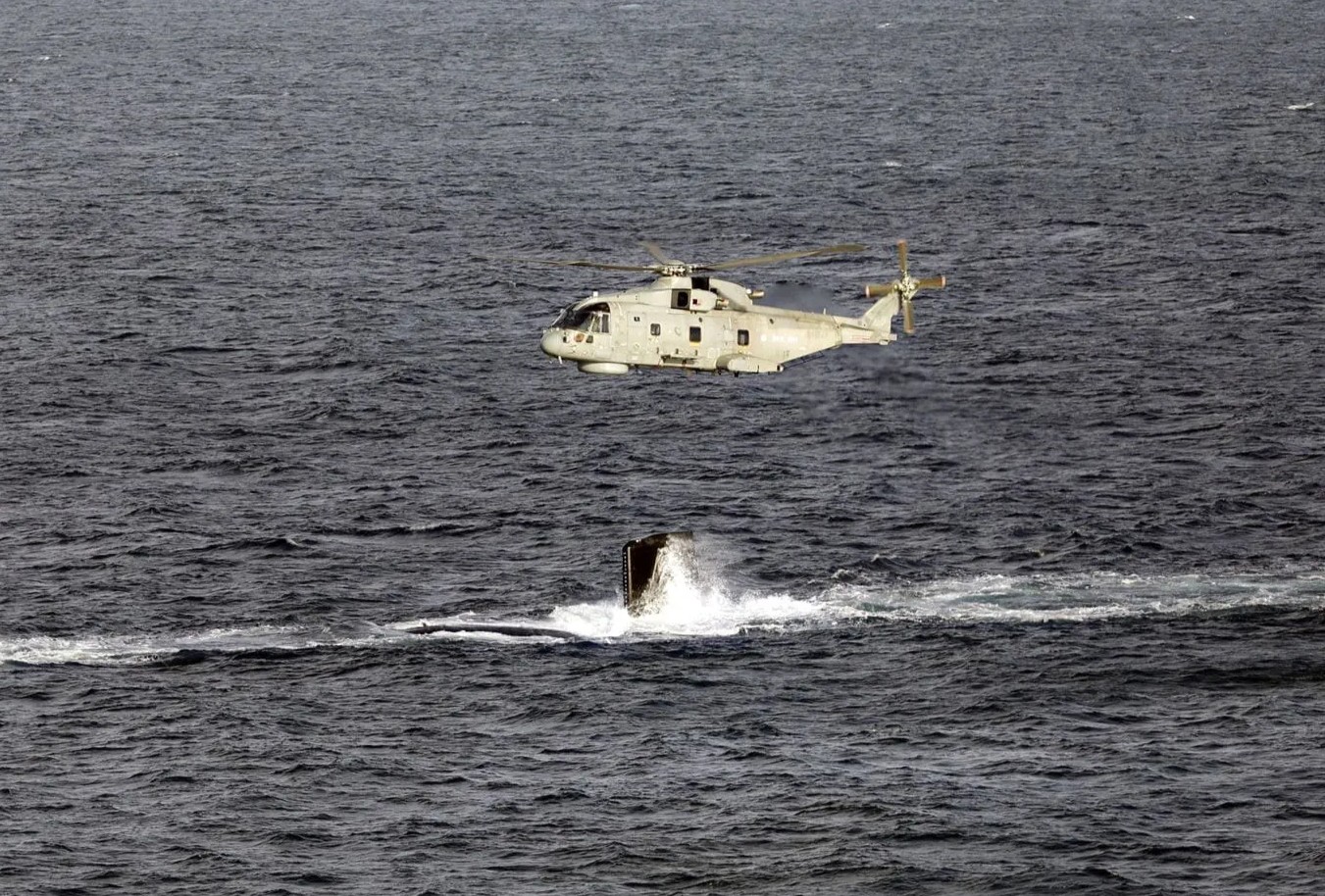
The Royal Navy has deployed four Merlin HM2s to Scotland to rehearse nuclear deterrent protection and demonstrate the helicopter’s advanced ASW capabilities.

Image: MOD Crown Copyright/Royal Navy

The Royal Navy has deployed four Merlin HM2 anti-submarine warfare (ASW) helicopters and roughly 90 personnel to Scotland at short notice as part of Operation Iceblast, testing its ability to rapidly reinforce protection around the UK’s submarine-based nuclear deterrent.

The detachment and its personnel – drawn from 814 and 824 Naval Air Squadron (NAS) at RNAS Culdrose in Cornwall – established a forward operating presence at HMS Gannet, Prestwick, for a series of operations designed to strengthen readiness and rehearse the defence of strategically important waters around HMNB Clyde in western Scotland, where the UK’s nuclear deterrent is based.

During the deployment, the helicopters monitored the arrival of HMS Agamemnon (S124) – the Royal Navy’s sixth and latest Astute-class nuclear attack submarine – at HMNB Clyde. Using their dipping sonar, the Merlin HM2 crews tracked the submarine during its dive trials, demonstrating their ability to detect and follow submerged contacts in support of maritime security operations.

The aircraft deployed to Scotland under Operation Iceblast also operated alongside NATO allies, including German and Norwegian forces, during Exercise Strike Warrior 2026, which was held from 28 September to 9 October.
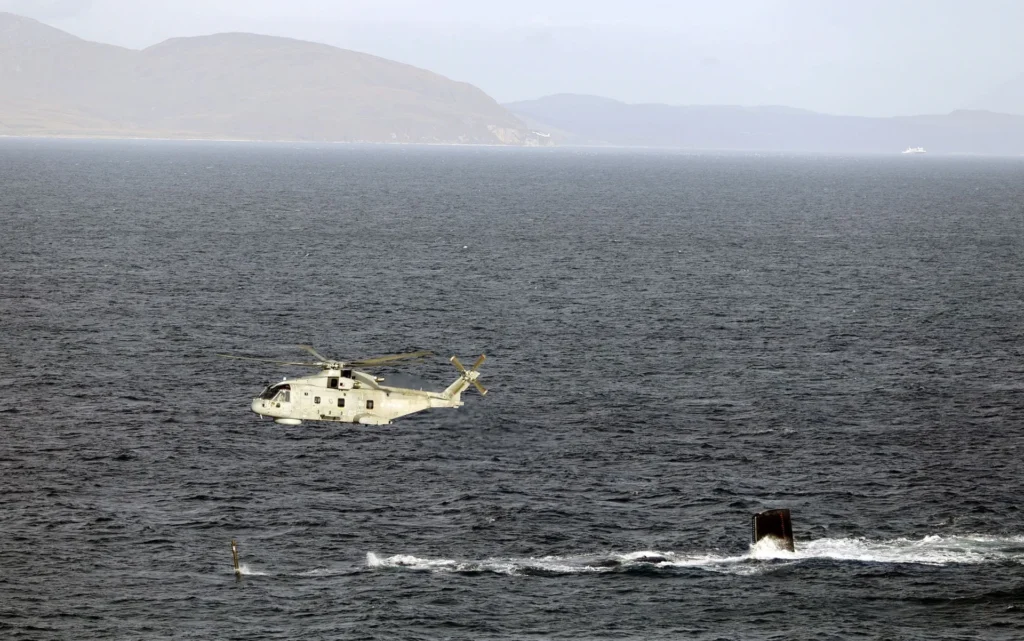
A Merlin HM2 passes over HMS Agamemnon (S124) as the Royal Navy's latest Astute-class nuclear attack submarine conducted sea trials in the Irish Sea during Operation Iceblast. Image: MOD Crown Copyright/Royal Navy
A Merlin HM2 passes over HMS Agamemnon (S124) as the Royal Navy’s latest Astute-class nuclear attack submarine conducted sea trials in the Irish Sea during Operation Iceblast. Image: MOD Crown Copyright/Royal Navy

The helicopters provided search-and-rescue (SAR) cover for Royal Marines practising boarding operations with the German Navy’s first-in-class replenishment ship, FGS Berlin (A1411), while further sorties focused on maintaining surveillance of strategic areas of the North Atlantic.

Capt James Hall, the officer commanding RNAS Culdrose, said: “Operation Iceblast demonstrated exactly what Culdrose and Merlin Helicopter Force are designed to do. That is to deploy at short notice and deliver warfighting readiness from a forward location with a world-class [ASW] capability – whenever and wherever it is required.”

The deployment also involved personnel from 700X NAS, whose drone team provided additional security around the Clyde. Together, the crewed helicopters and uncrewed systems supported a layered approach to protecting the UK’s nuclear deterrent.

Merlin HM2: The helicopter built to hunt down hostile submarines

The Merlin HM2 is a central component of the Royal Navy Fleet Air Arm’s (FAA’s) ASW capability. Developed from AgustaWestland’s (now Leonardo Helicopters’) AW101 family, the rotorcraft combines advanced acoustic sensors, radar, tactical mission systems and the ability to deploy up to four lightweight Sting Ray torpedoes.

Its Thales-made Folding Light Acoustic System for Helicopters (FLASH) dipping sonar is particularly valuable during ASW operations. Lowered into the sea on a cable while the helicopter hovers, the sonar emits acoustic signals and analyses returning echoes to help identify and track submerged contacts. This enables crews to investigate suspected submarine activity and refine a contact’s general position.
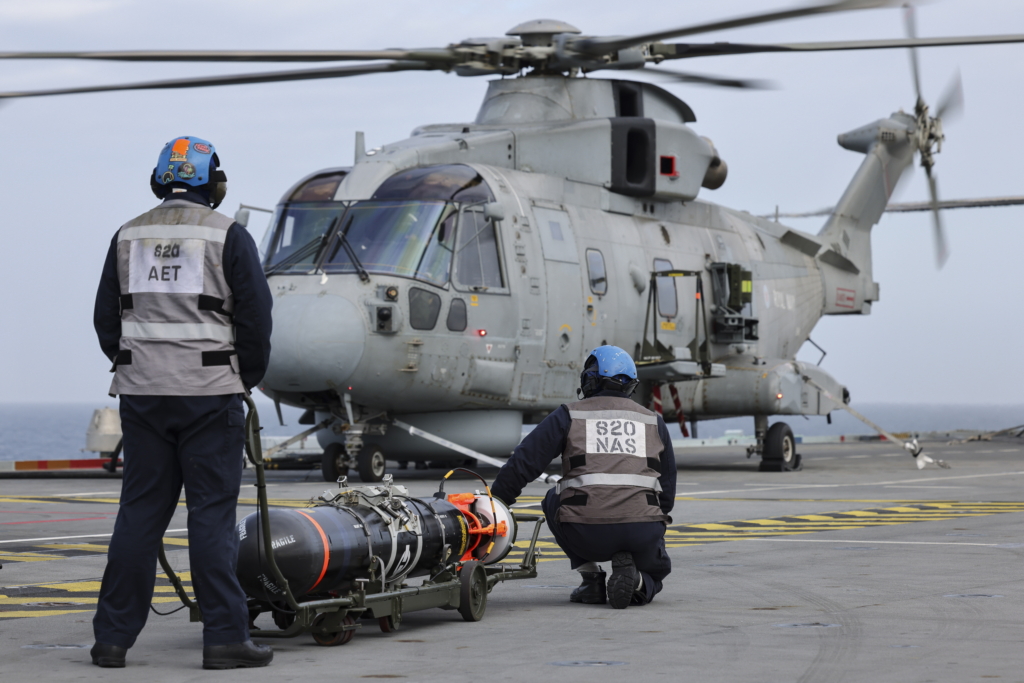
Sailors assigned to 820 NAS prepare to load a Training Variant Torpedo (TVT) onto a Merlin HM2 during a shipborne ASW training mission on 28 February 2024. Image: MOD Crown Copyright/LPhot Belinda Alker

The helicopter can also deploy up to 30 sonobuoys, which are expendable acoustic sensors that are placed in the sea to detect and monitor underwater sound. Used in tandem with the dipping sonar and the helicopter’s Blue Kestrel 5000 maritime surveillance radar, these systems allow crews to build a broader picture of activity beneath and on the surface of the water.

If an underwater threat must be engaged, the Merlin can carry four Sting Ray torpedoes. Its ability to search, localise and, if required, attack a hostile submarine makes the Merlin HM2 a potent complement to surface warships and other British maritime surveillance assets, like the Royal Air Force’s (RAF’s) new P-8A Poseidon MRA1 force.

From Culdrose to the Clyde: Testing the UK’s rapid-response readiness

The Merlin HM2’s value lies not only in its sensor suite, but also in its ability to deploy rapidly from shore bases or operate from Royal Navy warships. Its forward deployment to HMS Gannet tested the personnel, maintenance, logistics and command-and-control (C2) arrangements required to sustain operations while forward-deployed.

That flexibility is significant around the Clyde, which is home to the Royal Navy’s submarine force and the UK’s nuclear deterrent. Protecting the approaches to HMNB Clyde and monitoring surrounding waters form part of the wider security framework supporting the UK’s continuous at-sea nuclear deterrent.
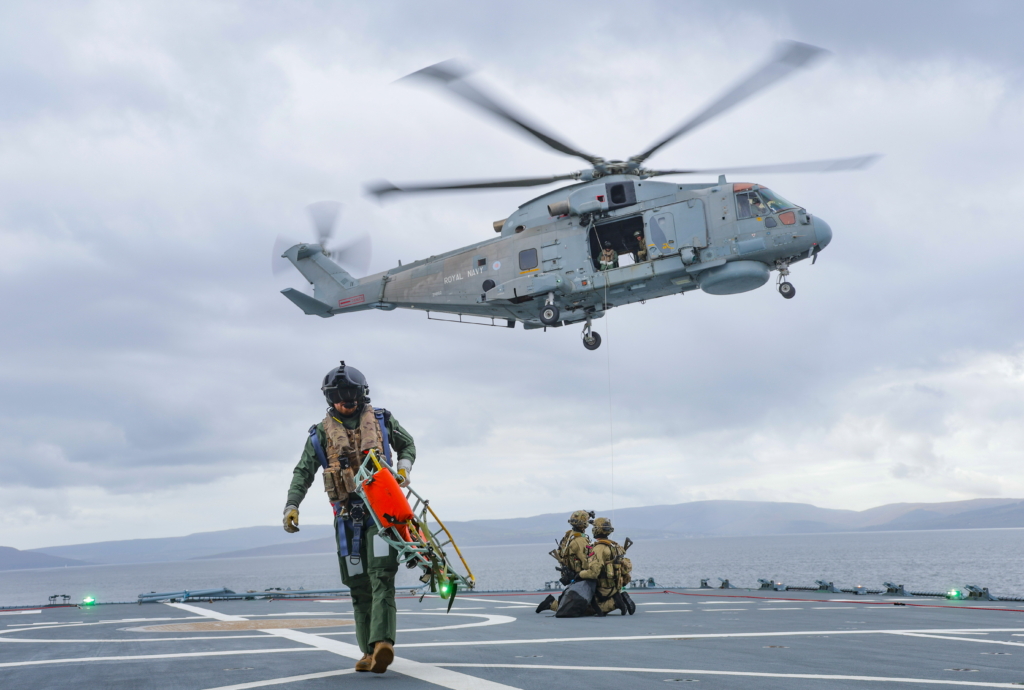
Royal Marines from 42 Commando's K Company conduct fast-roping drills onto the German replenishment ship, FGS Berlin, from an 824 NAS-operated Merlin HM2 during Exercise Strike Warrior 2026. Image: MOD Crown Copyright/PH Gregory Sirc
Royal Marines from 42 Commando’s K Company conduct fast-roping drills onto the German replenishment ship, FGS Berlin, from an 824 NAS-operated Merlin HM2 during Exercise Strike Warrior 2026. Image: MOD Crown Copyright/PH Gregory Sirc

Capt Hall said the drill tested Culdrose’s ability to operate across multiple sites and sustain ASW activity in demanding conditions. The lessons learned during this deployment will inform future procedures and training activities.

As underwater threats and the importance of maritime security in both the North Atlantic continue to shape NATO planning, Operation Iceblast demonstrated how crewed maritime helicopters and uncrewed surveillance systems can work together to reinforce deterrent protection and maintain operational readiness.

Related

Marshall Aerospace outlines its next chapter following AURELIUS acquisition
Marshall Aerospace
Marshall Aerospace outlines its next chapter following AURELIUS acquisition
Speaking exclusively to Advance, Marshall Aerospace discusses its military aircraft contracts, manufacturing priorities and search for a new home following the takeover.
Aerospace Insights

17 Oct 2026

17,000 aircraft on order: How does the industry actually clear the backlog?
Boeing 737 factory in Renton
17,000 aircraft on order: How does the industry actually clear the backlog?
Aircraft manufacturers are under pressure to deliver faster, but supply-chain constraints continue to hold production back. What will it take to turn growing orderbooks into aircraft ready to fly?
Aerospace

17 Oct 2026

Major drone incident could shut UK airport within five years, expert warns
Drone flying near commercial airplane
Major drone incident could shut UK airport within five years, expert warns
A major drone incident is “almost certain” to close a UK airport for a prolonged period within the next five years, according to a senior counter-UAS industry expert.
Aerospace Magazine

16 Oct 2026

BAE Systems to design satellite comms terminals for US Space Force
Satellite
BAE Systems to design satellite comms terminals for US Space Force
Building on its space-hardened family of software-defined radios, BAE Systems will develop resilient ultra-compact radio-frequency (RF) terminals for the US Space Force.
Defence Member News

16 Oct 2026

North Defence, Strongs launch joint venture ahead of British Army LMV competition
Image: North Defence
North Defence, Strongs launch joint venture ahead of British Army LMV competition
North Defence and Strongs have formed a UK manufacturing joint venture to support the LMV MKIII as the British Army’s £2bn LMV competition intensifies.
Defence

16 Oct 2026

UK Armed Forces dig in with new construction equipment
JCB equipment
UK Armed Forces dig in with new construction equipment
A £26 million investment in new construction and earth moving equipment is set to modernise the UK Armed Forces’ operational fleet for building new roads and bases.
Defence

16 Oct 2026

Viasat orders ALL.​SPACE Hydra MAX Terminals for Ka-band networks
ALL.SPACE Hydra
Viasat orders ALL.​SPACE Hydra MAX Terminals for Ka-band networks
Viasat has placed an order for multiple ALL.​SPACE Hydra MAX terminals approved to operate on Viasat's global NextGen Ka-band network, providing resilient SATCOM connectivity for defence and government users.
Defence Member News Space

15 Oct 2026

Cornwall Space Cluster launches £15k legal support programme for space SMEs
Goonhilly satellite near Cornwall Space Cluster
Cornwall Space Cluster launches £15k legal support programme for space SMEs
Cornwall Space Cluster has partnered with Stephens Scown to offer specialist legal advice to space businesses, helping them protect intellectual property, prepare for investment and support future growth.
Space

15 Oct 2026

ClearSpace selected to deliver UK’s first active debris removal mission
ClearSpace removing space debris
ClearSpace selected to deliver UK’s first active debris removal mission
The UK-led programme will remove two defunct satellites while creating specialist jobs, supporting supply chains and building capability in the growing in-orbit services sector.
Space

15 Oct 2026

Police officers risk accidental AI misconduct, watchdog warns
National Police Chiefs Council photo of police on duty
Police officers risk accidental AI misconduct, watchdog warns
The Independent Office for Police Conduct has warned that officers and staff risk misconduct investigations for inappropriate AI use.
Security

16 Oct 2026

NAD and CDS want accelerated capability as DSEI UK 27 launched
NAD and CDS launch DSEI UK 27
NAD and CDS want accelerated capability as DSEI UK 27 launched
As the National Armaments Director (NAD) and the Chief of the Defence Staff (CDS) launched DSEI UK 2027 yesterday, they said faster capability delivery, greater innovation and improved readiness are required to ensure the UK and its allies are suitably prepared for any future conflict.
Warwickshire Police turns to AI to review the quality of investigations
Chat with AI or Artificial Intelligence technology. Man touching chatting virtual with an intelligent artificial intelligence asks for the answers he wants. Smart assistant futuristic, Chatbot,
Warwickshire Police turns to AI to review the quality of investigations
An eight-agent system checks investigation records against policing standards, with officers retaining responsibility for decisions.
Security

14 Oct 2026