More women take the controls as UK pilot licence numbers rise


The number of women holding pilot licences in the UK is growing at almost twice the rate of men, according to new figures published by the UK Civil Aviation Authority (CAA).
The statistics, published on 11 November, show encouraging progress in female representation across both commercial and general aviation, with increases recorded throughout 2025 and continuing into 2026.
However, despite the positive trend, women still account for fewer than 7% of commercial pilot licence holders, highlighting the work that remains to achieve greater gender diversity in the aviation industry.
Significant growth in female pilot numbers
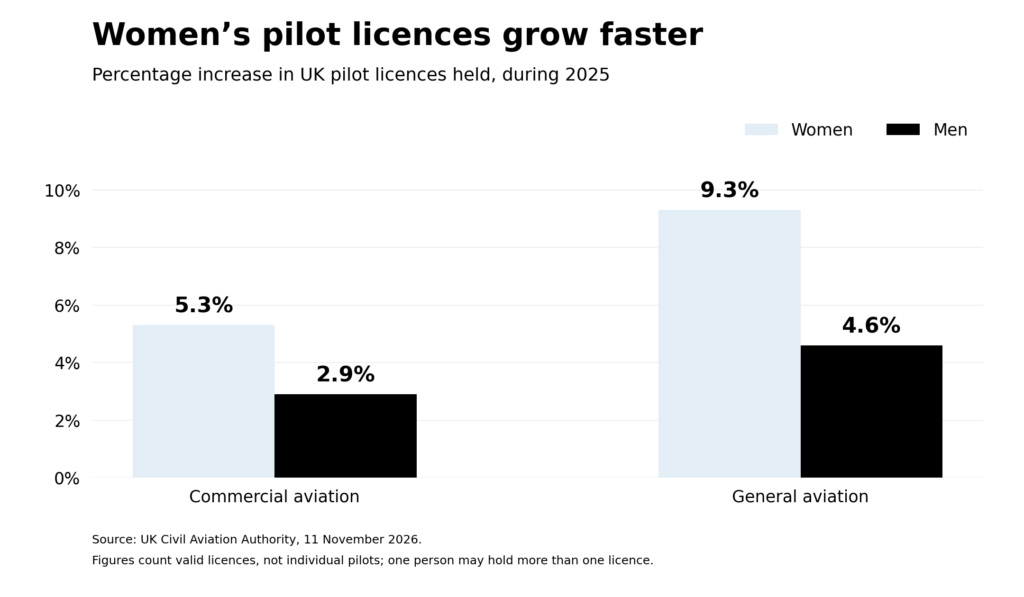
The CAA’s figures reveal that the number of commercial pilot licences held by women increased by 5.3% during 2025, rising from 1,098 at the end of 2024 to 1,156.
In general aviation, which includes recreational and private flying, the increase was even greater, with female-held licences rising by 9.3%, from 1,572 to 1,718. These increases compare with growth of 2.9% in commercial licences held by men and 4.6% in general aviation licences held by men over the same period.
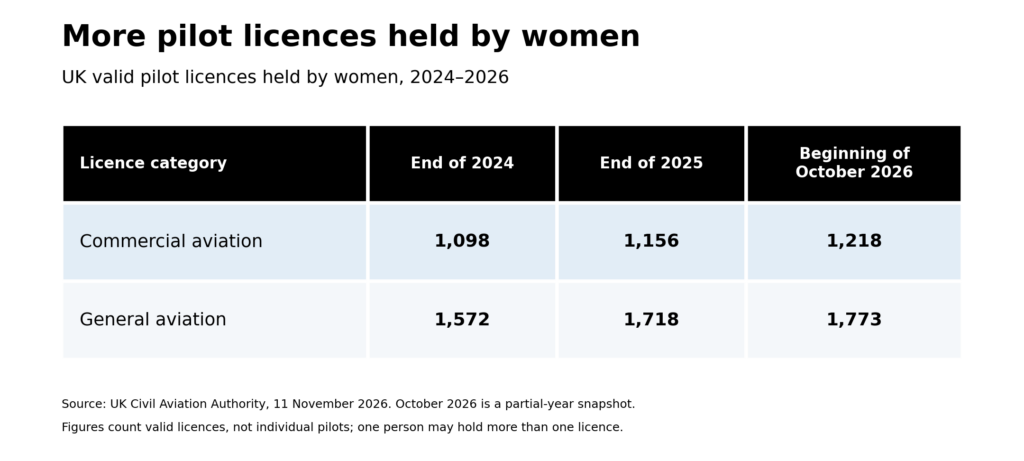
The upward trend has continued into 2026. By the beginning of October, the number of commercial pilot licences held by women had reached 1,218, representing a further 5.4% increase since the start of the year.
This means women held 120 more commercial pilot licences than at the end of 2024. The number of female general aviation licence holders also continued to rise, reaching 1,773 by October 2026.
More women taking their first steps into aviation
One particularly encouraging finding is the increase in women receiving their first pilot licences. During 2025, 295 initial pilot licences were issued to women. This was the highest annual figure since the COVID pandemic and almost 70% higher than the 174 issued in 2024.
The average age of women receiving a pilot licence was 30.2 years, demonstrating that aviation continues to attract people entering the profession at different stages of their lives.
Despite the progress, female representation remains relatively low. Women now account for 6.22% of commercial aviation pilot licence holders, compared with 5.9% in 2024 and 6.05% in 2025. In general aviation, the proportion has increased from 4.8% to 5%.
Industry leaders welcome the progress
Glenn Bradley, Chief Pilot at the CAA, welcomed the sustained increase in licences issued to women over the past five years. He highlighted that piloting is a career open to people regardless of gender or ethnicity and said the changing figures were an encouraging indication of progress.
He also emphasised the importance of encouraging young people into aviation through science, technology, engineering and mathematics (STEM) education, with the CAA supporting initiatives designed to introduce the next generation to the opportunities available across the industry. Aviation Minister Keir Mather also welcomed the figures, stressing that young people should be able to see a future for themselves in aviation.

He pointed to government initiatives aimed at improving access to aviation careers, including the recruitment of industry ambassadors to promote opportunities and £750,000 of investment in education and training. Support for young people from underrepresented backgrounds and those seeking employment is also part of the government’s approach.
Aviation organisations continue to tackle barriers
Katherine Moloney, founder of Elevate(her) Aviation, described the latest figures as a significant milestone for women in aviation. She credited the progress partly to organisations working to inspire and inform women and girls about career opportunities in the sector.
Since launching in 2023, Elevate(her) Aviation has focused on raising awareness of aviation careers and helping more women understand the routes available to them. Moloney believes these efforts are beginning to translate into measurable improvements.
However, she acknowledged that considerable challenges remain and stressed the importance of continued collaboration between industry organisations and their partners. The British Airline Pilots’ Association (BALPA) also welcomed the increase but warned against becoming complacent.

Its Acting General Secretary, Zohra Francis, said that although the figures were moving in the right direction, the fact that women still hold fewer than 7% of commercial pilot licences demonstrated the scale of the challenge.
She called for the industry to identify and address the structural barriers that discourage or prevent women from entering the profession, arguing that anyone with the necessary ability, skills and aptitude should have the opportunity to become a pilot.
A wider picture of the UK aviation workforce
The CAA publishes its pilot licensing statistics annually, providing an overview of licence holders by age and gender. The latest dataset shows that the total number of valid pilot licences across all categories increased from 51,038 in 2024 to 53,186 in 2025.
This includes licences for airline transport, commercial and private flying, as well as helicopters, balloons, airships, gliders and other aircraft. The regulator also highlights that its figures count valid licences rather than individual pilots, as one person can hold more than one licence.
Progress, but more work ahead
According to the CAA, the growth in female pilot licences represents an encouraging step towards a more diverse aviation industry. Increasing the number of women entering aviation is important, but ensuring they can access training, progress into professional roles and build long-term careers will be equally essential.
With initiatives from organisations such as Elevate(her) Aviation, industry support from the CAA and government investment in skills and education, there are positive signs of change.
Sign up for our newsletter and get our latest content in your inbox.
Similar Reads




Sign up for our newsletter. Select all sectors relevant to you.
Related