Schiebel demonstrates drone mothership role for helicopter used by Royal Navy

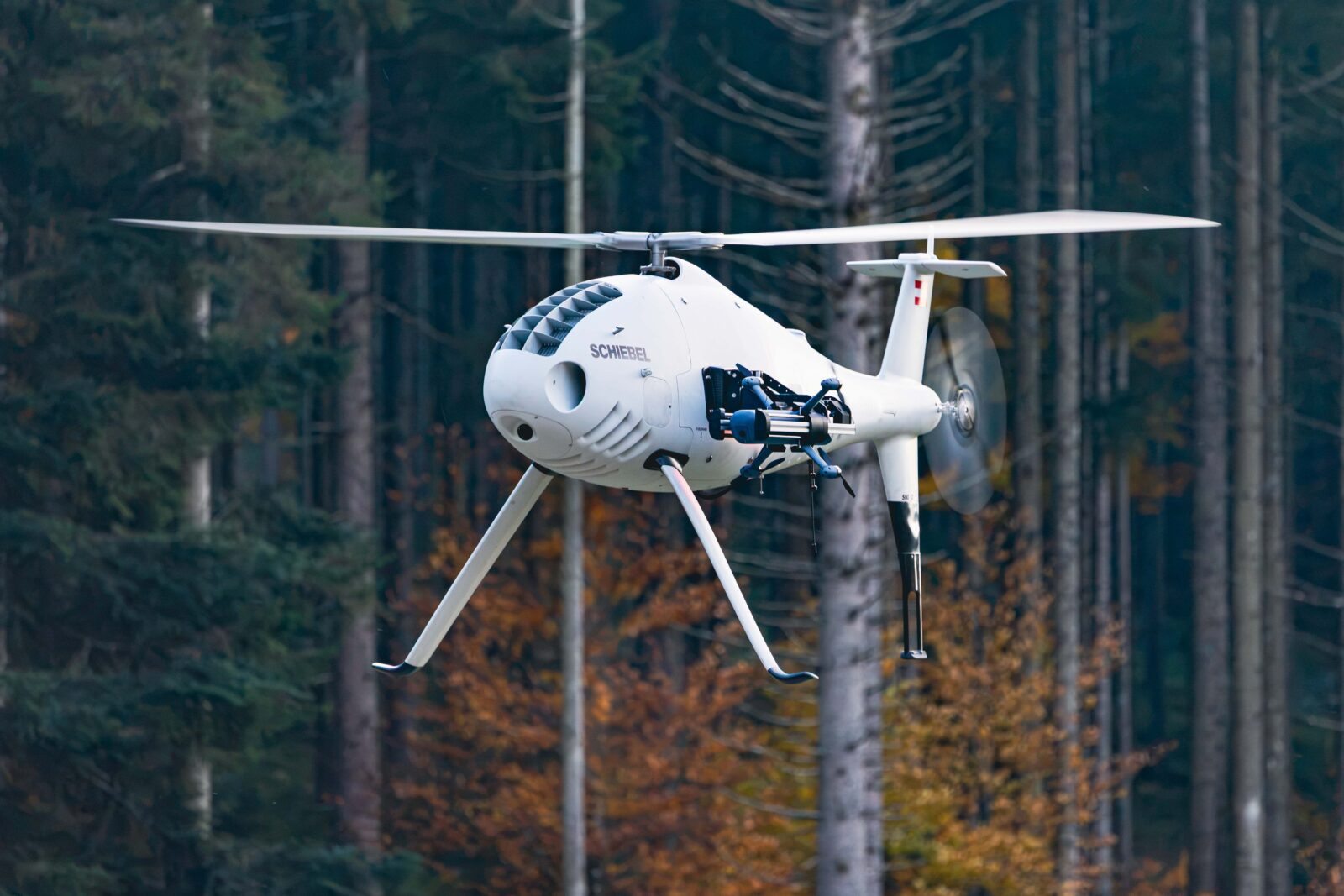
The Austrian company Schiebel, in partnership with Osiris Poland, has announced it has successfully demonstrated its Camcopter S-100 Unmanned Air System (UAS) acting as a mothership to launch smaller drones (sUAS).
Launching the parasitic sUAS allows the Camcopter to act as an airborne carrier, deployer, and communications relay. It can deploy the drones during forward flight.
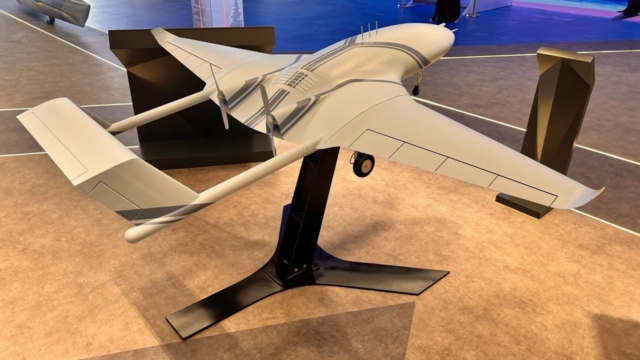
The sUAS deployed, an Osiris HSCD-1 (High-Speed Camera Drone), resembles the interceptor drone designs seen in Ukraine.
Schiebel writes, “Following release, the small drone was operated through a communications link relayed via the S-100, successfully demonstrating the concept of using the larger UAS as a drone mothership as well as an airborne control and video relay.”
Hans Georg Schiebel, Chairman of the Schiebel Group, said it opens up “new possibilities for diverse operational scenarios.
The potential C-UAS application
The pairing allows the duo to utilise the range and endurance of the larger Camcopter, while leveraging the speed and agility of smaller drones.
By transporting the sUAS closer to its intended area of operation or target, and by maintaining the communication link, the pair can significantly extend the operational reach of the smaller drones.
This is significantly further than what can be achieved by ground-based launching of the drone. Schiebel claims the proof-of-concept opens up a range of potential applications “particularly in the Counter-Unmanned Air System (C-UAS) domain.”
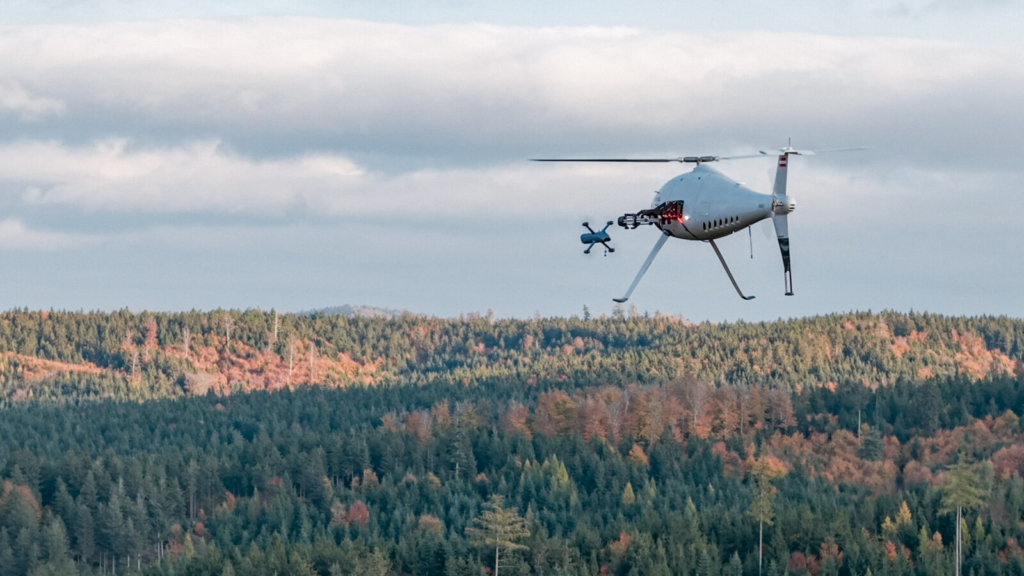
It suggests that the concept can support high-speed interceptor drones designed to destroy enemy drones. It also opens the door for the Camcopter to support loitering munitions.
This could allow the Camcopter series, including the S-100, S-300, S-101, and S-301, to serve as a carrier, launch platform, and airborne communications relay for smaller unmanned systems and loitering munitions.
The Schiebel Camcopter S-100 is operated by military, maritime, and civil agencies worldwide, including navies, coast guards, police forces, and aviation contractors. Navies include the Royal Navy (designated the Peregrine), the French Navy, Italian Navy, US Navy, German Navy, and others.
How this could add capability for the Royal Navy
The Camcopter S-100 is in service with the Royal Navy as the Peregrine (designated RWUAS / VTOL UAV). These first became operational in 2025 and are the Royal Navy’s first remotely piloted helicopter, and form a key part of the Maritime Aviation Transformation Strategy toward a hybrid composition.
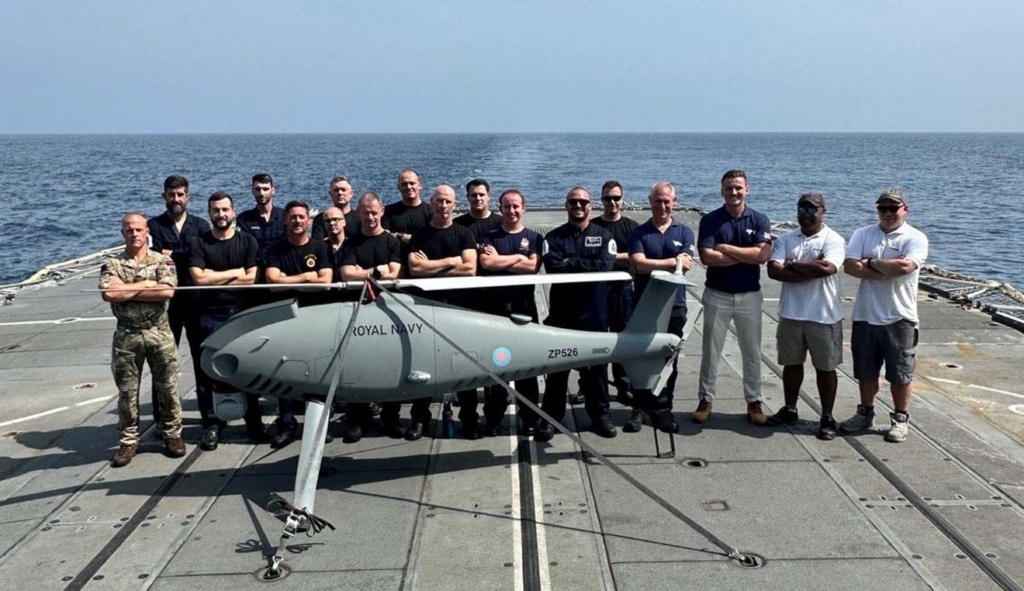
In the Royal Navy, the Peregrine’s primary role is Intelligence, Surveillance and Reconnaissance (ISR), helping to extend the “eyes and ears” of the ships. It plays a complementary role to the Navy’s Leonardo AW159 Wildcat helicopters.
Currently, only a limited number, perhaps two, are in service with the Royal Navy (registered ZP526 and ZP527).
The Royal Navy is working to integrate them onto smaller vessels that do not typically carry aviation (e.g., River-class Batch 1/2 patrol ships). It is also working with Thales and Schiebel to integrate the Martlet (Lightweight Multirole Missile / LMM) air-to-surface missile
Other potential roles include acting as relays in anti-submarine warfare and mine countermeasures (e.g., LIDAR). It is unclear if counter-UAS is an attractive proposition for the Navy or if it would better suit land-based operators.
Sign up for our newsletter and get our latest content in your inbox.
Similar Reads


Sign up for our newsletter. Select all sectors relevant to you.
Related