Advancing UK Aerospace, Defence, Security & Space Solutions Worldwide

Aerospace

A380 powered by 100% SAF takes first flight
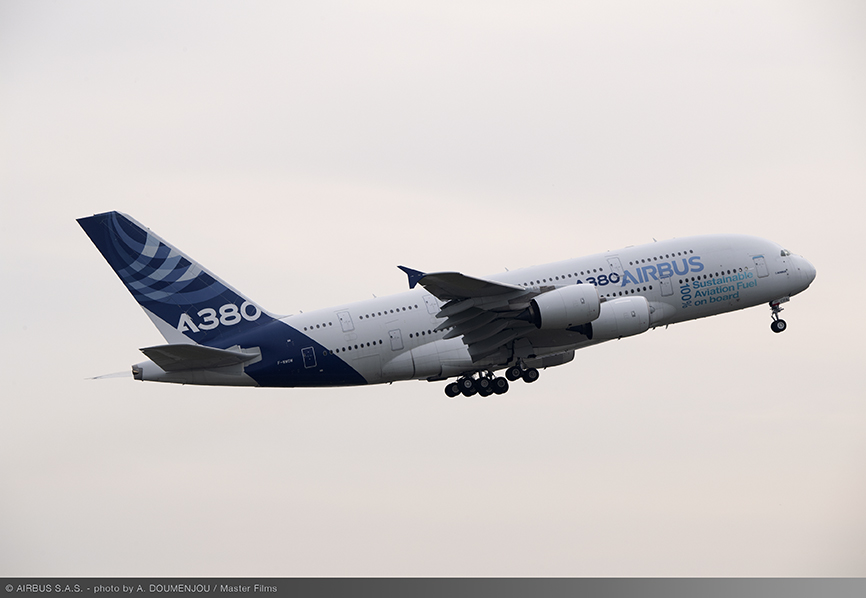
Airbus has completed the first flight of an A380 powered by 100% Sustainable Aviation Fuel (SAF).

Image copyright Airbus

Airbus’ A380 test aircraft MSN 1 took off from Blagnac Airport, Toulouse, France at 08h43 on Friday 25 March. The flight lasted about three hours, operating one Rolls-Royce Trent 900 engine on 100% SAF.

27 tonnes of unblended SAF were provided by Total Energies for this flight. The SAF produced in Normandy, close to Le Havre, France, was made from Hydroprocessed Esters and Fatty Acids (HEFA), free of aromatics and sulphur, and primarily consisting of used cooking oil, as well as other waste fats. A second flight, with the same aircraft, is scheduled to take place from Toulouse to Nice Airport, on the 29 March to test the use of SAF during take-off and landing.

Advertisement
ODU RT

This is the third Airbus aircraft type to fly on 100% SAF over the course of 12 months; the first was an Airbus A350 in March 2021 followed by an A319neo single-aisle aircraft in October 2021.

Increasing the use of SAF remains a key pathway to achieving the industry’s ambition of net-zero carbon emissions by 2050. Key statistics outlined in the Waypoint 2050 report indicate that SAF could contribute between 53% and 71% of required carbon reductions.

All Airbus aircraft are currently certified to fly with up to a 50% blend of SAF mixed with kerosene. The aim is to achieve certification of 100% SAF by the end of this decade.

The A380 aircraft used during the test is the same aircraft recently revealed as Airbus’ ZEROe Demonstrator - a flying testbed for future technologies instrumental to bringing the world’s first zero-emission aircraft to market by 2035.


Advertisement
ODU RT


Advertisement
FIA2026 animated banner
IFS launches IFS Zero

Aerospace Defence

IFS launches IFS Zero

10 June 2026

IFS has launched IFS Zero, an agentic AI Emissions Operating System designed for asset-intensive industries, such as aerospace and defence, where organisations face pressure to improve emissions reporting and supply chain transparency, with Scope 3 compliance now a contractual requirement.

Smith Detection

Aerospace Security

Smith Detection's SDX 10080 SCT receives UK DfT approval

10 June 2026

Smiths Detection announced today that its SDX 10080 SCT has received UK Department for Transport (DfT) approval for deployment across UK airports and cargo operators for hold baggage and air cargo screening.

Aston University secures £3.9m to boost aerospace and cybersecurity skills

Aerospace Security

Aston University secures £3.9m to boost aerospace and cybersecurity skills

10 June 2026

Aston University has secured almost £4 million in new funding to improve the UK’s aerospace engineering and cybersecurity skills.

Marshall Aerospace completes initial flight model for Horizon Aircraft’s Cavorite X7

Aerospace

Marshall Aerospace completes initial flight model for Horizon Aircraft’s Cavorite X7

10 June 2026

Marshall Aerospace has successfully completed a flight dynamics and control model to support Horizon Aircraft’s Cavorite X7, a revolutionary dual-use hybrid-electric vertical take-off and landing (VTOL) aircraft currently in prototype development.

Advertisement
ODU RT
NATS invests in carbon removals with CUR8

Aerospace

NATS invests in carbon removals with CUR8

9 June 2026

NATS has committed £500k to carbon removals through carbon removals intelligence provider CUR8, contributing to an initiative led by the UK Sustainable Aviation coalition, to stimulate the carbon removals market as part of a £2 million Advance Market Signal.

HutanBio partners with Wakud on scalable SAF feedstocks

Aerospace

HutanBio partners with Wakud on scalable SAF feedstocks

9 June 2026

Cambridge biotechnology company HutanBio, which is developing algae-derived oils for sustainable aviation fuel (SAF), has signed its first commercial offtake Memorandum of Understanding (MoU) with Oman's Wakud International, as the aviation industry searches for new feedstock sources capable of supporting future SAF demand.

Advertisement
ODU RT
Advertisement
General Atomics LB