Advanced Navigation opens high-tech robotics manufacturing facility
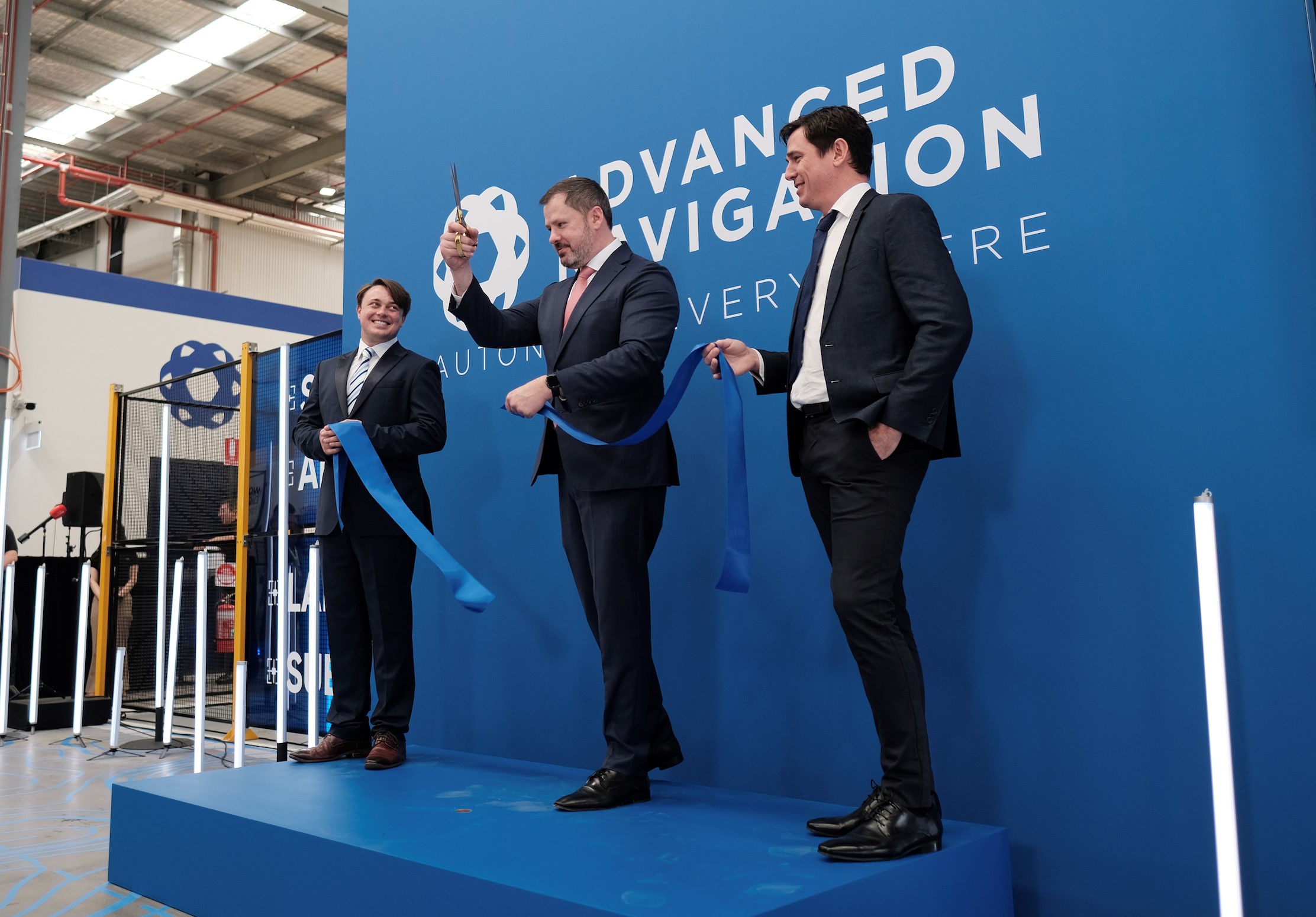
Image courtesy Advanced Navigation
Above
: The Hon Ed Husic MP - Minister for Industry and Science (middle) officially unveils the facility with Advanced Navigation CEOs and co-founders Xavier Orr and Chris Shaw.
The facility will scale up the manufacturing of Advanced Navigation’s world-first AI navigation systems for GPS-denied environments, including its digital fibre-optic gyroscope (DFOG) technology, Boreas.

Advanced Navigation is one of only four companies in the world with the capability to manufacture strategic grade fibre-optic gyroscopes. This technology empowers reliable navigation for marine vessels, space missions, aerospace, defence, autonomous vehicles and flying taxis. The company deploys its unique AI-based physics algorithms to solve complex challenges earth-bound and beyond.
Strengthening Australia’s sovereign capabilities
Xavier Orr, Advanced Navigation CEO and co-founder, said, “There is a critical need to improve Australia’s economic complexity and sovereign capabilities. A key step is to build our industrial capacity in high-tech, as well as drive knowledge exchange and propel collaborative initiatives between government agencies, academic institutions and industry leaders.”
State-of-art robotics manufacturing for autonomous systems
There is a seismic shift across the landscape of sovereign manufacturing, driven by advanced technologies like AI, automation and precision engineering. In the context of autonomous systems, the importance of precision and reliability is non-negotiable.
Adopting a vertical integration framework, the facility houses equipment and processes for automated manufacturing utilising machine learning. This guarantees the delivery of reliable, durable and high-quality navigation systems.
Collaborating with UTS academics and community
In addition to the manufacturing capability, the facility will be home to extensive research collaborations between Advanced Navigation and the University of Technology Sydney (UTS). This will expedite the commercialisation of several socially impactful technologies, including:
•
Light Detection, Altimetry and Velocimetry (LiDAV) system - LiDAV delivers precise three-dimensional velocity and altitude information relative to the lunar surface, enabling complex autonomous landing procedures and confident exploration on the moon. The technology is set to board US-based space systems company Intuitive Machines’ Nova-C lander as part of NASA’s ongoing Commercial Lunar Payload Services (CLPS) program.
•
Cloud Ground Control - A revolutionary cloud-based solution that allows pilots and mission planners to remotely command and control a swarm of uncrewed vehicles across air, land and sea through a web browser. By enabling real-time video feed, and telemetry, and easy access and management of captured data, Cloud Ground Control provides full remote visibility and situational awareness in search and rescue, emergency response and disaster relief operations.
•
Guiding visually impaired passengers - As part of the NSW Small Business Innovation and Research (SBIR) program, Advanced Navigation has developed an indoor positioning technology to support members of the visually impaired community navigate safely inside underground train stations.

Professor Andrew Parfitt, Vice-Chancellor and President of UTS, said , “UTS is pleased to be working with Advanced Navigation to tap into critical growth areas, including AI, robotics and space technologies.
The collaboration between UTS’s global research leaders in autonomous systems technology and Advanced Navigation’s exceptional team of scientists and engineers, utilising UTS Tech Lab’s cutting-edge facilities, highlights our commitment to developing sovereign capabilities for defence and space.
We look forward to deepening and expanding our collective capabilities with Advanced Navigation to accelerate the production of high-impact innovations.”
Bolstering societal demand for STEM roles
The facility appeals to the Federal Government’s ongoing commitment towards building a science, technology, engineering and mathematics (STEM) workforce. It is set to drive employment in robotics, manufacturing, photonics, mechatronics and mechanical engineering and other fields.
Chris Shaw, Advanced Navigation CEO and co-founder, said , “Our new facility will help drive rapid growth in Australia’s STEM industry. Determined to be the catalyst of the autonomy revolution, we are commercialising technologies that are key to addressing some of humanity’s biggest challenges. We are honoured to partner with UTS, who has a reputation for supporting multidisciplinary research and opening access to next-generation technologies.”
Advanced Navigation was founded on a culture of research and discovery. Powered by a deep curiosity to apply ground-breaking technologies to uncover and explore new frontiers, the company is ultimately extending human capabilities to build a more resilient and sustainable future with safer outcomes, on and off planet.