

Advancing digital rehearsal in defence


Image by Biaploo / copyright Shutterstock
In the rapidly-evolving world of defence, the ability to acquire and procure capability swiftly and efficiently is paramount. Yet, our current system has been labelled ‘highly bureaucratic, overly stratified and far too ponderous’ against the backdrop of intensifying global conflict.
Traditional methods can no longer keep up. The conventional ‘V-Model’ used by defence system engineers needs an injection with a heavy digital dose. Collaboration and knowledge transfer must be prioritised, with data and modelling used to feed step changes.
Programme teams need a centralised source of truth for data, initiated at concept stage and populated through user requirement gathering, and, crucially, remaining interoperable with downstream suppliers’ environments throughout design and testing. Within this context, new digital engineering techniques present ways to enable more responsive defence procurement.
‘Digital rehearsal’ is one such promising approach emerging within digital circles in defence This method involves using virtual simulations and digital environments to test and refine defence strategies, equipment, and protocols before implementation. It provides comprehensive scenario examinations, allowing decision-makers to identify potential issues and rectify them in a controlled, cost-effective manner. Digital rehearsal can inform full digital twins although it usually takes place earlier in the process.
Although now relatively commonplace across other sectors – nuclear, construction and utilities among them – and used by some of our allies, UK defence still has much to gain from broadening digital rehearsal uptake as one step in maturing our engineering technology base.
Preparation and practice
From purely mathematical modelling through to very ‘real’ augmented reality (AR), digital rehearsal can identify and mitigate risks ranging the banal to complex.
Consider the example of procuring a new multi-platform communication system which will identify incoming attacks across a fleet. Traditional procurement could involve mobilising the fleet to test this system, using real assets and people at immense cost.
A digital rehearsal, instead, might begin with a mathematical model establishing operational limitations, such as simulating a platform going dark. How would the remaining fleet’s processing capabilities be impacted? What contingency solutions could be implemented for the disabled platforms? This exercise serves dual purposes: refining system requirements by isolating areas of enquiry while systematically eliminating impractical design configurations.
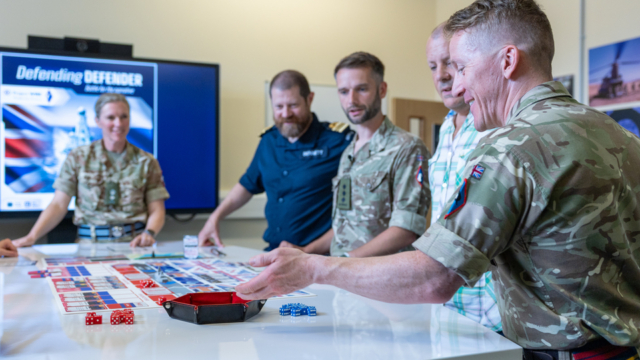
Building on the groundwork, teams can transition to a human-centric augmented reality solution. Here, insights are presented to personnel in training rooms, replicating the intense dynamics of a real control room. Such an approach enables the user experience design team exactly how to iteratively refine system design, gathering critical user feedback and operational insights without costly live testing.
Accelerating acquisition
By enabling rapid prototyping and virtual testing, digital rehearsal can dramatically reduce the time and resources typically required for equipment evaluation, unimpaired by physical tests. Stakeholders can quickly assess technology performance, evaluate multiple options, and make informed decisions with unprecedented speed.
Importantly, unlike traditional testing methods, digital rehearsal offers unparalleled scalability and flexibility. Defence organisations can simulate a wide range of scenarios, from small-scale operations to large-scale conflicts.
The scalability of digital rehearsal has recently been further unlocked through artificial intelligence (AI), with data-driven simulations providing rapid, evidence-based avenues. For example, in the water sector an AI-driven digital rehearsal to examine a wide range of input data, allowing 10,000 iterative design options to be considered simultaneously and ranked by suitability, whereas ordinarily just one or two options would be explored over the course of two weeks.
This same technique could be applied to trial multiple defence assets in an integrated defence scenario. Methods to measure success can follow a ‘triage, opportunity and roadmap’ approach, which first identifies digital engineering interventions, including digital rehearsal and considers how these could be combined to reduce programme timelines. In one notable instance at a defence organisation, digital rehearsal helped a team accelerate a project decision point from three years to just six weeks by leveraging advanced digital tools.
A shot in the arm
As the UK confronts growing and evolving threats, with renewed Government spending further stretching the system, digital engineering approaches like digital rehearsal can effectively augment procurement processes.
This is not about wholesale replacement of existing methods but about creating more data-driven and adaptable defence capabilities that enable faster, more precise technological development.
Sign up for our newsletter and get our latest content in your inbox.
Similar Reads






Sign up for our newsletter. Select all sectors relevant to you.
Related