Airbus and partners' formation flight demos fuel and emissions reduction
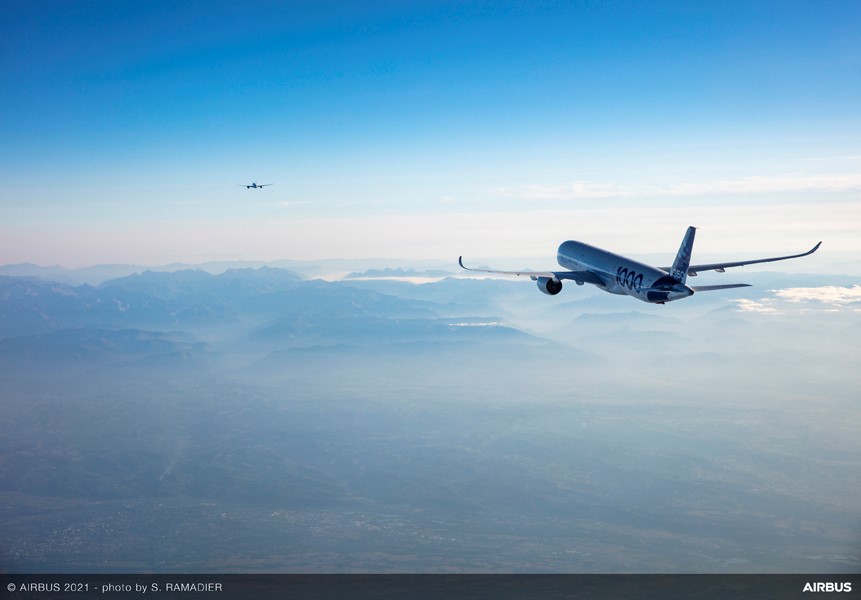
Image copyright Airbus
The aircraft were greeted at Montreal-Trudeau International Airport. Over six tons of CO2 emissions were saved on the trip, confirming the potential for more than a 5% fuel saving on long-haul flights.
The 'final demonstration' test flight took place on 9 November 2021 involving two A350 test aircraft, MSN1 and MSN59, the former as the leader aircraft and the latter as the follower. This was made possible with flight control systems developed by Airbus which position the follower aircraft safely in the wake updraft of the leader aircraft allowing it to reduce engine thrust and reduce fuel consumption. A similar principle can be observed with large migrating birds such as geese, which fly together in a distinct V-shaped formation.

Sabine Klauke, Chief Technical Officer at Airbus declared: “This demonstration flight is a concrete example of our commitment to making our decarbonisation roadmap a reality. It also speaks to how collaboration across the industry will be key to making this happen. We have received a strong level of support for this project from our airline and air traffic partners, plus regulators. The opportunity to get this deployed for passenger aircraft around the middle of this decade is very promising. Imagine the potential if fello’fly was deployed across the industry.”
Pilots from Airbus partner airlines SAS Scandinavian Airlines and Frenchbee witnessed the transatlantic flight onboard as observers. The flight was made possible by Airbus and its air traffic management partners and navigation service providers (DSNA, NATS, NAV CANADA, Eurocontrol and IAA), with the support of the DGAC, who together proved that wake energy retrieval flight technology leveraged in a fello’fly flight can be achieved without compromising safety. The demonstration also shows how fello’fly operations could significantly boost environmental performance of commercial aircraft and contribute to the aviation industry’s decarbonisation targets in the immediate term.
The next step is to get the support of the authorities so that this new operational concept can be certified, and ultimately enable airlines to reduce their fuel burn and CO2 emissions.
The Airbus pioneering fello’fly flight was welcomed upon its arrival in Montreal by the Council President and Secretary General of the UN aviation agency, ICAO. Council President Salvatore Sciacchitano said the demonstration represented “ an inspiring example of the level of current commitment to reduce aviation emissions,” while ICAO Secretary General Juan Carlos Salazar remarked on how it reflected “the incredible diversity of air transport innovations now being realized to meet the sector’s targets and ensure flying becomes more and more sustainable.”
Launched in 2019, fello’fly is a flight demonstrator project hosted within Airbus UpNext using biomimicry (the design and production of materials, structures and systems inspired by nature). Airbus UpNext is a wholly-owned Airbus subsidiary and part of the Airbus innovation ecosystem, created to give future technologies a development fast-track by building demonstrators at speed and scale, in order to evaluate, mature and validate potential new products and services that encompass radical technological breakthroughs.