Advancing UK Aerospace, Defence, Security & Space Solutions Worldwide
  • Home
  • /
  • Space
  • /
  • Airbus attaches MAGBOOM to JUICE

Space

Airbus attaches MAGBOOM to JUICE
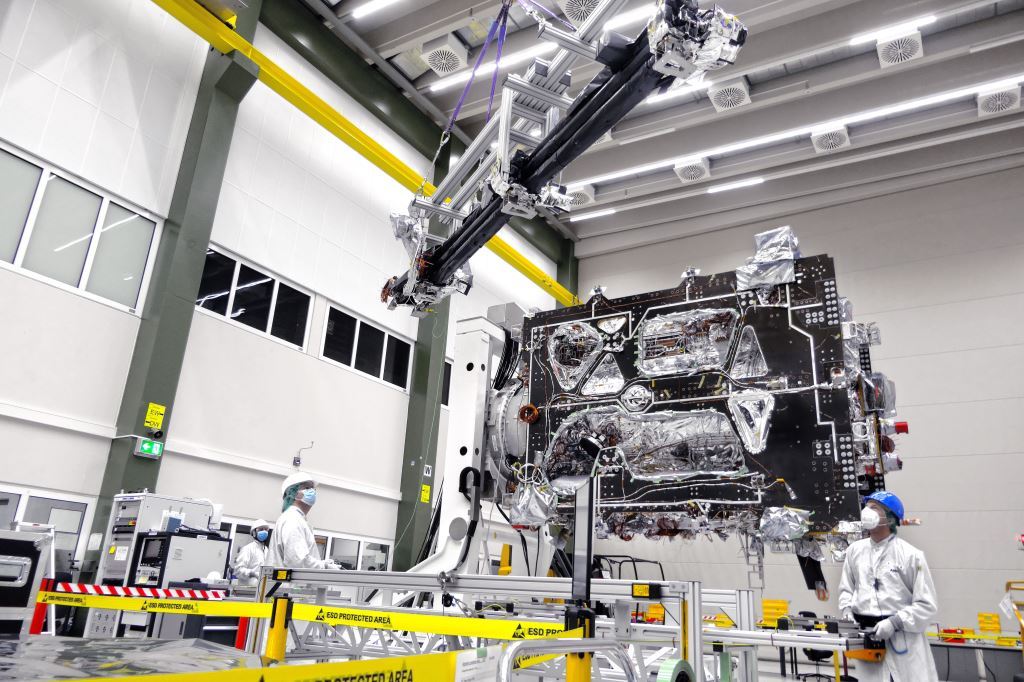
JUICE, the European Space Agency's JUpiter ICy moons Explorer mission, has passed its latest milestone, as Airbus attached the magnetometer boom (MAGBOOM) to the spacecraft.

Copyright Airbus / Mathias Pikelj 2021

The MAGBOOM carries five magnetically sensitive instrument sensors to keep them far from any disturbances from the main spacecraft. The sensors are part of the magnetometer J-MAG and the Radio and Plasma Wave Investigation (RPWI) scientific instruments.

J-MAG is a magnetometer package to study the Jovian magnetosphere and its interaction with the three icy moons, Europa, Ganymede and Callisto, in particular with Ganymede´s intrinsic magnetic field. The RPWI instrument will investigate the radio emissions and plasma environments of Jupiter and its icy moons.

Advertisement
Tritax 300x250

The MAGBOOM is made of non-magnetic materials, such as carbon fiber, various titanium and aluminum alloys, and bronze and weighs 44 kilograms (including the sensors). The boom must withstand temperatures from -210° to +250° Celsius. Once deployed its total length is 10.6 metres.
 
The 6.2 ton JUICE spacecraft will set off in 2022 on its near 600 million-kilometers-long journey to Jupiter. The spacecraft will carry 10 state-of-the-art scientific instruments, including camera, spectrometers, a sub-mm wave instrument, an ice-penetrating radar, a laser altimeter, a radio-science experiment and instrument packages to monitor the magnetic and electric fields and charged particles.
 
JUICE will spend more than three years around the gas giant, completing a unique tour that will include in-depth studies of three potentially ocean-bearing moons, Ganymede, Europa and Callisto and collecting data to provide answers on the conditions for emergence of life around a giant planet. It will perform a multidisciplinary investigation of the Jupiter system as an archetype for gaseous planets. It will spend nine months orbiting the icy moon Ganymede analysing its environment, surface, interior and its potential habitability.
 
As prime contractor, Airbus is leading an industrial consortium of more than 80 companies across Europe.

Advertisement
Leonardo animated rectangle


Advertisement
Tritax leaderboard 728x90 Tritax leaderboard 728x90
British designed satellites successfully launched

Defence Security Space

British designed satellites successfully launched

3 December 2025

A cluster of British designed and built satellites has been successfully launched into low Earth orbit, providing defence, security and civil sectors with UK space-based intelligence, surveillance and reconnaissance to enhance the nation’s ability to protect against modern threats.

Filtronic awarded NSIP funding to develop 550W Ka-Band SSPA

Space

Filtronic awarded NSIP funding to develop 550W Ka-Band SSPA

3 December 2025

Filtronic has been awarded funding through the UK Space Agency National Space Innovation Programme (NSIP) to develop a high-power 550W Ka-Band Solid-State Power Amplifier (SSPA).

Scottish space sector secures UK Space Agency investment

Space Events

Scottish space sector secures UK Space Agency investment

3 December 2025

Scotland’s space sector will receive a major funding boost to accelerate breakthrough technologies and boost commercialisation, the UK Space Agency will announce today at Space-Comm Expo Scotland.

Airbus

Space

Airbus' ESM-4 ships out for Artemis IV

1 December 2025

Airbus' fourth European Service Module (ESM-4) has reached a major milestone, as it began its journey last week to NASA’s Kennedy Space Center in Florida, for Artemis IV.

Advertisement
ODU RT
UK space weather probes capture solar radiation spike

Space

UK space weather probes capture solar radiation spike

27 November 2025

New balloon-mounted space radiation probes developed by the Surrey Space Centre at the University of Surrey have captured their first measurements of a major solar storm, confirming the research team’s model, which indicates the flare caused the highest levels of radiation at aviation altitude in almost two decades.

UKSA, IMEO and GHGS team to tackle methane emissions

Space

UKSA, IMEO and GHGS team to tackle methane emissions

25 November 2025

The UK Space Agency (UKSA) has announced a significant collaboration with the United Nations Environment Programme’s International Methane Emissions Observatory (IMEO), reinforcing the UK’s leadership in tackling one of the most urgent climate challenges: methane emissions.

Advertisement
ODU RT