Advancing UK Aerospace, Defence, Security & Space Solutions Worldwide
  • Home
  • /
  • Space
  • /
  • Airbus-built European Robotic Arm ready for Space

Space

Airbus-built European Robotic Arm ready for Space
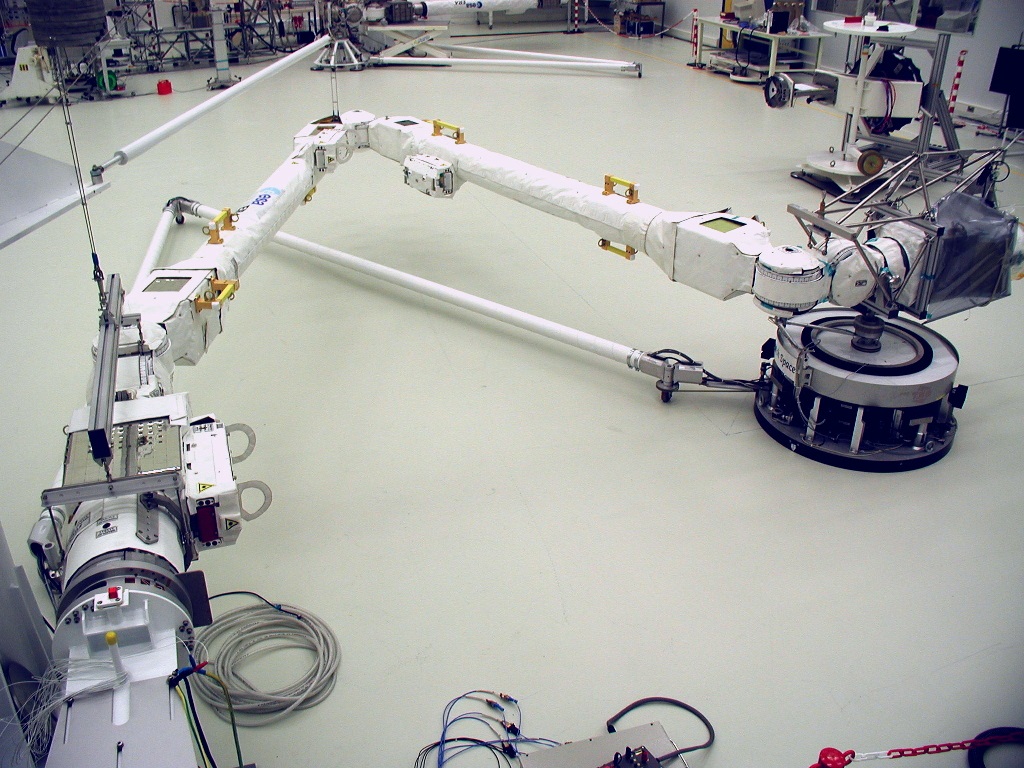
Airbus space engineers have installed ESA’s European Robotic Arm (ERA) onto the Russian Multipurpose Laboratory Module (MLM) and it is now ready for its flight to the International Space Station (ISS).

Copyright Airbus

After a one-week journey the European Robotic Arm will arrive at the ISS, where it will service the Russian segment of the space station. With a total length of 11.3 metres, the symmetrical, two-handed intelligent robot arm can 'walk' around the exterior of the ISS, hand-over-hand from one fixed base-point to another. ERA’s seven robust and accurate joints, the lightweight limbs and the control computer in the middle of the arm give the robot arm its versatility.

Advertisement
PTC rectangle

Astronauts and cosmonauts can control the European Robotic Arm in real-time or pre-programme it from inside or outside of the ISS, to make it move payloads, inspect the space station with its infrared cameras and to support operations outside the ISS. From its tip, the robot provides electrical power, a data bus, a video line and a rotating drive machine.

By connecting a tool to the tip, ERA can be equipped for one of the many tasks it can perform automatically or semi-automatically. ERA has a lightweight construction but thanks to the zero-gravity conditions in space, it can move very large masses: from 3,000 kg routinely up to 8,000 kg in slow modus. The robot arm operates with an accuracy of five millimetres.

ERA has been developed for European Space Agency (ESA) by a European consortium, led by Airbus Defence and Space in the Netherlands. Airbus designed the arm and its software functions, managed the development of subsystems throughout Europe and integrated and tested the system. In the last few months Airbus has integrated ERA on the MLM, together with ESA and Russian partners RSC/Energia. 

“The long awaited launch of the European Robotic Arm to the International Space Station marks a huge contribution of the Netherlands to the continued operation of the ISS, which was enabled by the loyal support of the Netherlands Space Office and the Ministry of Economic Affairs and Climate Policy,” said Rob Postma, Chief Executive Officer of Airbus Defence and Space Netherlands. “In addition, it celebrates the effort, commitment and determination of the many space professionals involved throughout the years.”

Advertisement
ODU RT


Advertisement
FIA2026 animated banner
UK and Ukraine strengthen civil space cooperation

Space

UK and Ukraine strengthen civil space cooperation

18 March 2026

A landmark agreement between the UK Space Agency and State Space Agency of Ukraine (SSAU) will open a new chapter in civil and commercial space cooperation between the two countries.

Met Office launches MAVIS

Aerospace Security Space

Met Office launches MAVIS

18 March 2026

The Met Office have officially launched the Met Office Aeronautical Visualisation Service (MAVIS) - a next-generation aviation weather platform designed to support a rapidly evolving aviation landscape, from traditional crewed aircraft to emerging spaceport operations.

Viasat

Aerospace Space

Viasat's advanced in-flight connectivity selected by National Airlines

17 March 2026

Viasat today announced that its advanced in-flight connectivity has been selected by charter operator National Airlines to enhance the passenger experience onboard a new fleet of three Airbus A330 aircraft.

ODU joins the UN Global Compact

Aerospace Defence Security Space

ODU joins the UN Global Compact

17 March 2026

Manufacturer of connector systems, ODU, has joined the United Nations Global Compact (UNGC), the world’s largest sustainability and corporate responsibility initiative.

Advertisement
PTC rectangle
UK–South Africa partnership using AI to make telescopes smarter

Space

UK–South Africa partnership using AI to make telescopes smarter

16 March 2026

AI is set to transform how South Africa’s astronomical observatories operate, as the Science and Technology Facilities Council (STFC) Hartree Centre is working with the South African Astronomical Observatory (SAAO), a centre for optical and infrared astronomy, to deliver the ‘Intelligent Observatory’ programme.

Cranfield University unveils wind-powered WANDER-bot

Space

Cranfield University unveils wind-powered WANDER-bot

13 March 2026

Researchers at Cranfield University have created WANDER-bot, a low-cost, 3D-printed robot that is powered by wind energy.

Advertisement
ODU RT
Advertisement
Gulfstream banner