Advancing UK Aerospace, Defence, Security & Space Solutions Worldwide
  • Home
  • /
  • Space
  • /
  • Airbus releases first detailed images from Pléiades Neo 3 satellite

Space

Airbus releases first detailed images from Pléiades Neo 3 satellite
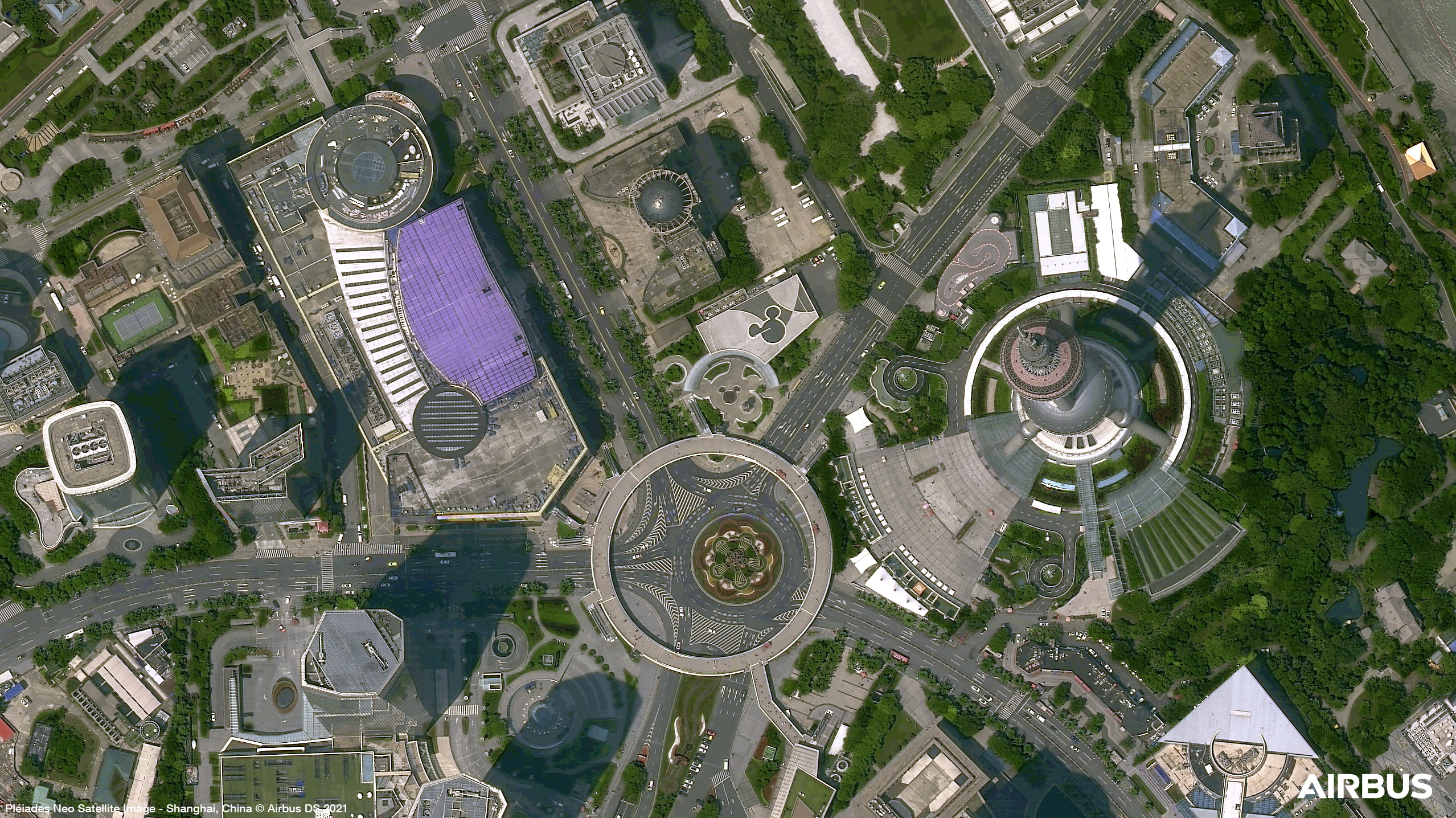
Airbus has released a first collection of sharp images at 30cm native resolution from the Pléiades Neo 3 satellite, recently safely launched and secured in orbit.

Above: Shanghai Tower, China - image acquired by Pléiades Neo 3 satellite offering 30cm native resolution.
Copyright: Airbus DS 2021

The successful acquisitions and delivery of these first images are the start of a new era for both commercial and government geospatial applications requiring a high level of accuracy and the ability to see fine details.

Advertisement
PTC rectangle

The Pléiades Neo 3 images, covering a variety of global locations and featuring diverse acquisition angles, provide an impressive level of detail. In one it is easy to count each and every limestone block of the Giza Pyramids, and even the number of people visiting. The multi-layered construction of Castel Sant'Angelo across the years can also be seen in detail in another. Urban areas and modern architecture, and their comprehensive diversity, are clearly visible in the images over Shanghai, Dubai and Washington DC.

These already very sharp images were acquired before full radiometric and system calibrations and the quality will continue to improve over the next few months. Imagery from Pléiades Neo 3 is expected to become commercially available in the third quarter 2021, after these calibration steps are completed.

With the full capacity of the satellite available for commercial use, the very high-resolution and geometrically consistent Pléiades Neo 3 imagery will provide analysts with a high level of detail, including more visibility of small objects, such as vehicles and road markings. This level of detection, recognition and identification of objects provides more ground truth for image analysts and improves reliability for machine learning capabilities. The new constellation will also provide a higher geolocation accuracy and deeper spectral band information, allowing more insights to be derived for various applications.

The Pléiades Neo constellation will be comprised of four identical and very agile satellites, offering reactive tasking and intraday revisit of any point on Earth. Entirely funded, designed, manufactured, owned and operated by Airbus, each satellite will add half a million km² per day at 30cm native resolution.

Advertisement
ODU RT

The next milestone of the Pléiades Neo programme is the launch of Pléiades Neo 4, which is already at the launch site in Kourou, French Guiana. It is expected to launch this summer, followed by the launch of Pléiades Neo 5 and 6, in 2022.


 

Advertisement
FIA2026 animated banner
UK and Ukraine strengthen civil space cooperation

Space

UK and Ukraine strengthen civil space cooperation

18 March 2026

A landmark agreement between the UK Space Agency and State Space Agency of Ukraine (SSAU) will open a new chapter in civil and commercial space cooperation between the two countries.

Met Office launches MAVIS

Aerospace Security Space

Met Office launches MAVIS

18 March 2026

The Met Office have officially launched the Met Office Aeronautical Visualisation Service (MAVIS) - a next-generation aviation weather platform designed to support a rapidly evolving aviation landscape, from traditional crewed aircraft to emerging spaceport operations.

Viasat

Aerospace Space

Viasat's advanced in-flight connectivity selected by National Airlines

17 March 2026

Viasat today announced that its advanced in-flight connectivity has been selected by charter operator National Airlines to enhance the passenger experience onboard a new fleet of three Airbus A330 aircraft.

ODU joins the UN Global Compact

Aerospace Defence Security Space

ODU joins the UN Global Compact

17 March 2026

Manufacturer of connector systems, ODU, has joined the United Nations Global Compact (UNGC), the world’s largest sustainability and corporate responsibility initiative.

Advertisement
PTC rectangle
UK–South Africa partnership using AI to make telescopes smarter

Space

UK–South Africa partnership using AI to make telescopes smarter

16 March 2026

AI is set to transform how South Africa’s astronomical observatories operate, as the Science and Technology Facilities Council (STFC) Hartree Centre is working with the South African Astronomical Observatory (SAAO), a centre for optical and infrared astronomy, to deliver the ‘Intelligent Observatory’ programme.

Cranfield University unveils wind-powered WANDER-bot

Space

Cranfield University unveils wind-powered WANDER-bot

13 March 2026

Researchers at Cranfield University have created WANDER-bot, a low-cost, 3D-printed robot that is powered by wind energy.

Advertisement
ODU RT
Advertisement
FIA2026 animated banner