
General Atomics

Airbus ships ESM-4 for Artemis IV

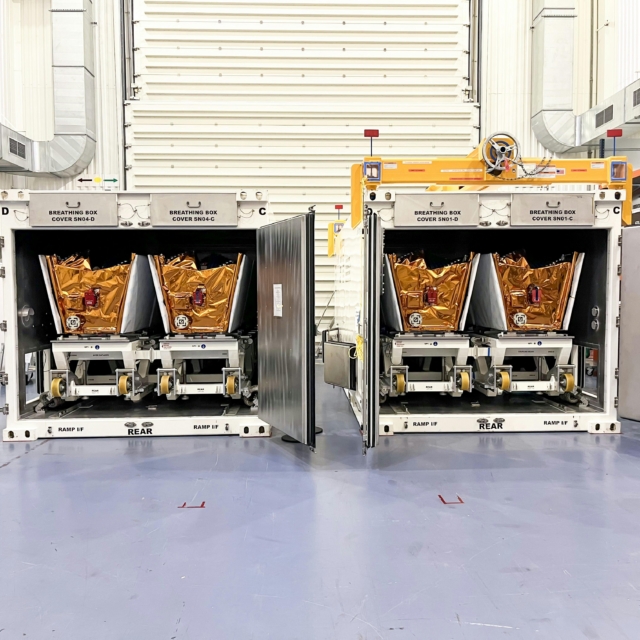
The fourth European Service Module (ESM-4) is on its way from Airbus’ facilities in Bremen, Germany to NASA’s Kennedy Space Center in Florida, USA, where it will be tested and integrated with the Orion Crew Module ready for the next stage of NASA’s Artemis programme.


Image copyright Airbus

Built by Airbus under contract to the European Space Agency (ESA), ESM-4 will be a vital part of the Artemis IV mission which envisages astronauts going to live and work in humanity’s first lunar space station, Gateway, which will enable new opportunities for science and preparation for human missions to Mars. 

Ralf Zimmermann, Head of Space Exploration at Airbus, said: “Delivering the fourth ESM takes us one step closer to a new space era with a lunar space station and increased opportunities for deep space scientific research. Europe’s role, through ESA, is crucial in this pioneering NASA-led programme."

Daniel Neuenschwander, Director of Human and Robotic Exploration at ESA, said: “ESM-4 will play a key role as the Artemis IV mission is due to deliver the International Habitation Module (Lunar I-Hab) of the Lunar Gateway space station. This state-of-the-art hardware, developed by Airbus Defence and Space and its subcontractors across Europe, demonstrates our ability to contribute to major international partnerships.”

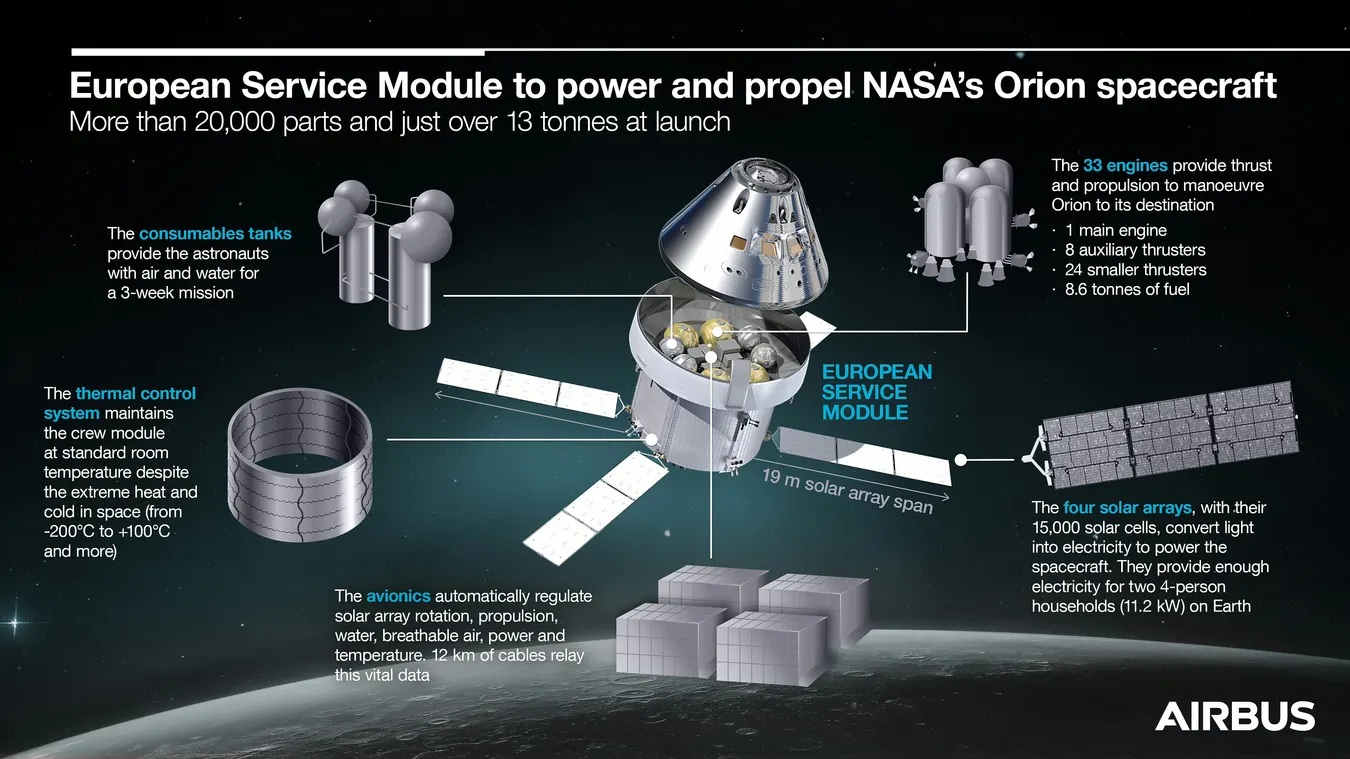
The ESM modules provide engines, power, thermal control and supply astronauts with water and oxygen. The ESM is installed underneath the crew module and together they form the Orion spacecraft. Thales Alenia Space Italia provides the thermal control system to keep the Orion crew modules between 18 and 24°C by radiating excess heat out of the ship but also keeping the cold at bay.

The four solar arrays on Orion generate 11.2 kW of electricity, enough to power two four-person households on Earth. Only about 10% of the power is needed for the ESM, with the remaining 90% going to the batteries and equipment in the crew module. The Artemis I mission showed the solar panels were able to produce a little more power than expected and this additional energy will be of use as the Artemis programme evolves.

The energy stored in the batteries of the Crew Module is key as it ensures that the Orion spacecraft has power even when the Sun is obscured. The batteries also provide power for a safe return when the ESM separates from the crew module at the end of the mission.

To enable astronauts to concentrate on the most important tasks, the electronics onboard the ESM, controlled by the Crew Module, provide a very high level of autonomy, such as temperature regulation and solar wing rotation to track the Sun.

Orion has 33 engines onboard the ESM to provide thrust and manoeuvring capabilities. The main engine, a repurposed Space Shuttle orbital manoeuvring system engine (OMS-E) provided by NASA, generates 26.5 kilonewtons of thrust. This provides enough force to escape Earth’s gravitational field and perform the translunar injection burn and to get into the Moon’s orbit. 

Eight auxiliary thrusters act as back-ups to the OMS-E and for orbital corrections. There are also 24 smaller engines for attitude control in space, enabling the spacecraft to rotate or change its angle during docking manoeuvres.

Related

Manchester Airports Group reports cyber security incident
Manchester Airport
Manchester Airports Group reports cyber security incident
Manchester Airports Group has reported a cyber security incident involving customer data, amid growing concern over cyber attacks in the UK.
Aerospace Security

27 Aug 2026

Unpublished DfT study strengthens case for tougher night-noise policy
London, England - November 2018: British Airways Boeing 777 jet (registration G-VIIJ) flying low over houses to land at London Heathrow Airport.
Unpublished DfT study strengthens case for tougher night-noise policy
New evidence on sleep disturbance and lost wellbeing could reshape how airport growth, noise thresholds and community mitigation are assessed.
Aerospace

27 Aug 2026

Sigma deepens UK aerospace footprint with new £125m Rolls-Royce deal
Rolls-Royce engine
Sigma deepens UK aerospace footprint with new £125m Rolls-Royce deal
Sigma Advanced Systems has won a further £125m Rolls-Royce agreement through UK subsidiary Bromford, following a £300m deal announced in April.
The Hawk was built in Britain. Its replacement may only be assembled here
Hawk T1 Jet
The Hawk was built in Britain. Its replacement may only be assembled here
Foreign-designed trainers are competing for the RAF requirement, leaving the UK to decide whether final assembly provides enough jobs, skills and sovereignty.
Defence

27 Aug 2026

BlackTalon Ecosystem trains allied military operators at NATO’s BATT26
SPX Communication Technologies team at NATO counter-UAS exercise Latvia, August 2026
BlackTalon Ecosystem trains allied military operators at NATO’s BATT26
NATO’s BATT26 exercise in Latvia - centred on interoperability between industry and allied forces - saw military operators trained on the counter-UAS BlackTalon Ecosystem in realistic field conditions.
Defence Events Member News

27 Aug 2026

Cellebrite reveals ruggedised C-TEK forensics field kit
Soldiers on patrol
Cellebrite reveals ruggedised C-TEK forensics field kit
With its portable forensics field kit, Cellebrite has brought together rugged hardware and software to allow mission-critical data and intelligence to be captured and actioned in the field, enabling forward-deployed teams to quickly triage data from phones, SIM cards, drones and portable media to advance their mission advantage.
Scottish space tech to power self-consuming rocket engine
Alpha Impulsion
Scottish space tech to power self-consuming rocket engine
Aurora Avionics is to supply crucial electronic systems that will deliver key electrical power functions for a pioneering new rocket engine, that aims to cut propulsion costs and support next-generation spacecraft.
Space

27 Aug 2026

STFC reveals latest Ernest Rutherford Fellows
space nebula
STFC reveals latest Ernest Rutherford Fellows
Backed by an investment of £6 million, seven early-career physicists have been awarded Ernest Rutherford Fellowship’s by the Science and Technology Facilities Council (STFC), supporting research, from the search for dark matter to the physics of black holes.
Space

25 Aug 2026

Austrian ENPULSION moves to acquire UK space propulsion specialist Lift Me Off
Enpulsion space propulsion manufacturer buys UK company lift me off
Austrian ENPULSION moves to acquire UK space propulsion specialist Lift Me Off
Austrian spacecraft propulsion manufacturer ENPULSION has agreed to acquire British specialist Lift Me Off, bringing together electric and chemical propulsion capabilities in a deal that will require UK Government approval.
Member News Space

21 Aug 2026

Manchester Airports Group reports cyber security incident
Manchester Airport
Manchester Airports Group reports cyber security incident
Manchester Airports Group has reported a cyber security incident involving customer data, amid growing concern over cyber attacks in the UK.
Aerospace Security

27 Aug 2026

Why the role of dogs in security is misunderstood
Sniffer dog
Why the role of dogs in security is misunderstood
The role of dogs and their use within today's security sector is often not fully appreciated, including their extraordinarily unique capabilities - which even the most sophisticated new technologies cannot match - and their incredibly selfless bravery.
Member News Security

27 Aug 2026

Cellebrite reveals ruggedised C-TEK forensics field kit
Soldiers on patrol
Cellebrite reveals ruggedised C-TEK forensics field kit
With its portable forensics field kit, Cellebrite has brought together rugged hardware and software to allow mission-critical data and intelligence to be captured and actioned in the field, enabling forward-deployed teams to quickly triage data from phones, SIM cards, drones and portable media to advance their mission advantage.