Army cyber specialists put to the test
Courtesy British Army
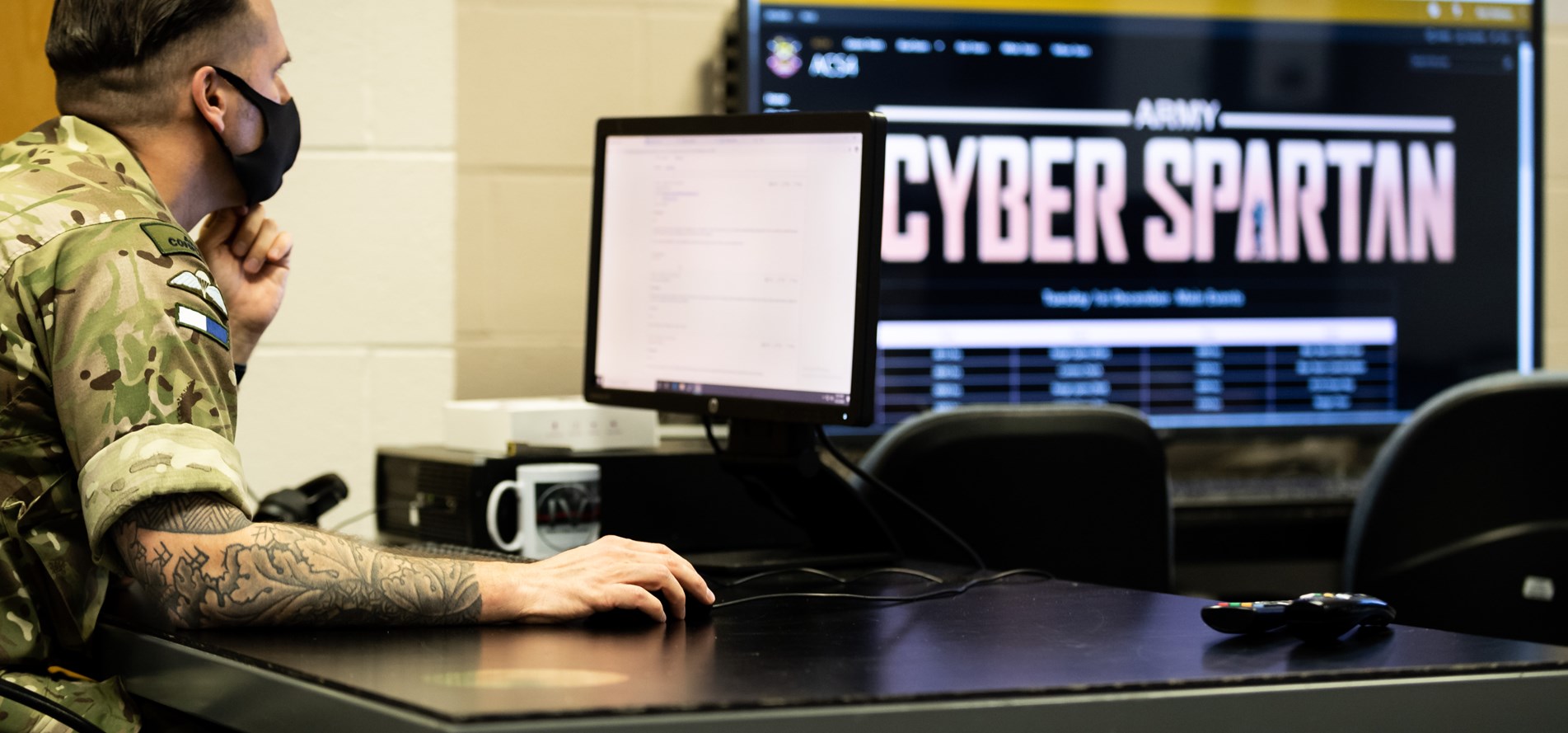
Exercise ARMY CYBER SPARTAN, presented teams with complex real-world cyber challenges that escalated over a five-day period.
In a year when the UK has seen an increase in cyber threats, teams from across the British Army’s regular and reserve forces, the Royal Navy, France and Denmark were tested in the exercise’s fourth year to help grow and develop cyber defence capabilities. In a world which is becoming ever more digitally reliant, the ability to protect ourselves, our people and way of life in cyberspace is increasingly important. Working with our allies, the UK and British Army are a leading cyber force, pioneering and developing new technologies and expertise to protect us from those who wish us harm.

During the five-day exercise hosted by the Royal Signals in their centenary year, teams working in a safe virtual training environment were presented with realistic scenario. These were tailored to their own capabilities to ensure this is a learning exercise as well as a competition. The exercise is funded by the Field Army and is being brought into the core training programme as an annual event, to continue to develop the Army’s capability in the cyber field.
Visiting the exercise Commander Field Army, Lieutenant General Ivan Jones said: “We're now in the fourth iteration of the exercise to test our cyber skills, to look at how we defend, what we can learn about our defence and how we can improve it. The exercise helps to identify and nurture new talent, not just from those that are in the technical streams, but across the Army and Armed Forces.
“If we are to succeed in the land environment, we've got to understand that technology is going to offer us an edge. It also presents a threat and we've got to protect ourselves. And we've also got to understand how our adversary relies upon and uses it. This is absolutely in an area of growth for the future.
“What is wonderful to see is at the very heart of this is people. You’ve got all the ones and zeros, but this is all about our people, and they are hugely impressive, every single one of them.”
Competing teams earn points depending on their performance on a series of tasks which incentivise learning, with dedicated time each day for teams to talk through their performance and identify weaknesses. The team which earns the most points will go on to join NATO’s cyber defence exercise Lockshields, which is held in Estonia in the mid part of next year.
Director Information, Major General Jonathan Cole said: “Our Land Cyber Programme is about training and equipping talented people to operate effectively in the cyber and electromagnetic domain, which is one of the five domains in defence. This is enabled by innovative and cutting-edge technology but most importantly it requires giving our personnel the technical and operation skills to face threats.
“The lessons learned from this exercise will be used to test and adjust our operating procedures and to continue to develop our capabilities. Everyone has a role to play in cyber space at every rank and it is great to see teams participating from across different units in the Army alongside the Navy and our international allies.”
Over the last three years, the exercise and other experimental activities have received funding from the Defence Secretary’s £40 million Transformation Fund. In addition to Cyber Spartan, a project to train Reservists, many of whom already work in the UK cyber industry, is being run by the Army. This provides remote online training that reservists can conduct around their civilian work and will help to provide reinforcements to the number of regular personnel as part of a whole force approach.
Complementing this, the Army is delivering a £30 million technical upskilling programme for Regular Forces’ digital professionals, providing them with additional industry certified competencies to further enable the Army to defend its networks, platforms and systems.
Explaining how the Army continues to develop at pace in this area, Brigadier John Collyer, Commander 1st (United Kingdom) Brigade commented: “In June we re-formed and launched the Army’s newest Regiment, the 13 Signals. It is the Army’s Cyber Defence unit and will identify, select and train specialists for cyber operational roles. We are developing skills for employment across the Royal Corps of Signals, the wider Army, Defence and nationally, supporting and protecting our outputs at home and overseas.
“Our success in cyber lies in attracting talent from Regulars, Reservists, Civil Servants and those from academia and industry. People with skills including entrepreneurial spirit, guile teamwork and ambition will help us drive forward our capabilities with vigour and excellence.
“While only one team can win this incredible event, all 24 teams will learn and develop and that is what this week is about. The experiences and skills will give a direct benefit for the Army, Defence and our nation.”